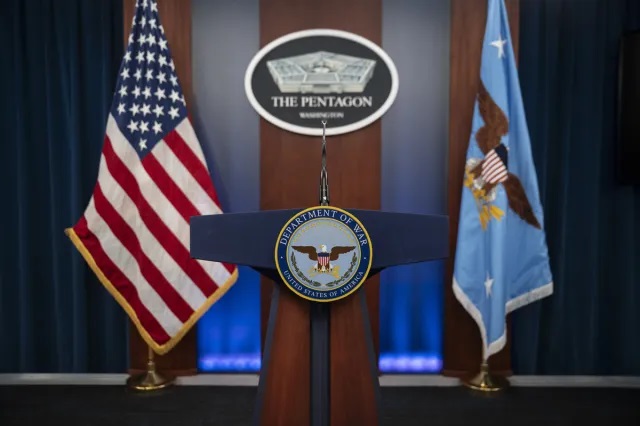
The Department of War formally launched its long-anticipated Artificial Intelligence Acceleration Strategy on Monday, signaling an ambitious drive to secure American dominance in AI-enabled military operations. Mandated by President Trump, the initiative promises to “unleash experimentation, eliminate bureaucratic barriers, focus our investments and demonstrate the execution approach needed to ensure we lead in military AI,” said Secretary of War Pete Hegseth. “We will become an ‘AI-first’ warfighting force across all domains,” he emphasized, highlighting the Department’s commitment to making artificial intelligence the central pillar of U.S. military operations.
According to the Department, the new strategy adopts a wartime approach to delivering capabilities, anchored in three primary tenets: warfighting, intelligence, and enterprise operations. These tenets are intended to “strengthen battlefield decision-making, rapidly convert intelligence data, and modernize daily workflows, all in direct support of more than three million DoW personnel.” In other words, the plan seeks to embed AI deeply across operational, analytical, and administrative layers of the Department, ensuring that AI is not merely a tool but a driving force behind all military activity.
The linchpin of this acceleration effort is a set of seven Pace-Setting Projects (PSPs), each led by a single accountable director and assigned aggressive timelines. The Department has described these PSPs as a framework to “establish a new AI execution standard for the entire Department.” For warfighting, the projects include Swarm Forge, which is described as a “competitive mechanism to iteratively discover, test, and scale novel ways of fighting with and against AI-enabled capabilities — combining America’s elite warfighting units with elite technology innovators.” Agent Network will facilitate “AI agent development and experimentation for AI-enabled battle management and decision support, from campaign planning to kill chain execution.” Meanwhile, Ender’s Foundry will accelerate “AI-enabled simulation capabilities — and sim-dev and sim-ops feedback loops — to ensure we stay ahead of AI-enabled adversaries.”
Intelligence-focused PSPs include Open Arsenal and Project Grant. Open Arsenal aims to transform the TechINT-to-capability development pipeline, allowing intelligence to be converted into actionable weapons in “hours, not years.” Project Grant, meanwhile, seeks to “enable transformation of deterrence from static postures and speculation to dynamic pressure with interpretable results,” offering a vision of an intelligence apparatus that is more agile, responsive, and operationally integrated than ever before.
Enterprise operations will be revolutionized by GenAI.mil and Enterprise Agents. GenAI.mil seeks to provide “Department-wide access to frontier generative AI models, like Google’s Gemini and xAI’s Grok, for all DoW personnel at Information Level (IL-5) and above classification levels.” Enterprise Agents will focus on “building the playbook for rapid and secure AI agent development and deployment to transform enterprise workflows,” effectively embedding AI into the backbone of the Department’s administrative and operational processes.
Under Secretary of War for Research and Engineering Emil Michael stressed the urgency of these initiatives, stating, “Speed defines victory in the AI era, and the War Department will match the velocity of America’s AI industry. We’re pulling in the best talent, the most cutting-edge technology, and embedding the top frontier AI models into the workforce — all at a rapid wartime pace.” Michael’s comments underscore the Department’s focus on velocity and iterative learning, emphasizing that operational speed and rapid deployment are as critical as the technological capabilities themselves.
The strategy reflects directives outlined in Executive Order 14179, which declares that “it is the policy of the United States to sustain and enhance America’s global Artificial Intelligence (AI) dominance in order to promote human flourishing, economic competitiveness, and national security.” The memorandum directing the AI Acceleration Strategy notes that “in the national security domain, AI-enabled warfare and AI-enabled capability development will re-define the character of military affairs over the next decade.” It adds that the United States must build on its lead over adversaries, a lead established during President Trump’s first term, to “make our Warfighters more lethal and efficient.”
Implementation will rely on aggressive investment in AI compute infrastructure, with the Department planning to expand its capabilities “from datacenters to the edge.” Officials noted that they would leverage “hundreds of billions in private sector capital investment being made in America’s AI sector through our growing array of creative partnerships with America’s world-leading companies.” The Department also plans to enforce strict data access protocols under the “DoD Data Decrees” to ensure that AI developers can fully exploit operational data for mission advantage. Intelligence data will receive “parallel treatment, with exploitation pathways established within the same timeframe.”
Talent acquisition is another central focus of the strategy. The memorandum directs the Department to attract and retain top American AI talent, making use of “special hiring and pay authorities Department-wide, as well as novel talent programs from the Office of Personnel Management and other partners, to accelerate our pace of technical talent hiring into AI roles.” The Department plans to monitor progress through monthly reporting to the Deputy Secretary of War and the Under Secretary of War for Research and Engineering, with an expectation that “each Service and Component provide AI hiring and talent development plans” within a 60-day window.
A central tenet of the AI Acceleration Strategy is the rejection of ideological influence in AI systems. According to the memorandum, “Diversity, Equity, and Inclusion and social ideology have no place in the Do W, so we must not employ AI models which incorporate ideological ‘tuning’ that interferes with their ability to provide objectively truthful responses to user prompts.” The Department will also require AI models to be free from usage policy constraints that could impede lawful military applications, making “model objectivity” a primary procurement criterion within 90 days.
The memorandum lays out several core principles for execution. Speed is paramount: “We must internalize that Military AI is going to be a race for the foreseeable future, and therefore speed wins. We must weaponize learning speed, and measure and manage cycle time and adoption rates as decisive variables in the AI era.” AI model parity is also emphasized, with officials directing that the Department “must have the latest and greatest AI models deployed for our warfighters… within 30 days of public release.” A wartime approach to bureaucratic blockers is mandated, instructing the CDAO and the Chief Information Officer to fully leverage statutory and delegated authorities to accelerate AI capability delivery, including cross-domain data access and rapid Authorization to Operate (ATO) reciprocity.
The Department is also committed to a competitive, decentralized approach, noting that “robust competition by small teams, with transparent metrics for results, is the engine of commercial AI leadership. Small, accountable teams will win over process in a race characterized by dynamic and unpredictable innovation.” Metrics for AI system usage and mission impact will be central to evaluating success, with decisions on future resourcing and capability deprecation based on measurable performance rather than centralized planning.
Military planning and operational concepts will be re-imagined around AI. The Department instructs each Service Chief and Combatant Commander to designate an AI Integration Lead responsible for “the co-evolution of AI-enabled capabilities with warfighting concepts and experimentation.” Exercises and experiments that do not meaningfully incorporate AI and autonomous capabilities will be subject to resourcing review, reinforcing the Department’s commitment to AI-native warfighting.
Modular Open System Architectures (MOSA) will be enforced to allow commercial-speed replacement of AI components, and the Department will mandate full transparency of data interfaces and documentation to facilitate third-party integration. The memorandum asserts that these standards are critical to maintaining operational overmatch in a rapidly evolving AI landscape.
The Department’s strategy emphasizes that 2026 is a turning point. “Becoming an ‘AI-First’ warfighting force requires more than integrating AI into existing workflows. It requires re-imagining how existing workflows, processes, TTPs, and operational concepts would be designed if current AI technology existed when they were created — and then re-inventing them accordingly,” the memorandum reads. Secretary Hegseth concluded that “we must drive this transformation across every aspect of the Department… 2026 will be the year we emphatically raise the bar for Military AI Dominance.”
With unprecedented investment in AI infrastructure, talent acquisition, and frontier technology integration, the War Department’s strategy represents a decisive push to ensure the United States maintains its lead in military AI. From battlefield operations to intelligence exploitation and enterprise efficiency, AI is positioned as the central force shaping the future of American military power. As officials make clear, “Speed defines victory in the AI era,” and the Department is mobilizing all available resources to ensure it remains ahead in the race to dominate the AI battlefield.