


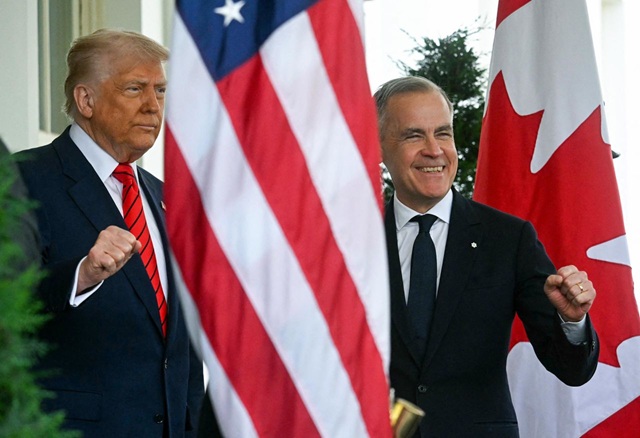
The United States has suspended participation in a long-standing defence coordination forum with Canada, accusing its northern ally of failing to meet key military commitments and widening a gap between political assurances and practical defence investment. The move, announced by senior US defense official Elbridge Colby, marks a rare public rupture in a security relationship that has been regarded for decades as one of the most stable pillars of Western defence cooperation.
Colby said the US Department of Defense would step back from parts of its engagement in the Permanent Defence Council, arguing that Canada had not sufficiently delivered on promises related to military readiness and burden-sharing. “We can no longer ignore the gap between words and actions,” he wrote in a post on X, adding that sustained investment in national defence capabilities was essential for both countries’ security and prosperity. The decision does not end all cooperation, but it freezes key coordination mechanisms that have historically guided joint planning between the two neighbours.
The suspension comes at a politically sensitive moment for North American relations, which have been increasingly strained since the return of US President Donald Trump to office. Trump has repeatedly criticized Canada’s defence spending levels and, in a series of controversial remarks, even suggested that Canada could one day be incorporated as a “51st state,” comments that have caused diplomatic friction in Ottawa and deep unease within Canadian political circles. The latest US move is widely seen as part of a broader recalibration of Washington’s expectations toward its allies, particularly those sharing the NATO security umbrella.
The defence council in question traces its origins to 1940, when the United States and Canada created the Permanent Joint Board on Defence to coordinate military strategy during the Second World War. At the time, both countries faced the urgent challenge of securing North America against Axis threats, and the board became the foundation for a long-term institutional framework that outlasted the war itself. It was one of the earliest examples of deep bilateral military integration between sovereign allies, setting the stage for decades of cooperation in air defence, maritime security, and intelligence sharing.
Over the Cold War era, that cooperation expanded significantly with the creation of the North American Aerospace Defense Command NORAD in 1958, a joint US-Canadian command designed to monitor and defend the continent’s airspace against potential Soviet threats. NORAD became one of the most symbolic institutions of the Western alliance system, representing an unprecedented level of military integration between two independent states. Even today, it remains central to continental air defence, including monitoring missile threats and aerospace surveillance across the Arctic region.
Alongside NORAD, the two countries also became core members of the intelligence-sharing alliance known as the Five Eyes, and worked closely in NATO operations from the Cold War through the post-9/11 era. Canadian and American forces fought side by side in Afghanistan under NATO command, contributing troops, logistics, and intelligence support, although Canada notably declined to participate in the 2003 Iraq invasion led by the United States. These decisions have periodically created tension, but the broader security relationship has historically remained resilient.
The current dispute, however, reflects deeper disagreements about defence burden-sharing in an era of renewed great-power competition. US officials argue that allies like Canada must increase military spending and modernize capabilities, particularly in Arctic defence and continental air surveillance, where Russian and Chinese activity has intensified. Canada, for its part, has faced domestic political constraints and competing budgetary priorities that have slowed defence expansion, despite repeated commitments to increase spending.
Elbridge Colby’s remarks also referenced a recent speech by Canadian Prime Minister Mark Carney at the World Economic Forum in Davos World Economic Forum, where Carney warned that the global order led by the United States was fragmenting under pressure from geopolitical rivalry and weakening international norms. The speech was interpreted in Washington as an implicit critique of US leadership, and reportedly drew a sharp response from President Trump, further complicating bilateral relations.
At the heart of the dispute is a growing divergence in how both countries view the future of the international system. Washington’s current defence posture emphasizes allied burden-sharing and rapid military modernization, while Ottawa has tended to prioritize diplomatic engagement and gradual increases in defence spending. US officials now appear increasingly impatient with what they see as delayed commitments from partners who benefit from American security guarantees.
Yet despite the current tensions, the US-Canada defence relationship has historically weathered far more severe disagreements. During the Second World War, the two countries coordinated closely through early defence institutions that laid the groundwork for continental security integration. In the post-war period, fears of Soviet expansion drove unprecedented collaboration, including radar installations across northern Canada and joint command structures that remain in place today.
The two nations also cooperated extensively in modern defence procurement and technological development, including joint participation in aerospace projects, missile defence systems, and fighter aircraft programs such as the F-35 Lightning II platform. Disputes over procurement costs and industrial participation have occasionally created friction, but have not fundamentally altered the strategic alignment between the two militaries.
In recent years, Arctic security has become a particularly sensitive area of cooperation and competition. Melting ice routes have opened new maritime corridors, increasing the strategic importance of northern defence infrastructure. Both Washington and Ottawa have acknowledged the need for upgraded radar systems, naval capabilities, and early-warning networks, but progress has been uneven, contributing to frustration among US defence planners.
The suspension of the defence council’s activities therefore represents not just a bureaucratic pause but a symbolic warning. While officials on both sides have emphasized that broader military cooperation remains intact, the decision underscores how quickly long-standing alliances can be strained under political pressure and shifting global priorities.
Whether the dispute escalates or is resolved through renewed negotiations will depend heavily on the coming months of diplomatic engagement. For now, the pause in formal coordination between Washington and Ottawa stands as a reminder that even the most deeply entrenched alliances are not immune to political strain, especially in an era where security, economics, and global influence are becoming increasingly intertwined.










