By Saturday evening (1), Mahara Prison had descended into scenes more akin to a battlefield than a correctional facility. What began as unrest around 4.00 p.m. rapidly escalated into one of the most serious prison disturbances in recent years, lasting until the early hours of Sunday (2). By the time calm was restored, one inmate had lost his life, several others had been hospitalised, multiple prison buildings had been destroyed, and authorities had mounted a large-scale security operation involving the military, police and air support.
While officials have yet to disclose what triggered the initial confrontation, the scale of the violence has renewed attention on the chronic overcrowding that has long plagued Sri Lanka’s prison system. According to recently released figures, Mahara Prison—designed to accommodate just 991 inmates—was housing more than 4,100 remand and convicted prisoners at the time of the unrest. Operating at more than four times its intended capacity, the prison had become emblematic of mounting systemic pressures that observers believe may have contributed significantly to the volatile conditions.
Senior Deputy Inspector General of Police for the Western Province, Sajeewa Medawatte, confirmed that the disturbance began at approximately 4.00 p.m. on Saturday. Although the precise cause remains under investigation, the severe overcrowding has inevitably become central to discussions surrounding the incident, highlighting longstanding concerns about prison management, inmate welfare and institutional capacity.
According to Prison Media Spokesperson A.C. Gajanayake, inmates initially attempted to break through a 15-foot temporary sheet-metal barrier surrounding the proposed new administrative office before attacking the prison’s main entrance. As the unrest intensified, several newly constructed and existing facilities came under attack. Among the buildings completely destroyed were the new rehabilitation centre and the prison kitchen, both of which had reportedly been inaugurated on the very day the violence erupted. Significant damage was also inflicted on the visitors’ centre, the prison hospital, the chief jailor’s office and the industrial wing, leaving substantial destruction across the prison complex.
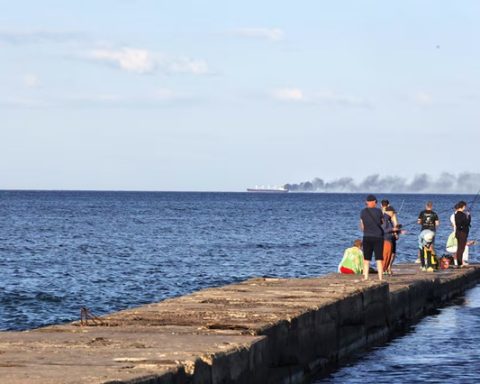
As authorities struggled to contain the escalating violence, reinforcements were rapidly deployed. Prison officers were joined by personnel from the Police Special Task Force (STF), the Sri Lanka Army and the Sri Lanka Navy, while multiple fire engines responded to blazes ignited within the prison. Thick black smoke rose above the facility as gunfire echoed through the surrounding area. The Sri Lanka Air Force also launched aerial surveillance, deploying a Bell 212 helicopter alongside three unmanned aerial vehicles to monitor developments. Air Force Media Spokesperson Group Captain Nalin Wewakumbura confirmed the deployment as part of efforts to assist security operations on the ground.
Police Media Spokesperson F.U. Wutler confirmed that one inmate was killed during the unrest and that seven others sustained injuries. At least five of the injured were admitted to the emergency treatment unit of the Colombo North Teaching Hospital in Ragama. As emergency services responded to the immediate crisis, concerns also emerged regarding the treatment of those injured inside the prison.
The Committee for the Protection of Prisoners’ Rights issued a statement on X, formerly Twitter, claiming it had received information suggesting that multiple deaths had occurred inside the prison and alleging that injured inmates had been prevented from receiving timely medical assistance. The organisation urged the Human Rights Commission of Sri Lanka to intervene immediately, calling for an independent inquiry and greater transparency regarding the events that unfolded inside the prison. At the time, the allegations had not been independently verified.
In response to the deteriorating security situation, police imposed an immediate curfew across three Grama Niladhari divisions—Kendaliyadda Road West, Kendaliyadda Road North and Dambuwa—within the Ragama Police area. Local media also reported that several houses surrounding the prison had been struck by stones during the unrest, extending the disruption beyond the prison walls. Police subsequently informed the Welisara Magistrate’s Court of the incidents as investigations commenced.
Justice Minister Harshana Nanayakkara later stated that the situation inside Mahara Prison had “calmed down to some extent” while noting that the Police Special Task Force remained deployed to secure the facility. By around midday on Sunday, media reports indicated that order had largely been restored. Footage also emerged showing groups of inmates being transferred to other correctional institutions as part of measures to stabilise the situation and reduce tensions.
Authorities have since strengthened security at other prisons across the Western Province in an effort to prevent similar incidents. Yet beyond the immediate violence, the events at Mahara have once again drawn attention to the deeper structural challenges confronting Sri Lanka’s prison system. With facilities operating far beyond their intended capacity, the uprising has become another stark reminder of the consequences of chronic overcrowding, ageing infrastructure and mounting institutional strain—problems that continue to test the country’s correctional system long after the smoke has cleared.