Sri Lanka Parliament has never been short of external help. The House began receiving substantial assistance by way of various projects, mostly sponsored by the USAID, after the 2015 change of government. This happened during the then UNPer Karu Jayasuriya’s tenure as the Speaker. The US stepped in after backing the UNP-led grouping that backed SLFP turncoat Maithripala Sirisena’s candidature at the presidential election. Since then, the US and other interested parties flooded Parliament with various sponsored projects, programmes and even schemes for certain individuals.
In spite of a plethora of external assistance which included numerous familiarisation tours, parliamentary standards continued to deteriorate. Successive ruling parties, and the Opposition, gladly received whatever offered by foreign governments, and various other organisations, funded by Western governments and other interested parties.
The US influence on the Yahapalana government was so much that Washington got Speaker Jayasuriya to accommodate one-time Foreign Secretary Prasad Kariyawasam as his international affairs advisor. Kariyawasam’s job was to supervise a plethora of USAID projects. What really embarrassed the utterly corrupt Yahapalana lot was the disclosure that Kariyawasam received his salary courtesy, the US taxpayer. Sri Lankans, regardless of their political convictions, love freebees. Our politicians and officials are no exception.
Having served as Sri Lanka’s Ambassador in Washington (June 2014 to August 2017), Kariyawasam received the appointment as Foreign Secretary. The USAID and the then Speaker agreed on Kariyawasam’s appointment, after the latter retired as Secretary to the Foreign Ministry. The disclosure caused a media furor with the issue receiving significant public attention.
Even the Chinese must have been stunned when Speaker Jayasuriya requested them to arrange all members of Parliament to visit China, in addition to seeking approximately 240 laptops for MPs and senior officials. By the time China granted both wishes, the strategically located Hambantota Port was in Chinese hands. The controversial 99-year irreversible lease on the Hambantota Port for USD 1.2 mn, finalised in 2017, is nothing but testimony to Beijing’s means and strategy here despite at the helm at the time being the right wing pro-Western UNP with Sirisena being a rather embarrassing executive President having virtually cut all his bridges.
It would be pertinent to ask whether the country benefited from high profile foreign projects or at least improved the parliamentary standards following the 2015 change of government. There had never been a genuine effort to examine the efficacy of those foreign projects because political parties considered them their privilege. Political parties, whatever their differences over contentious issues, including the NPP bid to extend the retirement ages of superior court judges, may not disagree on jaunts offered by foreign governments even now.
Although foreign projects, for the benefit of our lawmakers, sort of ebbed during the 2020-2024 period, the situation has changed again. In spite of the economic crisis that led to toppling of President Gotabaya Rajapaksa’s government, in July 2022, the Women Parliamentarians’ Caucus visit to New Zealand, in late July 2023, during Ranil Wickremesinghe’s tenure as the President, caused controversy.
The public questioned the necessity for such foreign jaunts at a time the country was experiencing its worst post-independence crisis.
Responding to public criticism directed not only at the Women Parliamentarians’ Caucus but the entire Parliament, Secretary General of Parliament Kushani Rohanadeera declared that public funds weren’t utilised at all. Without naming the sponsors, Rohanadeera simply said that Sri Lanka’s development partners funded the familiarisation tour. Among the 12-member lawmakers’ group was NPP MP Dr. Harini Amarasuriya. National List MP Amarasuriya had been the only NPPer in that group. Against the backdrop of all others failing to retain their seats at the parliamentary elections, held in November 2024, that particular familiarisation turned out to be just a trip for 11 out of the 12-member group. The likelihood of any of them returning to Parliament is slim. Very slim indeed. The political crisis skyrocketed the three-member NPP parliamentary group (2020-2024) to a mammoth unparalleled 159-members at the last general election held in November 2024 with Dr. Amarasuriya named as their Prime Minister.
The emergence of the NPP as the dominant political power, in 2024, thanks to the US- and India-backed regime change operation turned the political party system upside down. Once major political parties, the UNP and the SLFP-led alliance was reduced to rubble at the last parliamentary polls, with the party that introduced the Proportional Representation system left without a single parliamentary seat, whereas the SLPP was down to just three members, from a staggering 145 seats. But, with the support of some Opposition members, the SLPP commanded 2/3 majority in Parliament and its strength was proved in October 2020 when the dictatorial 20th Amendment received approval. But that didn’t do any good for the then ruling party.
Max Planck Foundation in new project
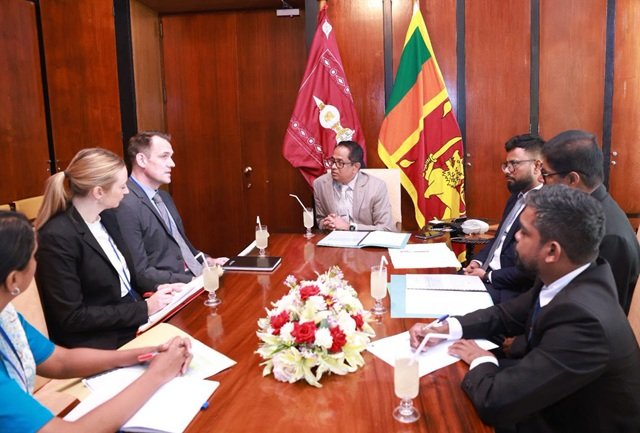
Thanks to a press release issued by the Parliament, regarding Speaker Dr. Jagath Wickremaratne’s meeting with Johannes Krusemark, Foundation’s Managing Director, Ms. Hayley Nicole Evans, Senior Research Officer, and Ms. Ruwini Perera, Legal Adviser of Max Planck Foundation, on 6 August, the public got to know Max Planck Foundation now functions as the development partner to the Parliament. We haven’t heard of such an arrangement before though the well-funded Foundation first launched operations here in 2017 during the Yahapalana administration.
The press release dealt with the move to transform the Speaker’s Official Residence, situated by the side of the road leading to Parliament, as the Parliamentary Research and Studies Centre, to be named the 10th department of the Parliament. The House statement quoted the Speaker as having said that he expected the proposed Centre to be established on the lines of Parliamentary research institutions operating within the Lok Sabha of India and the Parliament of the United Kingdom at Westminster.
Regardless of bombastic statements in Parliament there is no point in denying standards have deteriorated. The proceedings at parliamentary watchdog committees, namely COPE (Committee on Public Enterprises), COPA (Committee on Public Accounts) and COPF (Committee on Public Finance), over the years, revealed the pathetic state of affairs in the public sector. Obviously, various foreign-funded high profile projects, meant to enhance accountability, transparency and overall improvement of governance, failed to achieve set targets. Had there been an independent examination of such projects, with the inclusion of a comprehensive audit, the ugly truth would be revealed.
Let us briefly discuss a project carried out by Max Planck Foundation in the post-regime change operation carried out in 2022. Funded exclusively by Germany, the project, implemented from 1 August 2024 to 31 December 2025, according to a press release posted on the Foundation’s website, was meant to consolidate, what it called, the rule of law in Sri Lanka.
The project, launched during the tail end of the Wickremesinghe presidency in the run-up to the 21 September 2024 presidential election, involved Parliament, Sri Lanka Judges’ Institute, Commission to Investigate Allegations of Bribery or Corruption (CIABOC), Human Rights Commission of Sri Lanka (HRCSL) and the Bar Association of Sri Lanka (BASL). The professed objective was to provide essential checks and balances on the exercise of executive power and to hold the executive accountable for mismanagement. The Foundation declared that to perform the above-mentioned functions, the relevant stakeholders must develop resilience and strengthen their skills and competencies to understand their constitutional and legal role during moments of crisis and recovery.
The Foundation revealed the Sri Lanka Judges’ Institute, in collaboration with the Gilbert + Tobin Centre of Public Law at the University of New South Wales, worked together in this particular project with the Supreme Court of Sri Lanka.
Wouldn’t it be interesting to examine whether the German-funded project made an impact on the decision making process as the country is now in the midst of a major political controversy over the NPP’s unilateral decision to extend the retirement ages of superior court judges.
The government on Friday (07 August)issued the Gazette containing the Bill for the proposed 22nd Amendment to the Constitution. In line with the proposed amendment, Article 107(5) of the Constitution will be amended to allow judges of the Supreme Court to continue till 67, while judges of the Court of Appeal retire at the age of 65. Then the Chief Justice will retire on the earlier event of him reaching the age of 67 or completing six years in office. Incumbent Chief Justice Preethi Padman Surasena received the appointment on 27 July 2025 in the wake of Murdhu Fernando’s retirement. Fernando, who received the appointment on 2 December 2024 is perhaps the only CJ to hold the post for the briefest period.
Some of the institutes, including Parliament that had been involved in the Max Planck project, figure in the ongoing constitutional amendment controversy. The battle between two key elements in the Max Planck project, namely the BASL and the ruling NPP, that commands an extraordinary 2/3 majority in Parliament, indicates that the country’s political party system is far from consensus politics.
What would be the Foundation’s stand on the 22 Amendment, particularly against the backdrop of the International Judges’ Association (IJA) throwing its weight behind the BASL, totally opposed to the controversial government move.
External influence
The first post-Aragalaya (regime change project) House, elected in November 2024, like previous Parliaments, is the recipient of many invitations for foreign tours. As always India and China, seeking to further consolidate their position here arranged tours, and during the remaining period of the incumbent Parliament, the majority of members would visit the two Asian giants. Parliamentary officials, too, have been accommodated in the overall projects, covering capacity-building programmes, orientation sessions, and bilateral exchanges. The Indian operation seems to be larger than the Chinese programme with both countries seeking expanded relations with the media here.
Unfortunately, the overall conduct of the Parliament doesn’t reflect on experience gained during these foreign visits. Poor and irregular attendance of MPs remain a major problem. In spite of the Parliament meeting only eight days a month, members’ attendance and participation in proceedings continue to be low. With the NPP having the largest group in Parliament, with 159 members ,followed by the main Opposition SJB’s 40, the responsibility for maintaining respectable attendance is their primary responsibility.
Both the NPP and the SJB are targets of foreign influence, and the SLPP, to a much lesser extent, as foreign powers advance their agenda. Obviously, their projects are on track. Having declared the country bankrupt in 2022, the first post-Aragalaya government remains vulnerable to foreign influence for want of consensus on national issues.
As mentioned earlier in this article, China took hold of the Hambantota Port, in 2017, as the then two major political camps were yet to reach a consensus on the strategically located Port, located just 10 nautical miles north of the world’s busiest east-west international shipping lane, connecting Europe, the Middle East, and South Asia with East Asia. The Chinese gradually transformed the port and today the stage is set for its expansion. The unprovoked Israeli-US attack on Iran on 28 February, 2026, that triggered the latest West Asia war, significantly increased the importance of Hambantota. The Port’s importance has attracted unwarranted attention due to the US and India calling Hambantota a dual-use port meaning during time of war it could be used in support of the Chinese Navy. Parliament approved the 99-year-lease on the Hambantota Port.
Sri Lanka, entering into seven Memorandums of Understanding (MoUs) with India, in April 2025, should be examined taking into consideration the swift approval granted by Parliament. Both Sri Lanka and India strongly defended their decision not to fully disclose the content of the MoUs. With the NPP having a 2/3 majority in Parliament, it simply can go ahead with any controversial plan. The decision to extend superior court judges retirement age is a case in point. The 2/3 majority is used to defend whatever the wrongdoing, or controversial decision, and there cannot be a better example than the defending of the utterly corrupt Indian coal deal, finalised in late 2025. The NPP comfortably defeated a no-faith motion moved against Energy Minister Punya Sri Kumara Jayakody, in April 2026, over the import of substandard South African coal, via an Indian company. But, a week later Jayakody resigned as the government realised the catastrophic impact on the government and the rapid erosion of public confidence in the administration after he was indicted in the Colombo High Court over an earlier corruption case at the Fertiliser Corporation.
Externally funded projects are not primarily meant to enhance good governance in troubled countries but increase the influence of foreign powers at the expense of their own national interest. The vast majority would agree with me that various projects, advanced at the expense of Sri Lanka, never really brought tangible benefits to our people. Sri Lanka’s switch to South African coal, from the Russian, at the behest of the NPP, caused irreparable losses to the national economy. The coal fraud increased further pressure on the already troubled economy as the government found it extremely difficult to procure crude/refined products, following the outbreak of the West Asia war.
India never uttered a word, publicly, over the coal scam perpetrated by the government with the direct involvement of an Indian company. Even those who vigorously protested against the continuing substandard coal shipments remained conveniently silent over the Indian company’s hand in the massive fraud that was exposed by the Auditor General a couple of days before the vote on no-faith motion moved against Jayakody.
John Kerry’s disclosure
The US State Department report for the 2016 financial year revealed that the US spent USD 585 mn. Although the report didn’t specify the projects funded by the agency abroad, the then Secretary of State John Kerry wrote in the preface that “we have supported important democratic gains in Sri Lanka, Nigeria, and Burma.”
That line explains the US operation here in the run-up to the 2015 presidential election. But, our Parliament chose to ignore that frightening declaration. The recipients of the US funding, or the amounts allocated for individuals/organisations, were never revealed. Successive governments conveniently ignored the US interventions as some received benefits while others lacked the strength to face the US challenge. The US intervention at the 2015 presidential election cannot be discussed without taking into consideration the US backed coalition, comprising the UNP-TNA-JVP fielding Sarath Fonseka at the 2010 presidential election.
Over the years, major powers have enhanced their agendas meant to influence Parliament and other institutions. Regardless of who wielded political power, foreign agendas remain on track. Our readiness to accept freebees, regardless of consequences, is exploited. We have been weakened to such an extent, such influences are now accepted and even publicly appreciated. Post-Aragalaya developments suggest that the path is now open for all sorts of influences and no one is immune.
The single biggest agreement between our Parliament and a foreign government was signed in late 2016. The agreement worth USD 13.7 mn (Rs 1.92 bn) was meant to strengthen what the two parties called democratic governance and accountability over a period of three years. By the time USAID and Sri Lanka Parliament signed the agreement, the UNP-led government perpetrated the massive Treasury bond scams twice, in February 2015 and March 2016. The US had absolutely no qualms in entering into an agreement with a Yahapalana Parliament that protected bond thieves.
Only those who arranged that project, and the beneficiaries, would know how such a huge amount of funds were spent. There had been a sincere effort to ascertain how externally funded projects helped the country but the continuing deterioration of government at all levels suggest the failure of costly projects though some people must have received ample benefits.
Let me stress that what we have mentioned here is just a fraction of the questionable projects involving external donors and successive governments. The external funding made to the NGO community is a different ball game that should be dealt separately. But, one factor is clear. Both operations, at the end, are meant to influence the government and create conditions necessary to justify further external interventions.
Over the years there had been various highly publicised initiatives that involved the Parliament with the international community at different levels. The ‘Open Parliament’ initiative, which Sri Lanka entered into in 2015, can be identified as one such programme. Did that initiative benefit Sri Lanka? In spite of ‘Open Parliament’ meant to encourage transparency, participation, and accountability, throughout the legislative process, all of us know how our Parliament behaved since 2015.
Remember, the reference, in this article to the Women Parliamentarians’ Caucus controversial visit to New Zealand in late July 2023, and Secretary General Kushani Rohanadeera declaration that it was funded by Sri Lanka’s development partners. She refrained from naming the sponsors. However, the then US Ambassador Julie Chung, in early August 2023, revealed that the USAID funded the visit to New Zealand. She went on to say that the US partnered with Parliament here to establish the Women Parliamentarians’ Caucus. In addition to the USAID, its partner the National Democratic Institute (NDI) is involved in the Sri Lanka initiative.
What we have gained from all these initiatives can be examined by Parliament if it genuinely wanted to ascertain the truth. Unfortunately, the Parliament seems not interested even one bit.