
What does it really mean for a nation to possess an identity of its own? Can a small state survive by copying larger and/or wealthier countries, or does imitation ultimately become a strategic weakness? Is geopolitics merely about economics, military power, and diplomacy, or is it driven by something deeper—history, philosophy, religion, memory, and civilisation? And if the world is indeed entering an era shaped by competing civilisational visions rather than ideological blocs, where does Sri Lanka stand? These questions formed the foundation of an extensive conversation that challenged many of the assumptions underpinning contemporary political debate. Rather than discussing policy in isolation, the discussion moved across history, geography, philosophy, personal experience, and international strategy, weaving together subjects as varied as Antarctica, American politics, Chinese statecraft, Buddhist philosophy, Sri Lanka’s hydraulic civilisation, and the psychology of leadership.
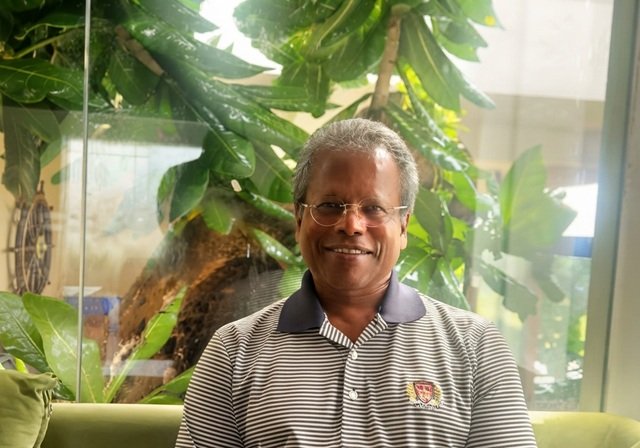
Patrick Mendis is a Sri Lankan-American academic, policy adviser, strategist and author whose work spans international relations, diplomacy, comparative civilisation, and geopolitics. Throughout a career that has taken him between universities, governments, international organisations and policy institutions, Mendis has written extensively on American foreign policy, China’s global rise, strategic competition in the Indo-Pacific, Sri Lanka’s geopolitical significance, and the relationship between culture and statecraft. His publications include numerous books and hundreds of articles exploring the evolution of global power, while his professional life has combined academic scholarship with public policy and diplomacy. Having travelled to more than 157 countries, all fifty American states, every province of China, and every district of Sri Lanka, Mendis frequently draws upon personal observation rather than theoretical abstraction.
Recently, we sat down with him in Colombo for a lengthy discussion that ranged across continents and centuries, revealing a worldview that consistently rejects narrow disciplinary thinking in favour of integrated civilisational analysis.
The conversation began not in Sri Lanka but in Antarctica. Patrick Mendis explained that his most recent journey had been motivated by a desire to understand the expanding geopolitical footprint of China in Latin America and the Southern Hemisphere. “Late last year we wanted to learn more about Chinese influence in Latin America and especially in Antarctica,” he explained. “Antarctica is a global balancer in the climate change and also all the weather pattern in Africa, Latin America, everything that’s happening in the oceans is impacted by the North Pole and the South Pole.”
His journey took him through Panama, Ecuador, Peru, Chile and Argentina before eventually reaching Antarctica itself. Throughout that journey, Patrick Mendis observed what he regarded as a striking contrast between Chinese and American engagement. “America is nowhere to be found compared to what the Chinese investments are,” he remarked. The most visible symbol of this transformation, in his view, was not military deployment but scientific infrastructure. “China is there now. Now they have the most sophisticated scientific laboratories.”
Antarctica, Patrick Mendis argued, should not be viewed merely as a frozen wilderness devoted to scientific curiosity. Instead, it has become one of the strategic frontiers through which future global influence will increasingly be exercised. During his visit, he observed permanent research stations staffed throughout the year with scientists, medical personnel and administrators from numerous countries. The laboratories conduct atmospheric research, climate science, oceanography, biological studies and investigations into the effects of extreme environmental conditions on human health. Scientific presence, in this interpretation, is inseparable from geopolitical positioning.
China’s activities there particularly attracted Patrick Mendis’ attention. According to him, “China has more laboratories than Americans,” and another facility is already under construction. “It’s just like outer space kind of thing,” he observed, describing the technological sophistication of the newest Chinese installations. While many countries maintain research stations because of their geographical proximity to Antarctica, Patrick Mendis regarded China’s expanding presence as evidence of a far longer strategic vision extending well beyond immediate scientific interests.
The discussion naturally widened from Antarctica to China’s broader global trajectory. Patrick Mendis invoked Napoleon Bonaparte’s famous observation: “Let China sleep. When she wakes up, it’s going to shake the world.” Whether Napoleon actually uttered those exact words matters less than what Patrick Mendis believes they now represent. “This is what is happening,” he said. For centuries, China experienced what Chinese historians describe as the “hundred years of humiliation”, a period marked by foreign intervention, internal weakness and imperial decline. Today’s China, according to Patrick Mendis, sees itself as reversing that historical interruption rather than creating an entirely new order.
He argues that this historical consciousness explains much of China’s contemporary behaviour. “They are wanting to bring their own glory back. Rejuvenation of the Chinese nation, Chinese culture.” Rather than seeing China’s rise simply through trade statistics or military expenditure, Patrick Mendis views it as a civilisational project deeply rooted in memory and philosophical continuity.
China’s governance, Patrick Mendis believes, also differs fundamentally from many Western political systems. “They are very, very deliberate,” he observed. Unlike governments driven by rapid electoral cycles or continuous public confrontation, Chinese decision-making is characterised by long-term planning and internal deliberation. Drawing upon his own experience of teaching at twenty-seven Chinese universities and academies, Patrick Mendis described a policy process that unfolds largely outside public view.
“They have intra-democracy inside. They have all the ideas, professors, intellectuals, they talk about debate and they make the policies. When you come to the top, put the seal—it’s a policy. They don’t have a debate in the parliament. Nothing. It’s a show. Chinese don’t show things. That’s why they are quiet.”
Patrick Mendis did not suggest that this system is perfect. Instead, he contrasted it with what he regards as increasingly reactive decision-making elsewhere. “Unlike some presidents tweet here and change his mind ten minutes later… Chinese are very deliberate.” In his view, the distinction lies less in ideology than in political culture and institutional temperament.
The foundations of Chinese statecraft, Patrick Mendis argued, cannot be understood through economics alone. Instead, they rest upon overlapping philosophical traditions accumulated over centuries. “They think they are Confucian ethics and Confucian Daoism and Buddhism,” he explained. Rather than treating religion and philosophy as separate from governance, Patrick Mendis regards them as deeply embedded within China’s strategic thinking. Buddhism, Confucianism and Daoism, in his interpretation, do not merely shape private belief but contribute to the way the Chinese state approaches patience, continuity and long-term planning.
This civilisational perspective also explains why Patrick Mendis rejects simplistic portrayals of China as merely a communist power. Political ideology, he argued, represents only one layer of a much deeper historical identity. The philosophical inheritance remains visible beneath the modern state. “They have all the best of the three philosophies there.”
For Patrick Mendis, Sri Lanka occupies an unexpectedly important place within this wider Asian history. Long before modern geopolitical competition, the island functioned as a connecting point between the Roman Empire, India and imperial China. He recalled the journeys of Buddhist monks such as Faxian, later exchanges associated with Xuanzang, the voyages of Admiral Zheng He, and even the wider commercial networks that linked Marco Polo’s travels with the Yuan Dynasty. These historical references were not offered simply as anecdotes. Rather, Patrick Mendis used them to argue that Sri Lanka has consistently underestimated its own civilisational significance.

“We underestimate,” he reflected. “When you have a huge ruby or the sapphire… you don’t know the value.”
For Patrick Mendis, that neglected inheritance is not merely geographical but spiritual. Buddhism, rather than being reduced to ritual or identity politics, represents one of Sri Lanka’s greatest strategic assets. “We are living on this treasured Buddhist teaching,” he observed, while also lamenting that contemporary society often remains only “nominally Buddhist.”
It is from this historical perspective that Patrick Mendis arrives at perhaps the central argument running throughout the conversation. Sri Lanka, he insists, should stop imagining that national success depends upon becoming another country. Throughout decades of political discourse, comparisons with Singapore, Malaysia or other development models have become almost habitual. Patrick Mendis rejects this entire way of thinking. Sri Lanka should not aspire to become somebody else because, in his view, such comparisons ignore the island’s own geography, history, culture and civilisational experience. Every nation possesses its own strategic logic. Borrowing another country’s identity only produces confusion rather than development.
Instead, Patrick Mendis offers an entirely different metaphor.”You should be a Mahaveli River.” That metaphor, offered by Patrick Mendis, becomes the pivot of the entire argument. It is not presented as poetry for effect, but as a structural claim about how small states survive in a world shaped by competing civilisational logics. In his framing, Sri Lanka’s recurring mistake is not lack of talent or geography, but imitation—attempting to stabilise identity by borrowing external models rather than developing internal coherence.
Sri Lanka, Patrick Mendis insists, cannot function as a copy of Singapore, Malaysia, or any other developmental reference point frequently used in political debate. The insistence is blunt: “Sri Lanka should be Sri Lanka despite imagining to become someone else which is continuous delusion and unmatched and unsuitable comparison.” In this reading, imitation is not neutral policy borrowing; it is conceptual disorientation.
The alternative is fluidity. The Mahaveli River is not a romantic symbol but a governing logic. It moves, adapts, connects regions, and never remains fixed in a single form. Patrick Mendis extends this metaphor into what he calls, in effect, a strategic framework: “You need to have our Mahaveli doctrine.” It is presented as a way of thinking about sovereignty that is rooted in geography, water systems, and historical connectivity rather than imported administrative templates.
To explain this, Patrick Mendis shifts into biological analogy. Threat and opportunity are not opposites but necessary dual forces. “You have a white cell and a red cell blood… you need to have both of them in your blood system to work.” In the same way, he argues, small states cannot survive by eliminating tension or attempting to sterilise their environment. They must operate within contradiction. He extends the analogy further: “If you want to be a Sri Lankan, try to be water.” Water, in his formulation, is not passive; it is adaptive force.
Sri Lanka’s foreign policy, in this logic, should not be rigid alignment but movement. Fixed positioning produces vulnerability in a fluid global order. Water does not resist pressure in a single direction; it finds pathways around it. The Mahaveli River becomes a national metaphor for strategic flexibility rather than ideological rigidity.
This idea is reinforced through historical memory. Patrick Mendis repeatedly returns to Sri Lanka’s hydraulic civilisation—its reservoirs, canals, rivers, and engineered water systems. “We have 103 rivers and around us water,” he notes, linking geography to governance. Ancient rulers are not invoked as nostalgia but as evidence of integrated statecraft.
King Parakramabahu is central to this reading. Patrick Mendis describes a civilisation that was outward-facing and commercially connected rather than isolated. “King Parakambahu sent rice to Chinese to feed. King Parakambahu sent the elephants from the Mantai.” These references are used to argue that Sri Lanka historically functioned within wider Eurasian and maritime networks, rather than as a closed cultural unit.
In the same historical register, he refers to ports such as Mantai and China Bay, and to canal systems that later became part of colonial infrastructure such as the Hamilton Canal. The point is not antiquarian detail but continuity: Sri Lanka’s geography has always positioned it as a connector, not an isolate.
This leads into a broader argument about identity itself. Patrick Mendis rejects the idea that Sri Lanka is composed of rigid, separable civilisational groups. Instead, he describes identity as historically blended through migration, conquest, and integration. In his formulation, the idea of absolute separation between communities does not withstand historical scrutiny. Civilisation, in this reading, is layered rather than segmented.
The critique then moves from history to contemporary governance. Sri Lanka’s deeper crisis, Patrick Mendis argues, is not only economic but moral and intellectual. “When a country is economically bankrupt what we could see is the depth of this moral bankruptcy also in the society.” The implication is that financial collapse is a symptom, not the root condition.
At the centre of this condition is the prioritisation of private gain over collective stability. “You put the personal interest before the national interest,” he states, identifying this as a structural failure rather than an individual flaw. The same diagnosis is extended to other political systems, including the United States, where similar dynamics are observed.
Patrick Mendis warns that inequality intensifies when political systems serve concentrated interests. “Only few people become rich at the expense of the rest of the people.” In this framing, economic disparity is not accidental but the outcome of systemic incentives.
Leadership itself becomes part of the critique. Material accumulation, he argues, does not correspond to intellectual expansion. Instead, he describes a reversal: “Their head is becoming bigger… mind becoming smaller.” The suggestion is that status and intellectual clarity often move in opposite directions.
This critique extends into institutions of expertise. Specialisation, while necessary, can fragment understanding. “If you are an economist, he only knows about microeconomic and macroeconomic… so you need to know a lot of things in a buffet.” Patrick Mendis argues for integrated thinking rather than isolated expertise—an approach that combines history, politics, geography, philosophy, and economics into a single analytical frame.
His own biography is used as illustration rather than ornament. From rural Polonnaruwa, where he grew up working with water buffaloes and agricultural land, to selection through the American Field Service programme, to arrival in the United States without English fluency, the trajectory is presented as a movement across radically different worlds. “I was not speaking a single word in English,” he recalls. Adaptation, not privilege, is emphasised as the mechanism of transition.
The conclusion returns to the central metaphor of the river. Identity is not static possession but continuous motion. “You can stay like a frog in the same well then thinking you know everything,” Patrick Mendis says, “or you can be a Mahaveli river.” The contrast is between enclosure and flow, between certainty and adaptation.
The argument does not end in policy prescription. It ends in philosophical positioning. “Everything is transitory,” he notes. “There is nothing permanent.” In that sense, governance is not the art of fixing identity but of managing change without collapse. Sri Lanka, in this interpretation, does not need to become Singapore, China, or any other reference point. It needs to remain Sri Lanka—fully, deliberately, and without imitation.