


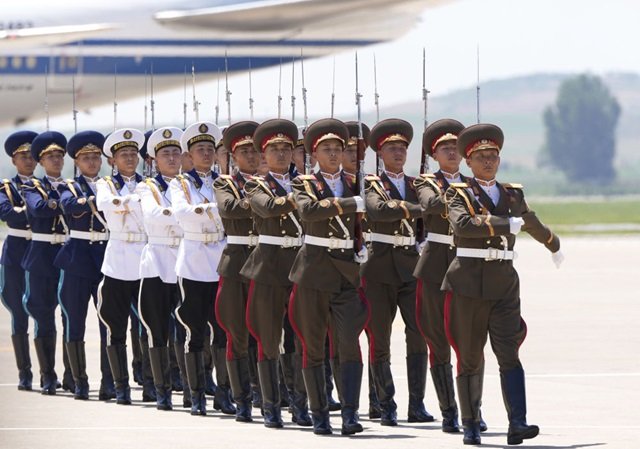
Xi Jinping arrived in Pyongyang on Monday for a rare state visit to North Korea, marking his first trip to the country in seven years and setting the stage for closely watched talks with leader Kim Jong Un. The visit, scheduled to last two days, comes at a moment of heightened geopolitical activity in Northeast Asia, with North Korea reiterating its nuclear position and global powers recalibrating their diplomatic outreach in the region.
Xi’s arrival was confirmed by Chinese and North Korean state media, which framed the trip as a state visit to the Democratic People’s Republic of Korea. The timing places the Chinese leader in Pyongyang shortly after a period of intensified international diplomacy, including back-to-back summits with United States President Donald Trump and Russian President Vladimir Putin in Beijing last month. Those engagements underscored Beijing’s expanding diplomatic visibility, while also setting the backdrop for Xi’s direct engagement with one of China’s most strategically significant but diplomatically isolated neighbors.
The upcoming meeting between Xi and Kim Jong Un is expected to be their first summit since September, when the two leaders last met in Beijing alongside Vladimir Putin and other international figures at a military parade. That earlier gathering reflected a rare convergence of high-profile leaders in the Chinese capital, but the Pyongyang visit shifts the setting to North Korea itself, where political messaging and symbolic diplomacy are expected to be tightly managed.
Ahead of Xi’s arrival, Pyongyang delivered a firm and unambiguous statement on its nuclear policy through Kim Yo Jong, a key figure in North Korea’s foreign policy communications and the sister of Kim Jong Un. In remarks carried by state media, she declared that North Korea’s nuclear weapons program is “absolutely non-negotiable,” reinforcing the country’s long-standing position that its status as a nuclear power will not be relinquished.
The statement was issued by the Korean Central News Agency and published in Rodong Sinmun, North Korea’s official newspaper, just ahead of Xi’s visit. It rejected external calls for denuclearization and dismissed recent interpretations of international diplomatic discussions that suggested otherwise. Kim Yo Jong specifically criticized assertions tied to a recent meeting between the United States and China, in which a White House fact sheet stated that both sides had reaffirmed a shared goal of denuclearizing North Korea. She described those claims as false and accused Washington of continuing to disseminate misinformation.
Her remarks went further, directly challenging the legitimacy of such positions. She said that North Korea’s nuclear status “carries no legal force” for outside powers to contest, and reaffirmed that the country would not tolerate threats. According to her statement, Pyongyang’s policy of strengthening its nuclear deterrent, as directed by its leadership, represents an irreversible course of action that must be carried out without exception.
The messaging underscores a consistent trajectory in North Korea’s official doctrine since the breakdown of the 2019 summit between Kim Jong Un and Donald Trump, when negotiations over denuclearization and sanctions relief collapsed without agreement on scope or sequencing. Since then, Pyongyang has repeatedly declared itself an “irreversible” nuclear state, further cementing that position in its constitution in 2023.
The current diplomatic environment has also been shaped by North Korea’s evolving external relationships. Following increased isolation under international sanctions, Pyongyang has deepened ties with Moscow, particularly amid the ongoing war in Ukraine. North Korea has reportedly received critical support from Russia after sending thousands of troops to assist Russian forces, a development that has contributed to its perception of strengthened strategic backing despite continued sanctions pressure.
Beijing remains a vital source of political and economic support for North Korea, and Xi’s visit is widely viewed as a reaffirmation of that relationship. Analysts and observers have characterized the trip as an effort to reinforce China’s influence over its neighbor, while also managing the broader regional balance in the face of shifting alignments and intensified global competition.
At the same time, North Korean state media has highlighted domestic developments that underscore its continued emphasis on military capability. Reports in recent days have noted that Pyongyang recently unveiled a new nuclear materials production facility. Kim Jong Un has also called for a significant expansion of the country’s nuclear arsenal and an increase in missile production capacity, reinforcing the direction outlined in earlier policy statements.
Visual coverage released by state media over the weekend showed Kim Jong Un attending the 80th anniversary celebration of the founding of the Korean Children’s Union at Kim Il-sung Stadium in Pyongyang, where he was seen interacting with participants, including a moment in which he hugged a child. The imagery, distributed by the Korean Central News Agency, formed part of a broader series of public appearances ahead of Xi’s arrival, reinforcing domestic visibility during a period of heightened diplomatic attention.
Xi’s visit, coming at a moment of intensified rhetoric and reaffirmed nuclear positioning from Pyongyang, places both governments in a delicate diplomatic setting. The talks are expected to focus on bilateral relations, economic and political cooperation, and regional stability, though North Korea’s explicit statements on its nuclear status suggest a firm boundary has been drawn around one of the most contentious issues in international relations.









