


At least 117 journalists and media workers have fled Yemen’s western coastal city of Mocha and surrounding areas after Houthi forces advanced into the region, with many leaving their homes, workplaces and equipment behind amid renewed fighting.
Motasem al-Jalal, a journalist with Al Joumhouriya TV, recalled leaving Mocha on September 9 after Houthi forces captured positions to the east of the city. He travelled towards Aden with two colleagues along a road crowded with civilians and retreating military units.
“When I heard that Al Wazi’iya and the Khalid military camp, in the eastern part of the city, had fallen to the Houthis, I decided to leave immediately for Aden,” he said.
Hours later, Houthi forces captured Mocha, according to the source. The Iran-backed movement controls Sana’a and large parts of northern Yemen and had been advancing along the western coast during a renewed escalation of the country’s civil war.
Al Jalal was among journalists associated with media organisations aligned with Yemen’s internationally recognised government and the National Resistance Forces, which controlled Mocha before the Houthi advance. He said he and other journalists fled with little more than the clothes they were wearing.
The Yemen Press Freedom Observatory, known as Marsadak, reported on September 17 that at least 117 journalists and media workers, including nine women, had been displaced from Mocha and nearby areas. Many worked for Al Joumhouriya TV, the 2 December News Agency and other outlets affiliated with the National Resistance, while others worked for government and independent media.
According to Marsadak, many journalists left only hours before Houthi forces entered the city because they feared detention or reprisals. The organisation also documented raids and looting at some journalists’ homes.
Al Joumhouriya TV’s Mocha studio stopped operating on the night of September 10, after which the channel continued broadcasting from Cairo using pre-recorded programmes. Its facilities in Mocha were subsequently raided and confiscated. The Houthi media office had not responded to requests for comment at the time of publication.
For some journalists, the escape itself involved direct exposure to the fighting.
Majed al-Maamari, editor-in-chief of the 2 December News Agency, initially remained in Mocha after sending his family to Aden. He later left with fellow journalists as the security situation deteriorated.
“The Houthi attacks continued and the journey was exhausting: it was crammed with displaced people and there were checkpoints, amidst overwhelming fear,” he said.
Ali Jaabour, who worked with the 2 December News Agency and the National Resistance media centre, was also caught in the exodus. After military forces began withdrawing, he and a colleague struggled to find transport because vehicles were filled with civilians and soldiers.
Hundreds of people, including women, children and elderly residents, were walking south along the Mocha-Aden highway, he said.
Jaabour eventually found a truck willing to take him out of the city. During the journey, a ballistic missile struck about 300 metres from the vehicle near another truck carrying ammunition. The resulting explosions blocked the road, forcing the two journalists to continue on foot.
“We were running, and bullets were whizzing past our heads,” Jaabour said.
A military vehicle eventually took them towards Bab al-Mandab. They then walked to Ras al-Ara in neighbouring Lahj province before travelling on to Aden.
“I lost my job and my home in an instant,” Jaabour said. He added that the experience had left him unwilling to return to reporting from front-line areas.
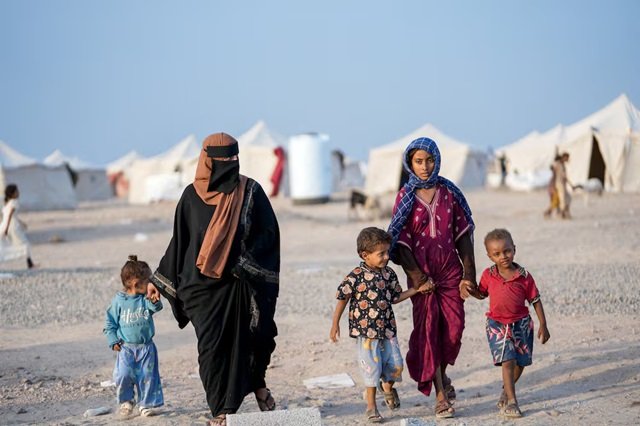
The journalists’ flight has taken place amid a wider displacement crisis. The International Organization for Migration estimates that nearly 130,000 people have been displaced by the renewed fighting since the escalation began.
The latest offensive followed years of relative calm after a UN-brokered truce reduced violence between the Houthis and forces of Yemen’s internationally recognised, Saudi-backed government. The truce formally expired in October 2022, but fighting did not return to its previous intensity until the latest escalation.
The Houthis launched an offensive along Yemen’s western coast on September 3 and captured Mocha and Al Khokha on September 10. By September 11, they had taken control of Yemen’s Red Sea coastline, including the Yemeni side of the Bab el-Mandeb Strait, a strategic maritime passage connecting Europe, Africa and Asia.
The renewed fighting has also intensified concerns about press freedom. Marsadak documented 2,717 violations against journalists and media workers between 2015 and June 30, 2026, including 72 killings and 540 arbitrary detentions. The organisation attributed 1,901 of those violations to the Houthis, compared with 294 attributed to the Yemeni government and allied forces and 103 to the Southern Transitional Council.
Kamel, a representative cited by Marsadak, said journalists in Houthi-controlled areas are routinely brought before the Specialized Criminal Court, which handles state security and terrorism cases, rather than the press court established under Yemeni law for publishing-related offences.
Some journalists have left Houthi-controlled territory or Yemen altogether, while others work under pseudonyms or avoid sensitive subjects. Kamel said fear among journalists and their families means the documented number of violations may not reflect the full scale of the problem.
The displacement has also removed journalists and media organisations that had reported on humanitarian, economic and political conditions along Yemen’s western coast. Marsadak has called for urgent assistance, including temporary accommodation, financial support and psychological services for displaced media workers.










