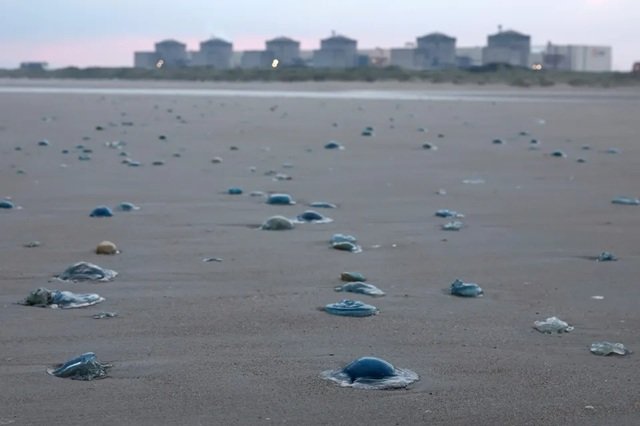
More than 200 tonnes of jellyfish have accumulated around the cooling-water systems of France’s largest nuclear power station, forcing operators to shut down two reactor units and reduce the output of two others. The incident at Gravelines, on the northern French coast, has once again disrupted a major part of the country’s nuclear generation capacity.
The French nuclear operator EDF said the jellyfish began appearing in large numbers during the previous night in the area around the filtration systems of the seawater pumping station. Two of Gravelines’ six reactor units were completely shut down as a precaution, with EDF saying the measure was intended to “ensure that this situation has no impact whatsoever on the safety of our facilities”.
The remaining reactors were also unable to operate as planned. Two units were running at reduced capacity because of the mass appearance of the jellyfish, while the other two were already shut down, among other reasons, for a maintenance inspection. The result was that none of the six reactor blocks at Gravelines was operating according to its normal schedule.
The disruption is not unprecedented. Jellyfish had already interfered with operations at the plant in the middle of the month and again in August last year. In response, EDF said Gravelines had established monitoring and detection systems designed to identify and manage large concentrations of jellyfish before they can cause significant operational problems.
The immediate response has involved an unusual intervention at sea. Seven boats are operating around the nuclear plant around the clock to capture jellyfish and release them further out in the sea. EDF said it was receiving assistance from France Pêche Durable as part of the operation.
The jellyfish affect the plant through its seawater cooling infrastructure. Their accumulation around filtration systems can interfere with the intake of seawater required for the plant’s operation, making precautionary reductions or shutdowns necessary. EDF did not provide an explanation for the unusually large concentration of jellyfish, saying it was currently unable to determine the cause of the phenomenon and was working with various partners to understand it better.
Despite the disruption, EDF stressed that there was no risk to the electricity system as a result of the incident. The shutdowns and reductions were described as precautionary measures focused on maintaining the safety and proper operation of the plant.
Gravelines is among France’s nearly 20 nuclear power stations and is located on the northern French coast, roughly halfway between Calais and Dunkirk. The facility is therefore an important part of France’s electricity infrastructure, making repeated interruptions caused by environmental conditions an unusual but significant operational challenge.
The episode also illustrates how nuclear power plants can be affected by conditions beyond the conventional risks associated with reactor operation. At Gravelines, the immediate threat has not come from a reactor malfunction but from an extraordinary concentration of marine life entering the systems on which the plant depends.