


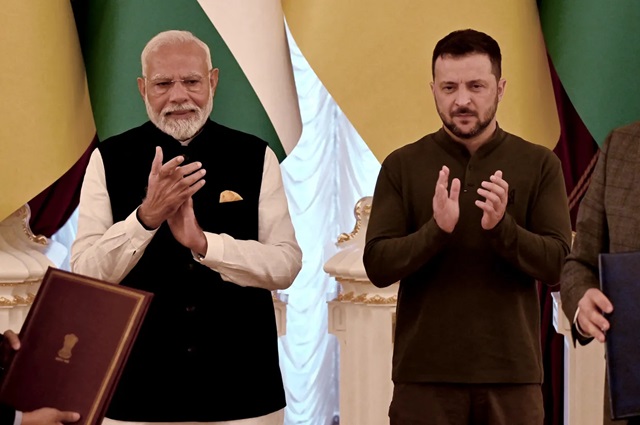
Certainly, eyebrows were raised when it was announced that Indian Prime Minister Modi would visit Ukraine, with many speculating about the purpose of his visit amid what seems to be an unending war between Ukraine and Russia. Particularly, since this visit to Ukraine was preceded by a visit to Russia a few weeks earlier, discerning observers suspected that this might be a balancing act by Mr. Modi to assure the USA that he would not be taking sides with Russia in the ongoing war.
In any case, there is considerable surprise at Mr. Modi’s initiative, and speculation continues as to whether he received the green light from Russian President Putin and Ukrainian President Zelensky to act as a mediator to end the conflict.
While Russia started this war with a timetable of just a few weeks to defeat Ukraine, this has not happened. With the war continuing for over two years, causing heavy casualties in both countries and significant economic suffering, there must be a growing urgency to end the conflict as soon as possible. The recent swap deal between Ukraine and Russia, which secured the release of 220 captives despite the ongoing war, only proves the underlying desire in both nations to bring the war to an end.
Obviously, both countries are seeking a face-saving formula and a credible mediator. Mr. Modi may have thought that, given the mindset of the leadership in both Russia and Ukraine, this could be the right time to play a proactive role in resolving the conflict. He might also have expected that such an initiative could raise India’s global standing and enhance his personal image both domestically and abroad.
With the hugs that Mr. Modi is known for, he has embraced both Mr. Putin and Mr. Zelensky, and the photographs are now prominently featured in the global media.
Now that Mr. Modi’s visit to Ukraine has concluded, what could be the future developments? Will the war end soon?
The reality is that even if the people and leadership of Ukraine want to end the war, President Zelensky can only make that decision if the USA permits it. Of course, European nations would welcome an end to the conflict. However, there may be a fundamental difference in attitude between the European countries and the USA regarding the Ukraine-Russia war, though Europe seems to have little choice but to align with the USA in taking an anti-Russian stance.
Any war must end one way or another, and the Ukraine-Russia war is no exception.
Mr. Modi has undertaken a challenging task, and in all likelihood, he may not succeed in his efforts to bring peace. So far, he has not presented a face-saving formula that would be acceptable to both nations. Whether Mr. Modi can catalyse the end of this war remains a moot question, though it is acknowledged that he has made a valiant attempt. To this extent, his efforts should be praised.
In the turbulent world of politics, there are not many leaders who could be acceptable to both warring parties. Mr. Modi seems to possess such stature, as evidenced by his successful visits to both Russia and Ukraine and the warm welcomes he received in both countries.
One fact that cannot be overlooked is the failure of the United Nations, and particularly the Secretary-General, to take on the role of mediator in this conflict. In this scenario, the UN and its Secretary-General are conspicuous by their absence, and Mr. Modi has highlighted this failure.










