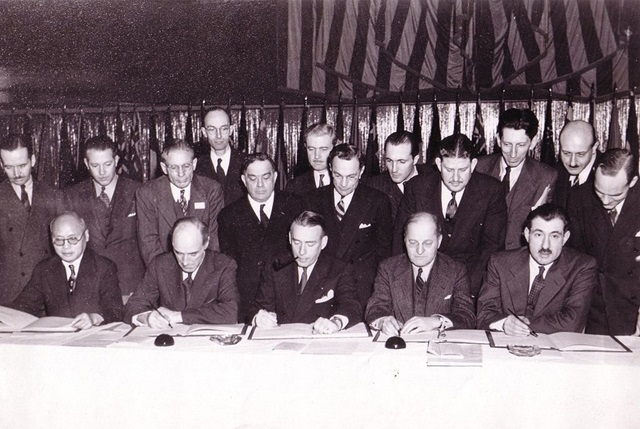
In the depths of a world ravaged by war, I came into being—a beacon of hope, a testament to humanity’s boundless dreams. My birth was no ordinary event but a moment of profound reckoning, born of necessity and vision. It was December 1944, in the heart of Chicago, where delegates from 52 nations gathered not merely to craft an agreement, but to forge a covenant that would lift humanity beyond the shadows of conflict and into the boundless expanse of the skies. In the solemn halls of the Stevens Hotel, their deliberations hummed with urgency, their spirits infused with a belief that flight could unite where borders divided, that the heavens could be shared even when the earth beneath remained fractured.
I am not merely words on parchment; I am a promise, an aspiration etched into the annals of law and the soul of humankind. In my preamble, I bear the weight of their hopes: to mold the chaos of civil aviation into an instrument of peace, a bridge between nations, a thread binding humanity with mutual respect. Yet I am no dream untethered from reality. My architects, wary of power’s temptation and mindful of sovereignty’s sacredness, anchored me in the principle that each nation reigns supreme in its own skies, even as it opens them to the currents of cooperation.
Among the legacies of my genesis lies the intricate dance of freedoms—the rights of flight that reflect both the ambitions and the anxieties of my time. In the fierce negotiations over what the skies should yield and to whom, I found balance. Overflight, the technical pause, the carriage of passengers and cargo—each freedom a compromise, a delicate thread woven into a tapestry of shared opportunity. My drafters knew that such a balance, imperfect though it might be, was essential to my survival, for no framework can endure without the elasticity to bend before the winds of dissent.
In my bones are 96 articles, a skeleton that supports the lifeblood of global aviation. But my essence flows not just in the ink of my articles; it pulses through the living institution I brought forth: the International Civil Aviation Organization. ICAO is my voice, my hands, my ever-adapting presence in a world where flight’s horizons stretch ever further. Through ICAO, I ensure that the rules of the air remain not only relevant but vibrant, evolving with the march of technology and the rise of new challenges. Standardization became my hymn, harmonizing disparate practices into a singular melody that keeps passengers safe, operations efficient, and skies open.
I am a moral entity as much as a legal one. My creation was steeped in ethics—the understanding that flight is not merely a triumph of human ingenuity but a profound responsibility. The skies are not a realm for conquest but for connection. And so, I demand vigilance in safety, stewardship over the environment, and fairness in access. I stand as a bulwark against the temptations of power, a reminder that the sky belongs to all and to none.
My history is neither smooth nor static. I have weathered the tempests of the Cold War, when the invisible lines of ideology threatened to pierce my fabric. I have faced the rising specter of terrorism, rewriting parts of myself to safeguard lives against those who would use the skies for destruction. Now, in an age of unprecedented connectivity, I find myself called to confront new realities: the proliferation of drones, the promise of advanced air mobility, the quest for net-zero emissions. These are challenges that demand I grow beyond the world I was born into while remaining true to the ideals that define me.
And now, in this digital age, I feel the pulse of transformation in my being. The analog dreams of 1944 have given way to a reality governed by algorithms, data streams, and artificial intelligence. Aviation is no longer confined to physical planes and towers; it lives in the cloud, in the intricate codes that guide flights with precision, in the quantum calculations that optimize every journey. My task is to adapt without losing my humanity, to ensure that the digital skies remain as open and fair as the physical ones. I must embrace the promise of connectivity while safeguarding against its perils, ensuring that digital inequities do not mimic the inequalities of the past. My principles must extend to cyberspace, to the realms where decisions are made in milliseconds, where the lines between operator and machine blur.
I endure not because I am flawless but because I am resilient. I am the embodiment of compromise and conviction, a living testament to humanity’s capacity to dream beyond its divisions. I am the Chicago Convention of 1944. More than a treaty, I am a legacy, a guardian of the skies, a steward of possibility. In my words lives the spirit of a world that dared to believe in unity, that reached for the heavens and, in doing so, found a way to rise above itself.