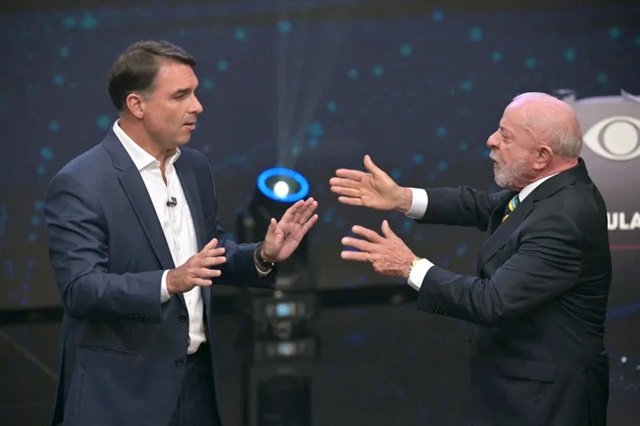
Brazilian President Luiz Inacio Lula da Silva and right-wing Senator Flavio Bolsonaro traded accusations of lying and corruption in their first presidential run-off debate on Sunday, exposing the bitter divisions shaping the campaign a week before voters decide between the incumbent and the son of former far-right president Jair Bolsonaro. The candidates confronted each other over the economy, public security, healthcare and Brazil’s relationship with the United States, while repeatedly turning to personal attacks and allegations involving their families.
Bolsonaro, 45, entered the debate after unexpectedly finishing ahead of Lula in the first round on October 4, securing 47 per cent of the vote against the president’s 45 per cent. Opinion polls have since indicated a narrow contest, with Bolsonaro maintaining a slight advantage despite some surveys showing the gap narrowing. Two polls published during the week before Sunday’s encounter put Bolsonaro on 51 per cent of voting intentions and Lula on 49 per cent.
The exchange was marked by confrontational gestures as well as verbal attacks. Bolsonaro paced behind Lula, shaking his head, smirking and scoffing while the president spoke. “Brazil is going to retire you,” he told his opponent. Lula, who is almost 81 and seeking a fourth term in power, described Bolsonaro as “a habitual liar, a thug” and said he did not want to stand close to a “militiaman”, referring to the senator’s alleged ties to paramilitary groups in Rio de Janeiro.
Bolsonaro responded with a reference to Lula’s past imprisonment on corruption charges. “Because my wallet could be stolen,” he said, explaining why he preferred to keep his distance from the president. Lula spent 580 days in prison in 2018 and 2019 after being convicted of corruption, but the conviction was later annulled because of flaws in the investigation and legal proceedings. During the debate, Lula repeatedly urged viewers to check his opponent’s statements on Google, while both candidates revived allegations and scandals involving political opponents and their relatives.
The candidates’ competing economic arguments focused on the cost of living, social welfare and government spending. Bolsonaro accused Lula of “reckless spending to get re-elected”, referring to social measures announced during the campaign, and sought to present the government as failing to address the financial pressures facing households. Lula countered by asking whether Bolsonaro intended to follow the approach of Argentina’s libertarian president, Javier Milei, whose drastic cuts to public spending had been accompanied by higher unemployment and reductions in benefits.
Bolsonaro repeatedly avoided answering the question directly, shifting instead to other subjects. Lula also questioned his opponent’s relationship with US President Donald Trump, an ally of the Bolsonaro family, and raised concerns about plans to transfer control of Brazil’s rare earth minerals. “It is striking how the Bolsonaro family is subservient to American interests,” Lula said. The exchange brought foreign policy into a campaign otherwise dominated by domestic concerns, including public security, healthcare and household finances.
The legacy of Jair Bolsonaro, who governed Brazil before losing the 2022 election to Lula, featured prominently. The former president is under house arrest while serving a 27-year sentence connected to an unsuccessful attempt to overturn the result of that election. His son challenged Lula over the support the president had received from prisoners, prompting Lula to say he wanted every vote, including that of the former president. “Vote for me, Bolsonaro, you know your son, you know I’m better than him,” Lula said.
The debate also touched on the handling of the Covid-19 pandemic under the elder Bolsonaro. Flavio Bolsonaro acknowledged shortcomings in that period, saying: “This wasn’t an area where we saw the best results during Bolsonaro’s presidency. I’ll offer a mea culpa here.” Lula, meanwhile, sought to portray the senator as detached from the everyday experiences of poorer Brazilians, arguing that he lacked familiarity with public transport and public healthcare. “My opponent only knows about buses from books. He has never even stepped foot on one. He has no idea what the world of work is like,” the president said.
The confrontation took place amid a series of public rallies reflecting the strength of both political camps. In Sao Paulo, Bolsonaro supporters wearing Brazil’s yellow and green national colours gathered along Paulista Avenue, where the senator addressed the crowd from the back of a truck. Monitors at the University of Sao Paulo estimated attendance at about 71,000. Sara Machado, 36, said the country was in a “state of calamity”, arguing that people had to work two or three jobs to meet their bills.
In Rio de Janeiro, swimmers at Praia Vermelha beach arranged themselves in the water to spell Lula’s name, while singer Caetano Veloso led a rally in support of the president on Copacabana Beach. University monitors estimated that event’s attendance at about 56,000. Fabiana Leite, a 51-year-old nurse and social worker, said Lula’s welfare programmes had helped her rebuild her life after she was wrongly imprisoned and lost custody of her daughters. “You might have the desire to fight and to grow, but without the means, without social programmes, it’s just not possible,” she told AFP.
The campaign also faced fresh scrutiny over allegations involving Bolsonaro. On Sunday, Brazil’s federal police asked the Supreme Court to open an investigation into the senator over an alleged money-laundering scheme involving a lawyer close to him. He was already under investigation for links to Daniel Vorcaro, a disgraced former banker who financed a film about Jair Bolsonaro’s life. The allegations remain separate from the accusations exchanged during the debate.
Both candidates are seeking to attract the 33 million voters who did not participate in the first round, representing about one in five eligible voters. Sunday’s encounter was their first debate after both had declined earlier opportunities to face each other. A second debate is scheduled for October 23, two days before the October 25 run-off.