


by Our Political Affairs Editor
Among Sri Lanka’s self-proclaimed “intellectuals,” few figures have stirred as much intrigue and scepticism as Dr Ashoka Sapumal Ranwala, a prominent member of the National Executive Committee of the ruling NPP government. Dr Ranwala, who recently assumed the prestigious role of Speaker of Parliament, now finds himself embroiled in controversy surrounding his academic credentials. This development raises pressing concerns about leadership, accountability, and transparency in the country’s governance.
Dr Ranwala’s elevation to the Speakership was initially hailed as a landmark achievement, with media narratives portraying him as a dedicated scholar and advocate of public service. His backstory, as propagated by NPP and JVP media, painted him as an accomplished individual who rose from union activism to become a national leader. Reports celebrated his purported academic journey, claiming he graduated in Chemical Engineering from the University of Moratuwa and earned a PhD in Biochemistry from Waseda University, Japan. His professional history was described as equally impressive, highlighting his tenure at the Ceylon Petroleum Corporation, presidency of the Petroleum Public Employees Union, and leadership at the BioGenic Green Technology Research Institute.
Yet, since assuming office, cracks have begun to appear in this carefully curated image. Dr Ranwala’s performance as Speaker has been characterised by immaturity and an apparent inability to meet the demands of the role effectively. Despite this, little public or institutional scrutiny has been applied to his qualifications, even as serious doubts have surfaced about their authenticity.
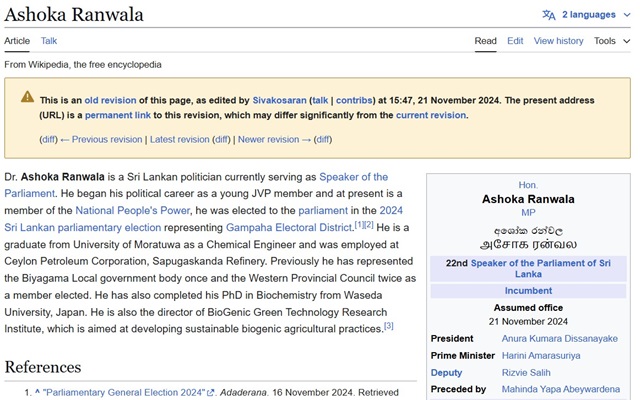
An email inquiry sent to Waseda University, where Dr Ranwala claims to have obtained his doctorate, has so far failed to uncover any evidence confirming his academic contributions. Curiously, there appear to be no research papers, publications, or records to substantiate his claims of advanced study. Furthermore, troubling discrepancies have emerged regarding his undergraduate qualifications. While earlier versions of his Wikipedia page credited him with a degree from the University of Moratuwa, recent edits now suggest that Dr Ranwala holds only a “National Diploma” from an affiliated institution, rather than a full degree.
This abrupt change—by whoever edited it, as Wikipedia is an open-source platform—casts doubt on the authenticity of Dr Ranwala’s academic credentials. It also raises questions about whether the public and his political colleagues have been misled. If these allegations are substantiated, it would mean that the Speaker of Sri Lanka’s Parliament has deceived not only his electorate but also the nation at large.
The situation demands an immediate and transparent response from Dr Ranwala. His position as Speaker places him in a role of significant national responsibility, and any suggestion of dishonesty compromises the integrity of his office. The public deserves a clear explanation. If it is proven that Dr Ranwala falsified his qualifications, he must be held accountable without delay.

This controversy also raises questions about the processes and judgement of the NPP leadership, which nominated him for this pivotal position. If due diligence was not conducted, it reflects a failure on their part to ensure the credibility and suitability of their appointees.
Leadership is built on trust, and that trust is earned through transparency and accountability. If Dr Ranwala’s academic claims are indeed fabricated, the damage goes beyond his personal credibility—it undermines public faith in the institutions of governance. Sri Lanka’s citizens deserve leaders who embody integrity, not individuals who construct their public personas on shaky foundations. This unfolding scandal should serve as a wake-up call for stricter vetting of public officials to safeguard the nation’s trust.










Biographical entries may be found in respect of the Hon. Speaker on the website of the Parliament of Sri Lanka, on LinkedIn and on Wikipedia, and they contain details of his alleged academic qualifications. These sources all say the same thing. This information has been repeated in many recent articles about Hon. Speaker in many news sources both in Sri Lanka and outside.
The Hon. Speaker, asserts that he has a Chemical Engineering Degree from the University of Moratuwa in Sri Lanka. Wikipedia has only recently been changed to say that he merely has a NDT diploma. Both LinkedIn and the Parliament webiste still claim he has a degree in Chemical Engineering.
The reality is that he has never been enrolled for an undergraduate degree at the University of Moratuwa in Sri Lanka. He has never been awarded a degree from this university.
He may have enrolled for a National Diploma in Technology at the Institute of Technology affiliated to Moratuwa University, but a NDT qualification is not a bachelor’s degree.
The Department of Chemical Process Engineering at the University of Moratuwa will be able to independently verify this.
Additionally, it is asserted that he holds a Doctoral qualification (a PhD) in Biochemistry from Waseda University in Japan.
There is no record of such a person having completed a doctoral dissertation at Waseda University.
Waseda University Library has a externally accessible database of all Waseda dissertations held by that Library which can be searched at:
https://waseda-jp.libguides.com/research-navi/find_theses/en
There is also Waseda University Repository, which purports to hold all of the University’s doctoral dissertations and many other documents. This source also has no record of a doctoral dissertation by this person. The data repository may be found here:
https://waseda.repo.nii.ac.jp/?page=1&size=20&sort=custom_sort&search_type=0&q=0
The DIET (Parliament of Japan) also has an online library of details of dissertations published in Japan. There is no relevant entry in this data source either.
https://dl.ndl.go.jp/en/
It seems reasonable to assume that both the Hon Speaker’s claimed academic qualifications are fictitious.
Very concerning, though he shows up in Google as having a LinkedIn account, on clicking the link it comes up with “something went wrong”
This is a disgrace for the country. Nobody should identify him/herself with wrong academic qualifications. Doing so by a person who gonna involve with the formulation of national polities will be a tragedy for a country like Sri Lanka, in which the university as well as education system is well accepted across the world. If this person has done a wrong, he should not have ethics to serve as the speaker.
How people would expect the truth from such people. NPP leadership should have the backbone to remove this person and apologize the people who trust this party.
The worst, most unethical, and ill-mannered group of students I have ever encountered were from the NDT course at the University of Moratuwa. They were the most frustrated individuals I have witnessed, often harassing students from other departments.
I suggest that the NPP and especially the Prime Minister should remind all their appointees that the new regime is commited to a policy of absolute honesty. Each individual should be given a final opportunity of revising their claimed qualifications.
Thereafter, all credentials should be verified and offenders should be exposed.
It should be remembered that a former President of Sri Lanka made similar bogus claims and was exposed by the late Lasantha Wickremetunga. There are several other politicians and public servants who are similarly guilty.
Unfortunately, the reason why we claim false credentials stems back to a psychological disorder, and this in turn questions the suitability of such people for high office.
,
It is disheartening to witness yet another instance where public trust is undermined by those in positions of power. The actions of a third citizen, mirroring the deceit of a previous leader, serve as a stark reminder of the erosion of integrity within our institutions. Such manipulation of the truth not only betrays the people but also damages the very fabric of democracy. Now, even the Speaker of the House, a figure meant to embody impartiality and responsibility, stands accused of similar misconduct. This is a moment for decisive action—accountability must prevail. The Speaker must step down and offer an unreserved apology to the nation, demonstrating a commitment to uphold the principles of transparency and justice. Only then can the path to rebuilding public trust begin.
Sad to hear this after all the trust and confidence we had on these people. The best is to check everyone’s credentials and police records to clarify these matters properly. If worked and studied overseas, those also should be individually checked and scrutinised to avoid such unethical and fraudulent happenings.
The NPP Leadership must answer to this openly
Disgrace.. He was at the forefront at the SITAM protests.