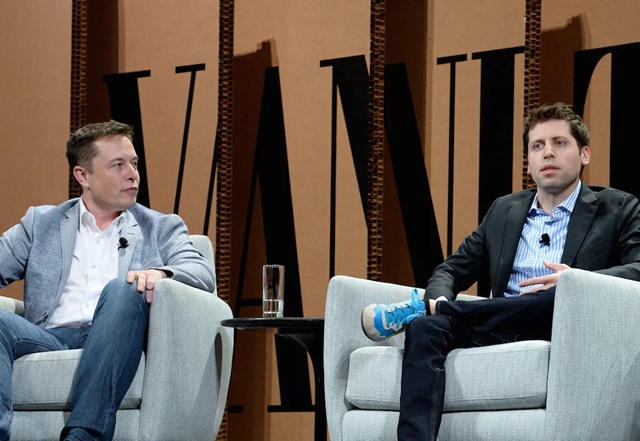
OpenAI’s Sam Altman is facing a significant challenge to his ambition of turning the company into a trillion-dollar business, with the unpredictable influence of Elon Musk now looming large. According to Financial Times, since Donald Trump’s election in November, executives at OpenAI have been bracing for the potential impact of a new administration—an effort complicated by Musk’s growing role as a confidant of the president-elect. As one of the most influential figures in technology, Musk’s position has raised concerns about how he may leverage political power to potentially harm OpenAI’s interests, especially as a competitor with his own artificial intelligence company, xAI.
Musk has long been a rival to OpenAI, and Altman’s biggest challenge now lies in the possibility that Musk might use his proximity to Washington to push for new regulations targeting OpenAI or influence government contracts in a way that could benefit xAI. Despite Musk’s claims on his social media platform X that rivals should expect him to be “magnanimous,” many in the tech industry remain skeptical of his intentions. As noted by a lawyer who has previously clashed with Musk, “No one believes that for a second.” Altman, on the other hand, has expressed confidence that Musk will act in the best interest of the U.S., insisting that it would be “profoundly un-American” to use political power to disadvantage competitors. This was reported in a Financial Times article, where Altman voiced his belief that Musk would make decisions in the national interest.
The relationship between Altman and Musk, once cooperative as co-founders of OpenAI in 2015, has deteriorated significantly. Musk has publicly referred to Altman as “swindly Sam” and filed lawsuits against OpenAI, accusing the company of deceit and seeking to void its lucrative partnership with Microsoft. These legal battles reflect Musk’s ongoing frustration with OpenAI’s direction, particularly the company’s recent shift toward greater external investment, which Musk claims betrays the original nonprofit mission of OpenAI. However, Financial Times reports that OpenAI has pushed back, asserting that Musk himself had pushed for similar changes back in 2017 when he was still involved with the company.
According to Financial Times, OpenAI’s policy chief, Chris Lehane, described Musk as “unique” and emphasized that the company’s strategy would focus on “controlling what we can control.” OpenAI has aligned itself with the Trump administration’s priorities in an effort to remain at the forefront of AI development. As Lehane explained, the company is positioning itself as a key player in strengthening U.S. competitiveness, particularly in relation to China, and supporting national security. In line with this, Altman has even donated $1 million to Trump’s inaugural fund to ensure that OpenAI remains an influential participant in the administration’s discussions on AI.
Despite Musk’s challenges, OpenAI has maintained its leadership in the AI sector, notably through the launch of ChatGPT in November 2022. As per the Financial Times, the company is now restructuring in order to attract more external investment, aiming to stay ahead of its competitors in the rapidly evolving industry. However, Musk’s lawsuits against the company argue that these changes contradict OpenAI’s original nonprofit mission, accusing the company of veering off course. The tension between the two former partners continues to grow, with Musk’s legal actions representing just one facet of a wider competition for dominance in the AI space.
The Financial Times also highlights concerns raised by Reid Hoffman, the founder of LinkedIn and an OpenAI board member, who expressed worry that Musk’s animosity toward Altman could influence AI policy under the new administration. Hoffman cautioned that if Musk’s personal grievances were allowed to shape U.S. government policy, it could lead to conflicts of interest that could undermine the broader AI industry. Musk’s critics fear that, in his new role, Musk could use his influence to privilege xAI over competitors like OpenAI, potentially stifling innovation in the sector.
For now, however, the greatest threat to OpenAI is not political interference, but direct competition from Musk’s xAI. As reported by Financial Times, Musk’s companies possess vast proprietary data resources—such as satellite images from Starlink, Tesla car footage, and data from X—that give him a significant edge in the AI race. Musk’s xAI, which launched Grok-2 in August, is already competing with OpenAI’s GPT-4, and xAI’s supercomputer Colossus, which became operational in September, is now one of the most powerful AI compute clusters in the world. This technological advantage makes Musk’s xAI a formidable competitor.
Despite the challenges posed by Musk’s growing AI presence and his proximity to the incoming administration, investors acknowledge that Musk’s ability to leverage his companies’ resources could pose the greatest risk to OpenAI. As one investor close to Musk’s companies pointed out, “Elon can manifest things in the real world that others can’t,” a factor that gives him a significant advantage in the AI space, even as the industry braces for potential political maneuvering.