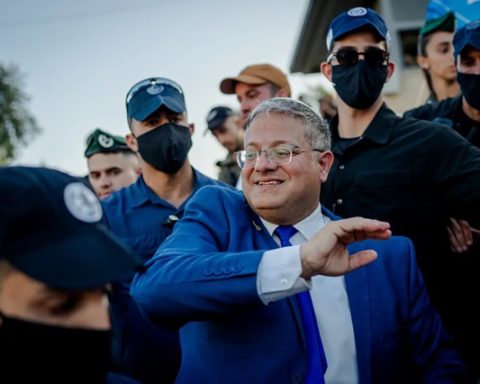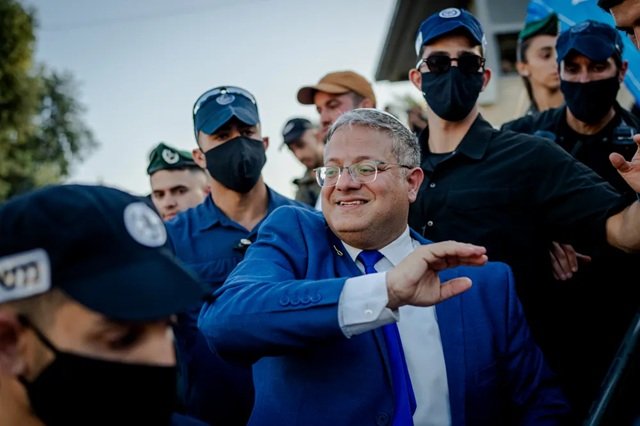
The latest remarks by Israel’s Police Minister Itamar Ben-Gvir have triggered international outrage, but they have also revived a more consequential question: how did views once associated with Israel’s radical political fringe become part of government policy?
In a podcast, Ben-Gvir said: “Ich denke, dass man gezielte Tötungen in Gaza ausführen sollte, jede Nacht 30, 40 (Menschen) entfernen.” He was not referring exclusively to terrorists. He said there were people in the Gaza Strip who “nicht verdient” hätten zu leben — people whom, in his view, were not even human.
The remarks prompted the Central Council of Jews in Germany to distance itself from him, while the SPD and other voices in the European Union called for sanctions against the far-right politician. German Chancellor Friedrich Merz of the CDU also sharply condemned Ben-Gvir’s latest statements.
Yet the controversy, according to Die Zeit, cannot be understood as an isolated outburst. Ben-Gvir’s statements form part of a political trajectory stretching back decades, from his involvement in extremist groups as a teenager to his emergence as one of the most powerful figures on Israel’s far right.
As a young man, Ben-Gvir became involved with extremist groups associated with the Orthodox Rabbi Meir Kahane. Kahane founded the Jewish Defense League, which later carried out several attacks against people of Arab origin in the United States and was classified by the government in Washington as a terrorist organisation. Ben-Gvir’s involvement in such circles resulted in his being rejected by the army.
For years, a portrait of Baruch Goldstein reportedly hung in Ben-Gvir’s living room. Goldstein carried out the 1994 massacre in Hebron, killing 29 Muslim Palestinians.
In the summer of 1995, as Israeli Prime Minister Izchak Rabin had just signed the Oslo peace agreements with the Palestinians, a television station interviewed the then 19-year-old Ben-Gvir during a demonstration against the agreement. He was holding the Cadillac emblem from Rabin’s official car, which he had broken off.
“So wie wir es geschafft haben, dieses Zeichen zu bekommen,” Ben-Gvir told reporters, “so können wir auch an Rabin herankommen.”
On 4 November 1995, Rabin was assassinated by a far-right Israeli. In 2007, a Jerusalem court convicted Ben-Gvir of “Aufstachelung zum Rassismus und Unterstützung einer terroristischen Vereinigung”.
Despite that record, Ben-Gvir subsequently built a political career. In 2021, he entered the Knesset, Israel’s parliament, as Benjamin Netanyahu was already seeking closer relations with radical small parties. At Ben-Gvir’s public appearances, hundreds of young radicals can still be seen, according to Die Zeit, some shouting “Tod den Arabern”. For them, Ben-Gvir has become a father figure expected to turn such rhetoric into political reality.
Warnings about his rise were not absent. Kobi Shabtai, the former police chief of Jerusalem, said that whenever far-right demonstrations took place in the Old City, Ben-Gvir was present “um die Lage weiter anzuheizen”. Nevertheless, after the December 2022 elections, Netanyahu brought him into government.
Shortly before that, Shaul Magid, biographer of Meir Kahane, wrote in Ha’aretz that Ben-Gvir was not a revolutionary like his former ideological model. Instead, Magid argued, he acted tactically and was supported by a broader movement among nationalist settlers. “Meiner Ansicht nach haben die Siedler den politischen Kampf gewonnen, und nun stellt sich die Frage, was sie damit anfangen werden,” he wrote.
Four years later, Ben-Gvir’s influence had become institutional. He renamed the Interior Ministry the Ministry of National Security and became responsible for the police, including the Border Police, which functions like an army unit. He also curtailed the freedoms of local police leadership, thereby politicising policing, according to Die Zeit.
During his tenure, violence in Arab communities, where predominantly Muslim and Christian Palestinians with Israeli citizenship live, spiralled out of control. In the first half of 2026, almost every day a person was killed.
At the same time, Ben-Gvir pressed for legislation introducing the death penalty for Palestinian terrorists. The measure was included in the coalition agreement and passed by the Knesset in March. Ben-Gvir celebrated the achievement with champagne inside the Knesset, wearing a gallows pin on his lapel.
In April, legal expert Amir Fuchs of the Israel Democracy Institute told Die Zeit that there had previously been a possibility that such breaches of political taboos would never become law, even when radicals placed them on the agenda. But the Hamas attack on Israel on 7 October 2023 had become a national trauma and fundamentally altered the mood in the country. Ben-Gvir, Fuchs said, knew how to benefit from that change.
Just last Tuesday, Ben-Gvir appeared outside a prison in central Israel and said that an execution facility was “derzeit … für die Hinrichtung verurteilter Terroristen durch Erhängen” being built there.
The policy shift extends beyond legislation. Since Ben-Gvir entered office, the number of Palestinians killed in the occupied West Bank has continued to rise. Human rights organisations have described attempted ethnic cleansing and documented land seizures and attacks by radical settlers. This week, settlers surrounded the property of a Palestinian family in Qusra, some of whose members hold US citizenship. Afterwards, Mike Huckabee, the US ambassador to Israel, described the settlers’ actions as “Terror”.
Ben-Gvir has also used his political power over Gaza. He has repeatedly threatened Netanyahu with a coalition breakdown if diplomatic steps are taken. He openly calls for the Gaza Strip to become Israeli territory and has participated in marches by radical settlers along the border fence with Gaza.
His political leverage remains substantial. Opinion polls give his party, “Jüdische Stärke”, ten of the 120 Knesset seats — its strongest projected result and enough to make the party politically vital to Netanyahu.
That helps explain why Ben-Gvir’s latest comments carry significance beyond another episode of inflammatory rhetoric. His political journey, as documented by Die Zeit, traces the movement of extremist ideas from the margins of Israeli politics into the machinery of government.
The timing has added another dimension. Ben-Gvir’s interview was published shortly before Jared Kushner, serving as US special envoy for peace missions, visited Netanyahu. According to Ha’aretz, following their meeting, Israel was expected to continue carrying out targeted strikes in Gaza.
For Ben-Gvir, condemnation from abroad may therefore be only one element in a much larger political calculation. His influence now rests not simply on provocative statements, but on a position inside government, control over policing, support among radical constituencies and a parliamentary presence capable of determining the stability of the governing coalition.
What once appeared to be the politics of an extremist outsider has become, according to the account published by Die Zeit, part of the exercise of state power.