
On November 3, President Trump signed an executive order declaring a “national emergency.” The “emergency” is due to “the unusual and extraordinary threat to the national security and foreign policy of the United States constituted by the situation in Nicaragua.” Supposedly, this emergency began in November 2018, has persisted for eight years and is expected to continue into 2027.
The scale of the “threat”
Here are some key figures by which to judge the scale of the “threat” posed by Nicaragua. First, some basics. The US population is nearly 50 times Nicaragua’s and its economy is 1,400 times bigger, with Nicaragua’s national income (GDP) only 0.07% that of the US.
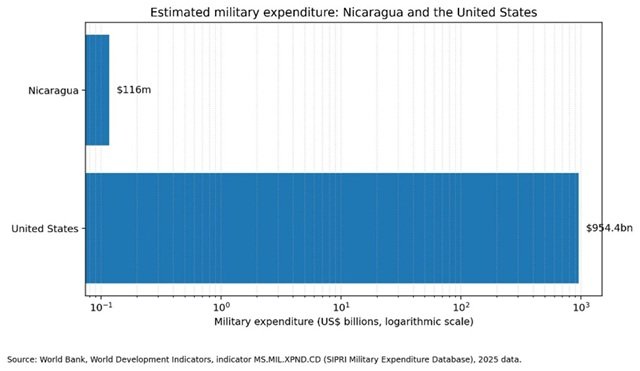
Second, a military comparison. Nicaragua has one of the smallest defense budgets in the Americas, devoting just 0.6% of its GDP ($116 million) to its military. The US, of course, has the world’s biggest “defense” budget at $954 billion or more than 3% of its GDP (see chart), and Trump wants to make it even bigger. Nicaragua deploys around 12,000 military personnel, under 1% of its northern neighbor’s 1.3 million.
Third, its military has little or no offensive capability. Its principal duties include preventing drug trafficking, protecting borders, and conducting maritime patrols. The military also responds to emergencies such as hurricanes and earthquakes and protects the nation’s vital coffee harvest, of which the US is the biggest consumer.
So, the notion that Nicaragua – 1,200 miles from the south Texas border – threatens US security is clearly absurd. What, then, is the basis of the so-called “emergency” and what has Washington done to stop it in the eight years since it began?
US campaign against Nicaragua
In Trump’s first term, he signed the original executive order after the US-inspired coup attempt against Nicaragua’s then recently re-elected Sandinista government in 2018. The anticipated collapse of the government in the face of a violent uprising failed to materialize.
Trump’s executive order was an integral part of a political and media campaign to ostracize Nicaragua internationally. Bodies such as the UN’s Office of the High Commissioner for Human Rights (OHCHR) and the Organization of American States (OAS) were instrumentalized to attack Nicaragua’s human rights record, even though they had sent delegations to the country in 2018 that received evidence of assassinations and torture perpetrated by the coup-mongers.
Washington started to put the squeeze on Nicaragua’s economy, cutting off access to loans from bodies such as the World Bank and the IMF, worth $500 million annually. Government officials were sanctioned, often on the basis of little or no evidence. Vital trade arrangements were threatened, including its membership in the regional free trade agreement that improves access to the US market. Media campaigns attempted to target Nicaraguan goods, such as its beef exports.
Under Biden, the US Trade Representative launched a spurious investigation into Nicaragua’s allegedly unfair trade practices, such as use of child labor. Biden also launched a damaging “humanitarian parole” scheme designed to lure away skilled Nicaraguans, one reason for an increase in their migration northwards. Trump’s second administration imposed worldwide tariffs that singled out Nicaragua for higher penalties than its neighbors.
Washington even attempted to damage Nicaragua’s important tourism sector by raising its travel advisory in 2018 to the same level as those for Guatemala and Honduras, where violent crime is much more prevalent. Nicaragua was refused help during the Covid pandemic. Consequently, its tourist trade recovered more slowly than in countries like Costa Rica. Visits by cruise liners, an important outlet for Nicaragua’s many artisan crafts, have never returned to previous numbers.
Renewed executive order
Despite these hostile measures, Nicaragua’s economy made a robust recovery after the damaging attempted coup of 2018 and the subsequent Covid pandemic. In 2025, Nicaragua recorded the region’s fastest GDP growth, along with low public-sector debt and high foreign reserves. Its 2027 budget forecasts higher spending but a lower deficit. S&P Global Ratings has recently upgraded Nicaragua’s credit rating.
Precisely because Nicaragua successfully fended off Washington’s attacks and rebounded, the hegemon was compelled to renew its proclamation of an “extraordinary threat.”
According to Trump’s executive order, Nicaragua poses three main “threats” to US security and foreign policy. First was the “violent response by the Nicaraguan government to the protests beginning on 18 April 2018.” These supposedly peaceful protests led to well over 200 deaths, including those of 22 police officers, and caused at least $1 billion of direct economic damage. Arguably, Nicaragua’s defensive actions were much more measured than Washington’s would have been if confronted with similar violence.
Second, Trump’s order hypocritically cites the “dismantling and undermining of democratic institutions and the rule of law” together with “indiscriminate violence and repressive tactics against civilians.” In fact, the measures taken by the Nicaraguan government to defend ordinary people and their constitutional rights have largely responded to US-funded criminal attacks and political interference.
Third, Trump calls out alleged “government corruption” contributing to “economic destabilization.” Again, this grossly hypocritical charge hardly squares with Nicaragua’s economic achievements or its massive success in improving life for ordinary Nicaraguans. They have seen poverty reduced to under 14%, along with major improvements in public health services, free education, subsidized housing and infrastructure such as water supply, electricity, highways and public transport.
The real threat
The real strategic threat to the United States is Nicaragua’s ability to improve the lives of its citizens while maintaining a strong economy, despite Washington’s best efforts to prevent it.
Trump’s renewal of the executive order signals that these threats will continue. His newly appointed chief of staff, Stephen Miller, identified Nicaragua as an exception to the realignment of countries behind Trump’s agenda for the hemisphere. He euphemistically suggested that the US could secure “a better future for the people of Nicaragua” via its regional alliance, the “Shield of the Americas.” All three of Nicaragua’s immediate neighbors are part of Trump’s “Shield.”
Secretary of State Rubio has used the OAS to push Nicaragua into compliance. Although the country is no longer an OAS member, ten Latin American nations have been persuaded to participate. This arrangement could further threaten Nicaragua’s trade links, its diplomatic status and even regional air connections. The OAS is convening again on December 1 to decide how to ramp up this pressure.
The ultimate hypocrisy in Trump’s executive order is, of course, that it is the US that poses an ever-present strategic threat to Nicaragua, not the other way around.