Drug trafficking, which has become a dark shadow enveloping all of Sri Lanka, operates very subtly from the deep waters of the blue ocean to the country’s coastline, where certain local fishermen and vessel owners working with international drug traffickers have become parties to the trafficking by subtly disabling tracking systems. In such a situation, these traffickers have also taken advantage of the legal and administrative loopholes existing within the state apparatus regarding secret voyages and their suppression. Based on the analysis of official data obtained under the Right to Information Act from the Police Narcotics Bureau, the Department of Fisheries and Aquatic Resources, and the Coast Guard Department, as well as investigations conducted by us, a wealth of information regarding this is revealed by this investigation.
An analysis of official documents obtained under the Right to Information Act No. 12 of 2016 from the Police Narcotics Bureau (PNB), the Department of Fisheries and Aquatic Resources (DFAR), and the Sri Lanka Coast Guard (SLCG) regarding drug trafficking and illegal activities occurring across the maritime zone around Sri Lanka reveals several serious structural and legal issues. Comparing the data received from these three institutions with each other shows that there is a direct link between maritime drug trafficking and the disabling of tracking systems on fishing vessels, and that the division of powers among institutions and data discrepancies have become advantageous to traffickers in suppressing these networks.
Multi-Day Vessels Venturing into the Deep Sea by Disabling Radar Systems
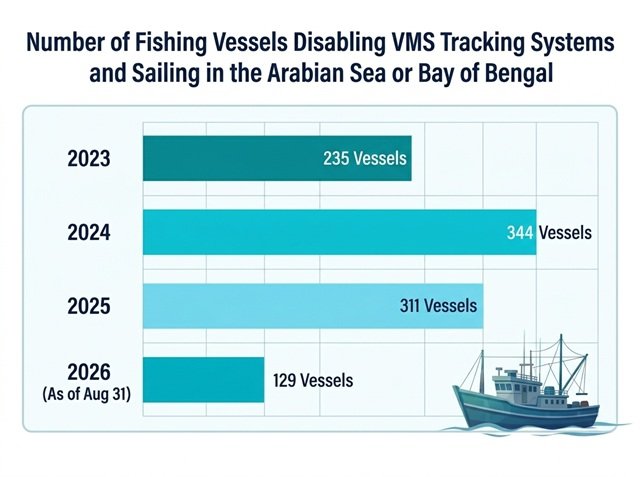
According to data released by the Department of Fisheries and Aquatic Resources under the Right to Information Act (letter RTI 2047/2026 dated 2026.11.19) regarding incidents of multi-day fishing vessels disabling their Vessel Monitoring Systems (VMS) and sailing in the Arabian Sea or the Bay of Bengal, 1,019 such incidents were reported from 2023 to August 31, 2026. Annually, that number is as follows:
- 2023: 235 vessels
- 2024: 344 vessels
- 2025: 311 vessels
- 2026 (up to August 31): 129 vessels
The Arabian Sea and the Bay of Bengal are considered major hubs of South Asian and Indian Ocean drug transit routes. Both international reports and local official documents indicate that drug consignments originating from drug production and transit networks centered in Afghanistan, Pakistan, and Iran are brought into these regions across international maritime borders via Mother Vessels and various other boats.
Furthermore, exchanges occurring via West and South Asian maritime routes through the Arabian Sea, as well as maritime routes operating around the Bay of Bengal, remain connected to drug distribution and transit networks across regional coastlines. During these deep-sea exchanges, traffickers operating by disabling tracking systems or sailing secretly has become a major challenge to maritime security and law enforcement; accordingly, a suspicion arises as to whether this dark reality is what is hidden within this data.
However, comparing this data with the drug seizures by the Police Narcotics Bureau reveals important information. While VMS disabling incidents rose to 344 in 2024, 867.51 kilograms of Methamphetamine (Ice) were seized in the country’s maritime zone in that same year. Similarly, against a backdrop of 311 VMS disabling incidents reported in 2025, 1,888.1 kilograms of Methamphetamine and 1,006.42 kilograms of Heroin were discovered in that year. The seizure of 919.682 kilograms of Heroin, 478.33 kilograms of Methamphetamine, and 256.2 kilograms of Cocaine within the first seven months of 2026 alone (up to July 31) shows that the deep-sea exchange process occurring along hidden routes is still active.
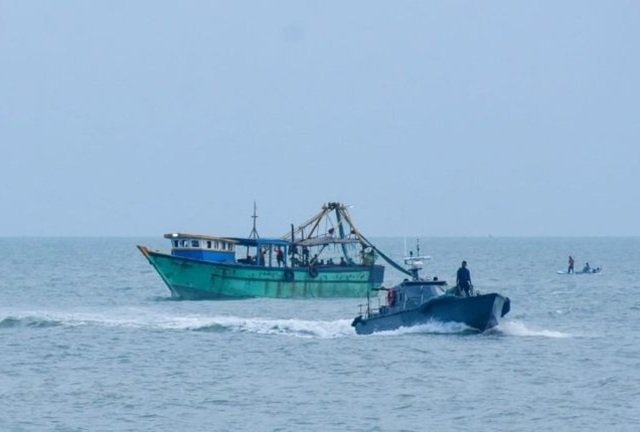
Information provided by the Coast Guard Department (letter CG/ADM/LS/09/2026 dated 2026.09.23) presents details of seven vessels seized between January 05 and June 17, 2026, clearly stating the technical tactics used by skippers to disable the systems. Incorrectly connecting wires to cause them to melt, removing the power supply “fuse” (referred to as “pause” in the documents), connecting two wires together to burn them out, and disabling both VMS and AIS systems are among those tactics. These vessels include multi-day vessels registered in Matara (MTR) and Galle (GLE), and several vessels were reported around the Mirissa fisheries harbor.
Discrepancies Among Institutional Data
When matching the reports received from these three institutions with each other, several statistical and administrative discrepancies emerge:
- Difference in the number of VMS actions: As shown in both letters dated 2026.10.27 from the Department of Fisheries (RTI 2029/2026 and RTI 2047/2026), regarding VMS disabling, there were 78 vessels whose voyages were temporarily suspended and 02 vessels against which legal action was taken in 2025, while up to September 2026, there were 22 vessels with suspended voyages and 07 vessels against which legal action was taken. However, it is noteworthy that while 129 vessels were reported sailing with VMS disabled in the first part of 2026 alone, legal action has been taken against only a very limited number of vessels.
- Discrepancy in data on foreign suspects: According to information provided by the Police Narcotics Bureau, in the table categorizing the nationalities of suspects arrested during the 2021–2026 period, when analyzing the data for suspects in 2022, it appears that apart from Sri Lankan suspects, the majority observed are Pakistani and Iranian nationals.
- Absence of past data: Although the Department of Fisheries reported 127 vessels in 2025 and 36 vessels up to September 2026 whose voyages were canceled on charges of fishing within the Exclusive Economic Zones (EEZ) of other countries, it has stated that data for the years from 2021 to 2024 is not included in the data system of that department’s investigation division.
Division of Powers and Legal Loopholes
The limitations of powers existing among state institutions in suppressing maritime crimes are also evident through these reports. The Department of Fisheries states that under the current provisions of the Fisheries Act, their department has no power to impose penalties or take any other legal action for drug trafficking or illegal maritime activities, and that legal matters related to those activities are carried out by the Ministry of Defense and the Narcotics Bureau.
On the other hand, the Coast Guard Department states that no raids were conducted regarding illegal fuel transport smuggling carried out by multi-day vessels from January 05 to August 31, 2026, and that their department does not conduct prosecutions. Instead, they have indicated that they hand over suspects and goods to the relevant institutions, and only provide testimony during the judicial process regarding the arrest and the Chain of Custody of the goods.
Meanwhile, according to data from the Police Narcotics Bureau, among the cases filed during the period from 2020 to 2026, the number of convicted persons is shown for the years 2020 (07), 2021 (06), 2022 (16), and 2023 (08), but data regarding the number of convicted persons for the cases filed in 2024, 2025, and 2026 (08, 11, and 09 respectively) has not been recorded. Furthermore, the Bureau has informed that information regarding the country’s major organized traffickers or networks cannot be provided under Section 05 of the Right to Information Act No. 12 of 2016.
Fuel Transfers and the Risk to the Maritime Economy
The Department of Fisheries’ response to RTI 2047/2026 (2026.10.27) states that no incidents of secretly selling diesel issued to multi-day fishing vessels at sea have been reported from January 2021 to August 31, 2026, and that the department does not possess a mechanism to investigate such matters. The lack of a formal investigative mechanism regarding operations occurring between multi-day vessels staying in the deep sea for days and foreign or suspicious vessels further expands the space available for illegal maritime activities.
Taken as a whole, what these official documents demonstrate is the urgent need for strict legal and technical measures to prevent the disabling of tracking technology (VMS/AIS), integrated data sharing between fisheries and security agencies, and the strengthening of investigative mechanisms in order to curb maritime drug trafficking.