Editorial
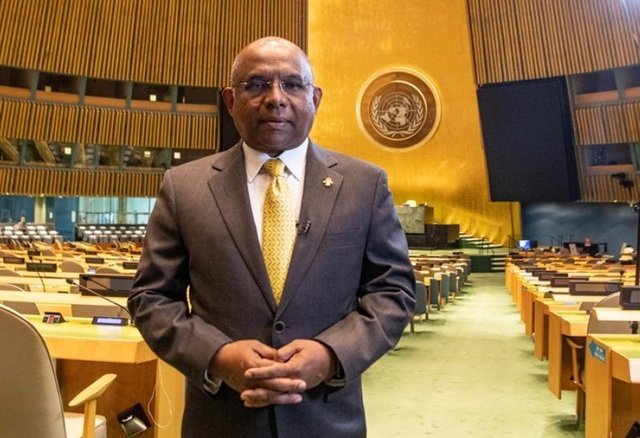
The arrest of Abdulla Shahid, former Foreign Minister of the Maldives and President of the 76th Session of the United Nations General Assembly, over allegations of sexually abusing a minor is a matter that demands serious public scrutiny. It is not an ordinary criminal investigation involving an obscure public figure. It concerns a man who occupied one of the most prominent diplomatic positions in the international system, represented his country on the world stage and presided over the deliberations of the UN General Assembly. The allegations against him are grave. They must be investigated thoroughly, without political interference, intimidation or preferential treatment.
Shahid was arrested on 2 November 2026 under a court warrant on suspicion of sexually abusing a person under the age of 18. The Maldives Police Service confirmed the arrest and said investigations were continuing. On 3 November, the Criminal Court ordered him to remain in custody for 30 days. His legal team subsequently appealed the arrest order to the High Court. The authorities have not publicly disclosed the detailed evidence or the full circumstances of the alleged offences.
The most disturbing reports circulating locally concern the alleged victim’s relationship to Shahid. Accounts suggesting that she was his stepdaughter, and that the alleged abuse extended over a prolonged period, require particular attention from investigators. However, neither the police nor the publicly available reporting has confirmed these specific details. They must not be presented as established facts. If the investigation substantiates repeated abuse of a child within a family or household, the case would involve an especially serious breach of trust. The authorities must establish the victim’s circumstances, examine the available evidence and ensure that the child’s safety is not compromised by the political and media attention surrounding the accused.
Shahid, as usual, has rejected the allegations, describing them as politically motivated attempts to destroy his reputation. His arrest has occurred while he was seeking the Maldivian Democratic Party’s nomination for the 2028 presidential election. That timing provides a political dimension to the case, but it does not provide an answer to the allegations. Political rivalry cannot establish guilt, just as an assertion of political victimisation cannot establish innocence. Attempts by political sympathisers to turn a criminal investigation into a contest between rival political camps would be equally irresponsible. The central issue is not which party benefits from Shahid’s downfall. It is whether a child was sexually abused and whether the available evidence establishes his responsibility.
There must be no political immunity for alleged crimes against children. A public figure cannot invoke decades of political service, diplomatic achievements or international recognition as a shield against criminal investigation. Nor should his former office make him a target of prejudgement. He is entitled to due process and a fair hearing. The alleged victim is equally entitled to protection, justice and a judicial process that does not subordinate her interests to the reputation of a politically influential man. If Shahid is found guilty, the punishment must reflect the seriousness of the offences established by the court. His status must neither mitigate accountability nor obstruct justice.
There is an additional dimension that makes this case particularly uncomfortable for the international community. Shahid served as President of the 76th Session of the United Nations General Assembly from 2021 to 2022, becoming the first Maldivian to occupy that position. He presided over an institution in which governments discuss international cooperation, human rights and the protection of vulnerable populations. The position did not make him the head of the United Nations, but it placed him among the organisation’s most prominent elected office-holders. His former international standing cannot be used to prejudge the case, but neither should it discourage scrutiny. International prestige is not a certificate of private conduct.
The Maldives must allow its investigators and courts to establish the facts without political pressure. The proceedings must be transparent to the extent permitted by the need to protect the child, and the alleged victim must not become the subject of public exposure, intimidation or political exploitation. If the allegations are proven, the conviction must carry consequences sufficient to demonstrate that neither political influence nor international stature places an individual beyond the reach of the law. If they are not proven, Shahid must receive the protection of the law. What cannot be accepted is a political settlement in place of a criminal investigation, or the use of political controversy to silence a child whose allegations deserve to be heard.