
Pakistan is in a state of poly-crises and is hardly managing them, or rather, crushing and diverting attention by playing survival geopolitics with slim substance. On the economic and security fronts, Pakistan is almost smoked. On the economic front, a high-risk cycle of structural stagnation and intense financial strain persists. The deep crisis is worsening as total debt remains at a historic high of nearly $290 billion (PKR 83.6 trillion), forcing the state to spend most of its tax revenue on debt servicing.
On the security front, the western front of Pakistan is almost collapsing due to continuous terror strikes by TTP and BLA. To top that, socio-political instability in Pakistan, especially at the western frontier, is deepening, as the provincial government (dominated by PTI-backed politicians) remains at odds with the federal government and the military establishment over local security policies. Public discontent is fuelling widespread civil protests against military operations.
The trade blockade and advancing militant capabilities, especially those of the TTP, are giving a major setback to the Pakistan military. Amid this crisis, General Asim Munir is busy with suppression and diversion tactics at home.
The General’s Playbook
Though coercion against civilian machinery is still the go-to option for every powerful Pakistani general, it carries a heavy price. Historical precedent shows that generals rose quickly but fell just as fast when the politico-security environment deteriorated and no longer supported them. Former military dictator Zia, who seized power in Pakistan through a coup in 1977, used severe Islamisation policies and martial law to crush political opposition and even designed a terror strategy to bleed India with a thousand cuts. He began to lose his iron grip on power by 1988, as the politico-security situation in Pakistan challenged his authority.
After lifting the martial law Zia had imposed, he appointed Muhammad Khan Junejo as Prime Minister, expecting a rubber-stamp executive. Instead, Junejo began asserting authority. The Junejo government even signed the Geneva Accords to support Soviet withdrawal from Afghanistan, but Zia severely opposed this move, as it bypassed his authority over Afghan affairs. He was actively seeking a Mujahideen government in Afghanistan, favouring the hardline Islamist commander Gulbuddin Hekmatyar over moderate Afghan factions, which ultimately failed. The situation further nosedived when a massive ammunition depot explosion in Rawalpindi killed hundreds of citizens. Junejo demanded a high-level public inquiry to ensure military accountability, infuriating the top brass in 1988, known as the Ojhri Camp disaster (a CIA-funded depot housing arms and ammunition supplied by the CIA to fund the Mujahideen under Operation Cyclone).
By May 1988, domestic pressure, especially from the civilian government, had increased. Zia used this diplomatic deadlock in the UN-brokered Geneva Accords to paint Junejo as weak, using it as a pretext to dismiss the civilian government in May 1988. Even on the security front, Zia’s regime was flanked by terror and gang wars. According to reports, the Soviet-backed Afghan intelligence agency (KHAD) and the Soviet WADP launched a destabilising campaign inside Pakistan to punish and deter Zia’s active involvement in Afghanistan. Gang wars, sectarian tensions and violence, and the Pakistan black market were aggressively active, causing internal security crises. The 1987 Karachi bombings killed over 70 people, shattering public confidence in military protection.
Amid this high-stakes tussle between the military and the civilian government and a deteriorating security situation in Pakistan, Zia explored rescue options to divert attention and stay afloat, using aggressive geopolitical grandstanding to seek legitimacy. He began with “cricket diplomacy” and brinkmanship with India. He staged a surprise visit to Jaipur to watch an India-Pakistan match, defusing a near-war border standoff while subtly projecting nuclear deterrence, which distracted domestic critics. He even utilised backchannel talks with India, displaying soft-power grandstanding while keeping up the ante with sharp, private nuclear warnings.
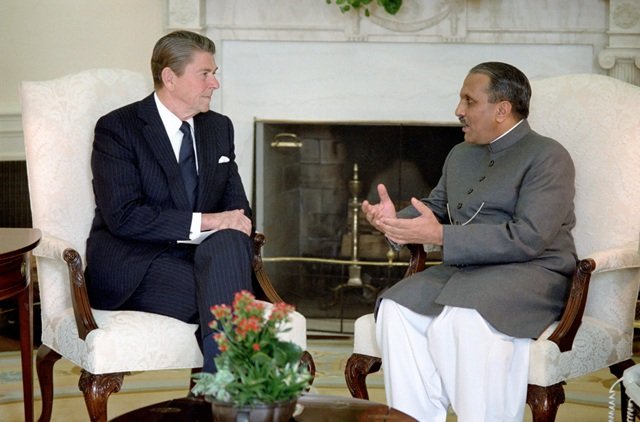
Apart from grandstanding tactics, Zia desperately tried to cultivate Islamic solidarity to keep hardline factions with him, bandwagoning around a post-Soviet vision in Afghanistan. He advocated installing a pliant, friendly Islamist government in Kabul and establishing a broader Islamic confederation extending into Central Asia. To further control waning legitimacy, he ramped up anti-India and nuclear rhetoric (Islamic bomb prestige). Zia even skilfully capitalised on U.S. President Ronald Reagan’s fierce anti-communist stance. By keeping the Afghan pipeline running, Zia ensured a steady influx of billions of dollars in economic and military aid. In externalising political survival, Zia played his cards on every front, from military to diplomatic.
However, all strategies and grandstanding failed, and ultimately Zia hit his lowest ebb after the Soviet withdrawal, when the Reagan administration no longer considered giving the Zia regime a blank cheque. The Ojhri Camp incident caused internal embarrassment in the military, and top corps began to view Zia’s personalised, erratic rule as a direct threat to the army’s institutional survival and reputation. The economy during the Zia regime, which was effectively built upon US aid and famously dubbed the “heroin and Kalashnikov” economy, gutted the country’s social fabric. Inflation soared, and ethnic riots in Karachi and Hyderabad became uncontrollable after the US halted covert aid to Pakistan in the post-Soviet scenario in Afghanistan. According to reports, Zia spent his final weeks desperately trying to re-inject religion into the political mainstream by decreeing the Shariat Ordinance. Still, the public widely dismissed it, the last blow to his desperate efforts to salvage his legitimacy.
Musharraf’s Gamble
Even Musharraf tried to follow Zia’s playbook of grandstanding and coercion when he was losing his iron grip on power after politico-security instability rocked Pakistan, especially in the post-9/11 scenario, the Lal Masjid siege in 2007, and the military raid (Operation Silence) that killed over 100 people, including radical cleric Abdul Rashid Ghazi. The storming of Lal Masjid acted as a major catalyst for religious extremists. Militant groups unified to form the Tehrik-i-Taliban Pakistan (TTP), which led to a series of bombings targeting Pakistani security forces, military facilities, and hotels, making 2007–2008 the bloodiest period in the nation’s history. The situation further complicated when the Baloch insurgency began picking up momentum. Even on the political front, the situation for Musharraf appeared grim, with the lawyers’ movement triggered by Musharraf’s move to suspend the then Chief Justice of Pakistan, staging a massive, historic pro-democracy agitation that united lawyers, civil society, and opposition parties against military rule. In a desperate move to protect his legitimacy and power, Musharraf enacted a state of emergency.
On November 3, 2007, he declared a state of emergency, suspended the constitution, jailed top judges, blacked out independent media channels, and arrested thousands of political activists. Under intense international pressure, especially from the US, to restore democracy and civilian government, Prime Minister Benazir Bhutto returned to lead the PPP in November, but in December 2007, Bhutto was assassinated in a suicide gun-and-bomb attack at a political rally in Rawalpindi. The inquiry into the assassination, according to reports, suggested that Musharraf was responsible for the assassination by withdrawing Bhutto’s security despite threats from Al-Qaeda.

Facing intense domestic pressure, Musharraf stepped down as Chief of Army Staff in late November 2007. By February 2008, Musharraf’s proxy political party was defeated when fresh elections were called, and Nawaz Sharif’s PML-N formed a coalition government determined to oust him.
Interestingly, before facing the final blow to his power in the February 2008 elections, Musharraf tried geopolitical grandstanding tactics or the symbolic exercise of visiting four European nations after Bhutto’s assassination. Many analysts viewed this trip as a desperate attempt to convince the West that he was still in control. Musharraf even tried to convince Washington through its terror narrative that if he were removed, nuclear weapons would fall into the hands of terrorist organisations. This was an attempt to secure US support and a geopolitical bargaining chip to seek legitimacy and externalise political survival, as Zia did. However, by August 2008, he was charged with multiple serious offences, including treason, and the Sharif government moved a motion to impeach him. Facing impending impeachment, Musharraf resigned as President of Pakistan, with the military under General Kayani making clear that the Pakistan military would not intervene to protect its former chief.
Munir’s Fate
A similar situation, as history has shown, may be slowly unfolding for Asim Munir. He has been flanked by security crises (insurgency in the East) and an economy in shambles. The survival strategy, like every general’s, has been grandstanding diplomacy to divert attention, a madman’s approach, and domestic power consolidation. Munir, too, is gradually embarking on this survival strategy through propaganda in the Middle East, first through a mediator drama and now through symbolic pacts with temporary value (ensuring economic survivability), much like Zia relied on the US during the Cold War days. After grandstanding geopolitics to ensure survivability, Munir has also used a coercion-like, ordinary general’s playbook to consolidate more power (the 27th Amendment passed last year).
However, with security and the economy in a deteriorating state, the political situation has gradually begun to show currents that may move against Munir. The Supreme Court of Pakistan’s order to shift former Pakistan Prime Minister Imran Khan, Munir’s arch-rival, and the recent statement by the US Ambassador to India, Sergio Gor, travelling to J&K and affirming that J&K is an internal part of India, further give an impression of classic temporariness and limited strategic relevance of Pakistan in US-Pak relations.
If this political situation develops further and the current flow picks up pace in favour of Imran Khan in the coming time, then the trio of crises (political, economic, and security) that have been responsible for sending every general into a nosedive will gradually start haunting Asim Munir.