


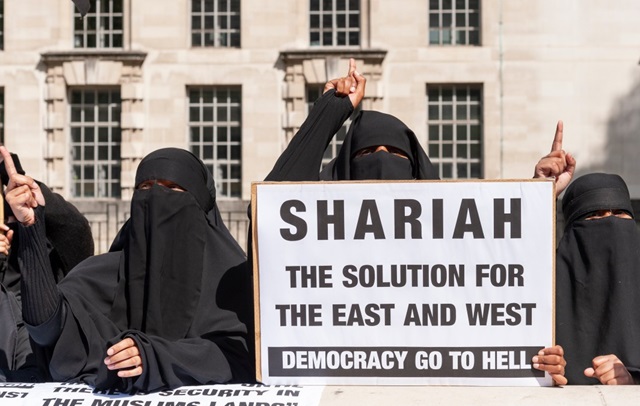
Britain has become the “western capital” for sharia courts, with a growing number of these courts issuing religious rulings on marriage and family matters. According to a recent investigation by The Times, the number of sharia councils in the UK has surged to 85 since the first one was established in 1982. These councils have become key bodies for Muslim communities, issuing rulings that are often informal and based on Islamic jurisprudence, which is grounded in the teachings and opinions of jurists from the classical period of Islam.
One of the key revelations from The Times report is the ease with which men can end their marriages under sharia law. In certain cases, men can divorce their wives simply by saying the word “divorce” three times, a practice that has raised concerns about gender inequality. Furthermore, the investigation uncovered that polygamy is so ingrained in some sections of British society that a Muslim app, designed for creating Islamic wills, features a drop-down menu allowing men to select how many wives they have, ranging from one to four. This app, which is approved by a sharia court, also includes provisions where daughters inherit half as much as sons, reflecting the classical interpretations of sharia law.
The Times report notes that many Muslims in the UK, as well as from Europe and North America, are increasingly turning to Britain’s sharia courts. These courts deal primarily with Islamic marriages, many of which are not officially registered with civil authorities. It is estimated that around 100,000 Islamic marriages have taken place in Britain, with many of them not recognized by the state.
Sharia law, as defined in an official review by Professor Mona Siddiqui, is a set of legal principles rooted in the teachings of early Islamic jurists, dating back to the time of the Prophet Muhammad in the 7th century. While sharia has been adapted over time in many Muslim-majority countries, in the UK, many of these courts still adhere to classical rulings, especially when it comes to matters like marriage and divorce.
In some of the more prominent sharia courts, such as those founded by radical preacher Haitham al-Haddad, the interpretation of Islamic law has been controversial. Al-Haddad has been criticized for his misogynistic views, particularly regarding marriage and the treatment of women. In one infamous statement from 2009, he suggested that men should not be questioned about hitting their wives, framing it as a private matter between the couple. This view, which has been condemned by figures such as Dame Sara Khan, the former counter-extremism tsar, reflects broader concerns about the potential abuse of religious texts to control women.
Women who seek help from sharia courts have reported feeling pressured and manipulated by religious authorities. They described how certain male figures within these courts exploit religious teachings to justify actions like denying women their rights within marriage, including insisting that wives must always agree to sexual relations. There have even been instances where women have been advised to enter into temporary “pleasure marriages,” a controversial practice that allows couples to have sexual relations without any long-term commitment.
Baroness Cox, a member of the House of Lords, has long campaigned for stronger protections for women who face discrimination under sharia law. She has attempted to introduce a private member’s bill to address the rapidly expanding influence of sharia councils and their potential to perpetuate religiously sanctioned gender inequality. Meanwhile, former Prime Minister Theresa May commissioned an independent review into the role of sharia courts in the UK. The review, led by Professor Siddiqui, proposed the establishment of a government regulator to enforce a code of practice for the councils. However, the Conservative government rejected this recommendation, asserting that sharia law has no jurisdiction in the UK and that regulation could inadvertently suggest that these courts offer an alternative to British law.
The debate surrounding sharia courts in Britain continues to divide opinions. On one hand, critics argue that these councils represent a dangerous step toward a parallel legal system that undermines the principle of equal justice for all. Stephen Evans, chief executive of the National Secular Society, warned that allowing these councils to operate unchecked could negatively impact the rights of women and children. He emphasized that sharia courts exist primarily because Muslim women need them to obtain religious divorces, while Muslim men can unilaterally divorce their wives.
On the other hand, some organizations are taking steps to improve the standards within Britain’s sharia councils. The Muslim Women’s Network charity plans to introduce a new code of conduct for sharia councils in 2025, based on research by academic Rajnaara Akhtar. The proposed code would aim to ensure that these councils operate transparently, respect the Equality Act, and provide clear guidelines on their costs and procedures. However, it remains to be seen whether these reforms will be effective in addressing the inherent inequalities that many women face when seeking religious rulings.
A government spokesperson reiterated that sharia law does not form part of the legal framework in England and Wales. The spokesperson emphasized the importance of legally recognized marriages in ensuring the protection and security of couples in the UK, pointing out that their manifesto includes plans to strengthen the rights of couples who cohabit without formal marriage.









