
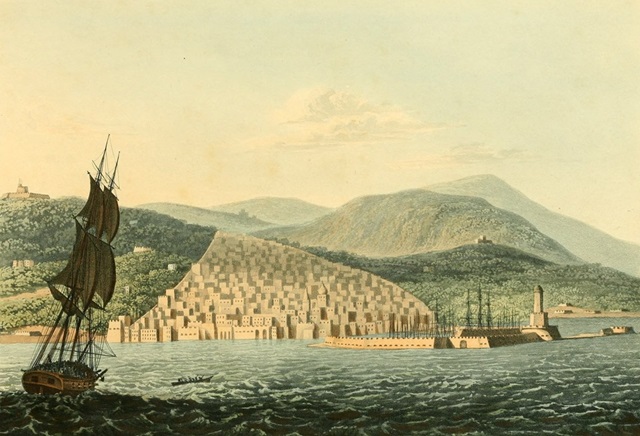
The following excerpts are adapted from the author’s book The Kings of Algiers: How Two Jewish Families Shaped the Mediterranean World During the Napoleonic Wars and Beyond, published by Princeton University Press.
The Revolutionary and Napoleonic Wars in the Mediterranean provided the setting and circumstances that allowed for the extraordinary rise and success of the Bacris. Very much at home in their world, they were able to take full advantage of the possibilities that the war offered them. As Jews in Algiers, they could be close to the center of power. They could draw on the nature of power relations in the regency to their advantage, establishing personal and business relations with the regency’s elite. Their skills and methods—already established—lent themselves to the circumstances of the war: the dire need for raw materials and the intense contest to obtain them. They were perfectly placed to profit from the shipping chaos that the Revolutionary War brought to the Mediterranean in the form of blockades, battles, and the reinvigoration of corsairing. It was the war that allowed them to rise to unprecedented heights. It was the war, too, that set the stage for the way they were understood, as inordinately powerful.
In 1793 the Revolutionary War came to the Mediterranean. France declared war against Britain and the Netherlands on February 1 of that year and soon afterwards against Spain. Britain entered the Mediterranean, and the sea became a major theater of war. Britain put in place a close blockade of France’s Mediterranean coast, and there was fighting in the Western Mediterranean and the Ligurian Sea near Corsica, between French and British naval forces, the latter supported by the navies of Spain and several Italian states. While the British had no colonies or naval bases in the Mediterranean, except for Gibraltar and Mahon, they did have significant trade interests there. As well as maintaining the blockade, Britain sought to protect their trade routes. Warships or small squadrons were sent to accompany merchantmen, and these would clash with corsairs. Trade and communications ran the gauntlet of conflict and criminality. In the absence of reliable shipping, demand for supplies increased, as not just populations, but forces in foreign lands, needed feeding. The increasing demand and shipping chaos offered an unprecedented opportunity to the enterprising trader. Into this chaos came the Bacris.
The origins of the Bacri family are unclear. They spoke Judeo-Arabic—the dialect of the so-called Arab Jews—a Jewish language whose base language is Arabic, with Hebrew and Aramaic content, written in Hebrew characters. But some of the Jews who had settled in the Maghreb after fleeing Spain adopted Judeo-Arabic over time. It is uncertain which language the Bacris used to communicate with foreign consuls, although we know that they had French. Whatever their beginnings, by the time this story begins, the Bacri and Busnach families had become Livornese, because their ancestors had taken advantage of a trade opportunity. In 1591, Ferdinand I, the grand duke of Tuscany, delivered the Livornina (an expanded version was issued two years later, in 1593). Wishing to develop his port of Livorno, Ferdinand invited Jews, Turks, and Muslims to settle there, in the hope that they would establish trading businesses. In order to make the invitation attractive, Ferdinand promised that those Jews who settled in Livorno would be protected from the papal inquisitors, still active in Italy. Unsurprisingly, many Jews, and particularly recent refugees fleeing the Inquisition, took up this invitation. So, too, did long-established families of Jews from the Maghreb. They came to a “bustling free port” on Italy’s northwest coast, and Tuscany’s main commercial center. In the mid-eighteenth century, the city was also home to the second-largest Jewish community in Western Europe, after Amsterdam, and the largest in the Mediterranean. It was a diverse and thriving trade hub, at the heart of the celebrated trading networks built by Jews from the Iberian Peninsula, seeking places of refuge from the inquisitorial powers. It was probably the most important port in the Mediterranean, until it was eclipsed by Marseilles in the eighteenth century.
By the time Livorno entered its decline, the Bacris and Busnachs had either returned to or settled in the port of Algiers to take advantage of the burgeoning trade relationship between the regency and France. In 1716, a Jacob Coen Bacri was newly arrived and busy in the port of Algiers, receiving a consignment of precious stones from Tunis. In 1721 a Busnach, also named Naphtali, moved from Livorno to Mahon, a British naval base on the island of Minorca, in the Western Mediterranean. By 1723, he was established, or reestablished in Algiers, shipping various goods. The Arab version of his name—Boudjenah—means “he who has wings,” and this was certainly appropriate, given this Naphtali’s business acumen. Already wealthy, Naphtali quickly planted roots in Algiers and, in 1724, the shipping registers find him sending ribbons, paper, and mirrors to Tetouan in Morocco, as well as cargoes to Livorno and, in 1728, wheat to Marseilles. In Algiers, he was buying Christians out of slavery, to sell them back to their home states. In 1726, he shipped a cargo of wool and elephant tusks to a client in Livorno, on a ship that was rather incongruously named the Jesus Mary Joseph. Naphtali Busnach was indeed making himself comfortable in a diverse world. A year later another Busnach—Abraham—followed his relative to Algiers and joined him in import and export, as well as the ransoming of Christian captives. By the late eighteenth century, the two families had joined, through the marriage to a Busnach of a Bacri sister. They became one extended family: the Bacris.
The five Bacri brothers—Mordecai, Joseph, Abraham, Salomon, and Jacob—worked in loose concert, through their trading house. The business had its headquarters in Algiers, but members of the family also set up office in Livorno, Marseilles and Paris. Joseph, the eldest Bacri brother, stayed in Algiers to run things there, together with his brother Mordecai, and his handsome, talented son David. It is not possible to know whether they truly worked in partnership. Abraham never joined the company formed by the brothers and seems to have worked behind the scenes.
Salomon was perhaps the most successful of the brothers. He had left Algiers around 1787 to settle in Livorno, and he ran a branch of the family business there, receiving goods and moving them on, insuring cargoes, and acting as banker when needed. Salomon implanted himself in the Livorno community and became a respected member of its elite. Jacob, the youngest brother, was sent to Marseilles, to try to persuade the French regime to pay for the wheat that the Bacris had been supplying on credit to revolutionary—and cash-strapped—France. When Jacob found himself deep in debt, it was to Livorno and the brother he called Shlomo that he went, to beg for a loan. Jacob’s correspondence, some five hundred letters preserved in the departmental archives in Marseilles, gives an insight into the minutiae of the family business, and of the dynamic (if not the actual business arrangement) between the brothers. His older siblings clearly did not trust Jacob: Joseph formally dissociated himself from him, and Salomon bailed him out a first, but not a second time. When Jacob found himself in terrible financial trouble, his brothers left him to cope on his own. Jacob was to have his revenge.