Leaked military documents obtained by the Financial Times have revealed alarming details about Russia’s military preparations for potential strikes on Japan and South Korea. The documents, dated between 2013 and 2014, outline specific targets for airstrikes, including nuclear power stations and other critical civilian infrastructure, in the event of a conflict. These plans, designed to neutralize critical infrastructure and military capabilities, highlight Moscow’s heightened concerns over its eastern flank, particularly in the context of rising tensions with NATO and the United States.
The leaked files, spanning a total of 29 secret Russian military documents, include a comprehensive list of 160 targets across Japan and South Korea. Among the prioritized sites are vital energy infrastructure, such as nuclear power plants in Japan and chemical factories in South Korea, along with military installations like radar bases, airfields, and naval bases. The documents suggest that Russia considered infrastructure strikes not only to weaken military capabilities but to disrupt the functioning of these nations in a time of war.
The files also shed light on the strategic reasoning behind Russia’s military posture in the region. Russia has long perceived its eastern borders as vulnerable to potential attacks from NATO forces or their regional allies, particularly if the West were to engage Russia in a broader European conflict. Experts have warned that in the event of an escalation in Europe, Russia could be forced to retaliate against U.S. military presence in Japan and South Korea, thus pulling these nations into a larger geopolitical conflict.
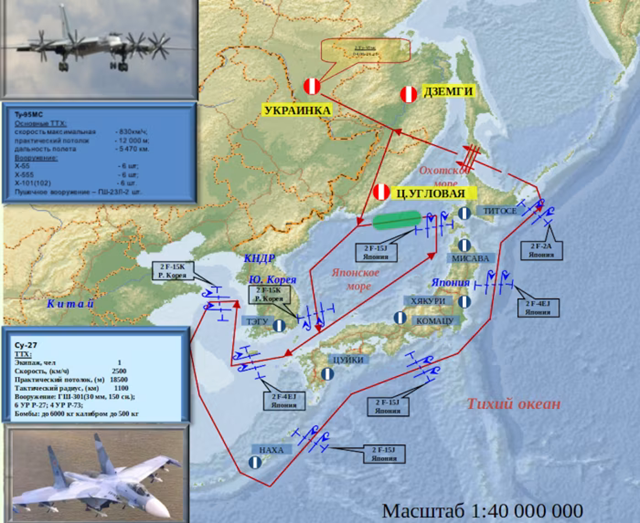
The documents underscore Russia’s reliance on its Kh-101 non-nuclear cruise missiles, which were proposed as the primary weapon for delivering these strikes. A presentation slide from the files details a hypothetical strike on Okushiritou, a Japanese radar base, with an estimated 85% probability of success if 12 Kh-101 missiles were launched from a single Tu-160 bomber. However, experts have since raised doubts about the missile’s effectiveness, citing performance issues with its stealth and accuracy, which were later observed during Russia’s invasion of Ukraine.
The revelations also offer insight into Russia’s ongoing military activities in the region. The documents describe an operation in February 2014 where Russian Tu-95 bombers tested the air defenses of Japan and South Korea. This mission coincided with Russia’s annexation of Crimea and joint U.S.-South Korean military exercises, reflecting Moscow’s constant efforts to probe the capabilities of its neighbors.
Further analysis of the leaked files indicates a meticulous approach in selecting and evaluating targets. For instance, two South Korean command-and-control bunkers are assessed for the necessary force to breach their defenses, and photographs of buildings at key targets, such as Okushiritou, were included in the briefing. These details underscore the level of planning and precision involved in Russia’s military strategy for potential operations in the region.
The leaked documents also provide a rare glimpse into Russia’s broader strategic thinking, including its nuclear weapons policy and war-gaming scenarios for potential conflicts with China and NATO. As Russia’s military continues to evolve, these plans highlight the country’s ongoing focus on both European and Asian theaters of war.
For Japan, the documents reveal a troubling scenario: conflict could spread from Europe to the Asia-Pacific region, in a phenomenon referred to as “horizontal escalation.” Michito Tsuruoka, an expert on Japanese defense strategy, noted that Japan’s military preparedness for such a conflict would be significantly constrained by the shorter warning times and fewer available options to prevent a conflict stemming from Russia’s actions in Europe.
The diplomatic context also remains tense. Despite ongoing negotiations with Russia over territorial disputes, including the Kuril Islands, Russia’s military strategy paints a grim picture for Japan. Former President Dmitry Medvedev’s dismissive comments about the Kuril Islands dispute add a layer of complexity to these military revelations.
As geopolitical tensions continue to rise, these documents serve as a stark reminder of the interconnectedness of global military threats. William Alberque, a former NATO arms control official, emphasized the linkage between conflicts in Europe and Asia, warning that neither theater of war is isolated. “Asia cannot sit out conflict in Europe, nor can Europe sit idly by if war breaks out in Asia,” Alberque stated, underlining the escalating risks for global security.