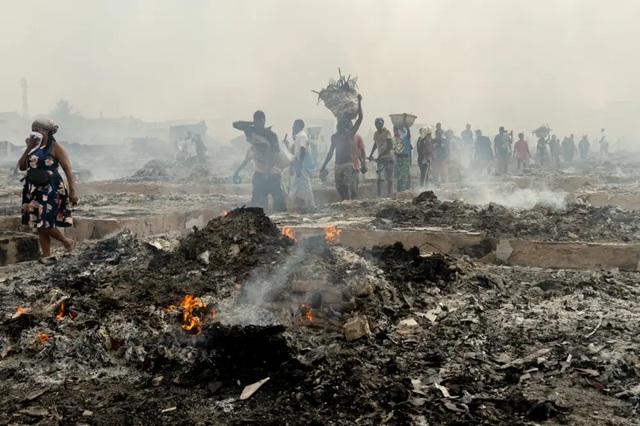
A catastrophic fire tore through Kantamanto Market in Accra, Ghana, one of the largest secondhand clothing markets in the world. The fire, which began on Thursday, decimated up to two-thirds of the market, displacing thousands of traders and destroying livelihoods.
Kantamanto Market, a bustling hub for the global secondhand clothing trade, employs around 30,000 people and handles 15 million garments weekly. These items, often originating from wealthier nations such as the United States, the United Kingdom, and China, provide a lifeline for many Ghanaians through resale, repair, and remanufacturing.
The Ghana National Fire Service reported that the fire had been fully extinguished with no injuries or fatalities, though the exact cause of the blaze remains under investigation. Initial reports indicate extensive damage to vendor stalls, leaving countless traders without their primary source of income.
Clean-up efforts are currently underway, but the road to recovery will be long and arduous. The destruction highlights the precarious nature of informal economies and the urgent need for global intervention.
Kantamanto Market plays a crucial role in the global fashion ecosystem. Every week, millions of garments that might otherwise end up in landfills are resold or repurposed here. However, the market has also become a dumping ground for the fast fashion industry’s excesses. According to The Or Foundation, a Ghanaian nonprofit, about 40% of the clothing that arrives at the market remains unsold, contributing to mounting textile waste that clogs waterways, landfills, and beaches.
This tragedy underscores the global fashion industry’s reliance on secondhand markets to manage its waste and the lack of sustainable solutions for textile disposal.
The Or Foundation, a nonprofit organization dedicated to supporting Kantamanto workers, has stepped forward with a $1 million commitment toward relief efforts. They have also launched a fund to provide financial assistance to vendors and rebuild the market.
“This is a critical moment for the global fashion ecosystem to show solidarity, not just by recognizing the value of secondhand markets, but by providing tangible help to rebuild and sustain them,” said Daniel Mawuli Quist, the foundation’s creative director.
Advocacy groups are urging the global fashion industry to take responsibility, not only for immediate relief but also for creating sustainable practices to address textile waste.
Kantamanto Market is more than just a trading hub—it is a cultural and economic cornerstone of Ghana. Originating in the 1960s, the market grew alongside the global secondhand clothing trade. Over the decades, it has evolved into a thriving ecosystem where traders, tailors, and artisans create value from discarded clothing.