


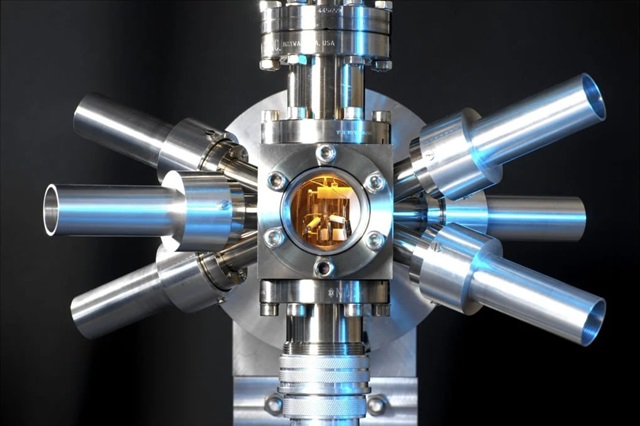
Chinese scientists have made a groundbreaking achievement in timekeeping with the development of cesium-based atomic clocks that boast extraordinary precision. These clocks, which measure just 1.5 meters in height and resemble the size of a small refrigerator, are capable of maintaining an error margin of only 0.2 quadrillion seconds, even after enduring harsh conditions like bumpy roads and long-distance transport. This level of accuracy, once believed to be attainable only by large, stationary atomic clocks in secure laboratories, marks a significant advancement in the field of timekeeping. The implications of this technology are profound, particularly for military applications.
The NIM-TF3 atomic clock, created by the National Institute of Metrology of China, is designed to operate autonomously for extended periods, eliminating the need for specialist maintenance. This autonomy and portability make it a highly valuable asset for military operations, where precision timing is essential. For example, the clock’s ability to synchronize radars across vast distances is crucial for tracking stealth fighters, providing an edge in detecting and responding to high-tech military threats. This synchronization could be a game-changer, allowing for coordinated radar systems that operate seamlessly, even when separated by thousands of miles.
Beyond radar systems, the atomic clock has the potential to revolutionize other aspects of military technology. In electronic warfare, the enhanced precision of the clock could improve the quality of signals, making them more resilient to interference and improving communication reliability in hostile environments. Furthermore, the clock’s exceptional accuracy plays a pivotal role in enabling real-time transmission of vast amounts of data, enhancing the efficiency of military networks and operations.
This level of precision also opens doors to futuristic military concepts that were once confined to science fiction. For example, the atomic clock could allow different combat platforms to combine lasers or microwaves emitted from various sources into a single, highly concentrated beam, capable of delivering immense destructive power. Such applications could transform the nature of warfare, making these new technologies central to high-tech confrontations in the coming decades.
The development of these cesium-based clocks builds on decades of progress in atomic timekeeping. Atomic clocks, first developed in the mid-20th century, have become essential tools for a variety of scientific and commercial purposes, from GPS navigation to telecommunications. However, the advancement of portable and highly accurate atomic clocks represents a new frontier in their use, one that could fundamentally change military strategies and capabilities. As these clocks continue to evolve, their impact on both military and civilian sectors is likely to grow, reshaping how we think about time, precision, and technological warfare.











