As Orthodox Christmas approaches, crosses and religious icons bearing the initials of President Vladimir Putin are being sent to Russian commanders on the front lines in Ukraine. These gifts were recently blessed by Patriarch Kirill, the head of the Russian Orthodox Church and a staunch ally of the Kremlin, in a ceremony held in Moscow. During the event, Putin expressed his belief that Russian troops would be honored to receive these “symbols of faith,” further solidifying the Russian leader’s close ties with the Church, which has supported his policies in the ongoing war.
In a continuation of this religious-political alliance, Putin had also previously approved the distribution of religious icons depicting images of himself to Russian soldiers during Orthodox Easter in 2023, according to reports. Despite the ongoing conflict in Ukraine, which has led to the destruction of hundreds of Orthodox churches and a deep divide among the faithful, Putin has continued to portray Russia as a defender of Christian values in the face of Western opposition.
Patriarch Kirill, a vocal supporter of the war, delivered a sermon during the Christmas service in which he lashed out at the West, accusing it of trying to “smother” Russia. He claimed that the West hated Russia because of its commitment to an “alternative path of civilized development,” one that Kirill framed as aligned with Orthodox Christian teachings. The Patriarch has been outspoken in his condemnation of the West’s “satanic” policies, particularly regarding LGBT rights, which he sees as a threat to Russia’s traditional values.
While Russian Orthodox Christians celebrate Christmas on January 7, Ukraine’s Orthodox Church made the significant decision to move its official Christmas celebration to December 25 in 2023, distancing itself further from Moscow’s influence.
Putin, who has long claimed a strong Christian faith despite his background as a former KGB officer in the atheistic Soviet Union, has increasingly aligned himself with the Russian Orthodox Church throughout his time in power. Kirill has previously referred to Putin’s rule as a “miracle of God,” framing his leadership as part of Russia’s divine destiny.
However, the Church’s support for the war has not been universal. Some Russian Orthodox clergy have openly opposed the conflict, with hundreds of priests signing letters against the invasion. Others have faced punishment, with some barred from conducting services after refusing to pray for a Russian victory. In contrast, many clergy have fled Russia, citing the militarization of the Church under Putin’s regime.
The situation also highlights a complex and often contradictory picture of Russia’s Christian identity. While Putin has framed the war as a righteous defense against the West’s “neo-liberal ideologies,” his leadership has also seen the recruitment of convicted criminals, including serial killers and rapists, to fight on the front lines in Ukraine. Despite this, Putin’s administration continues to project an image of Russia as a stronghold for Christian values, even as the conflict rages on.
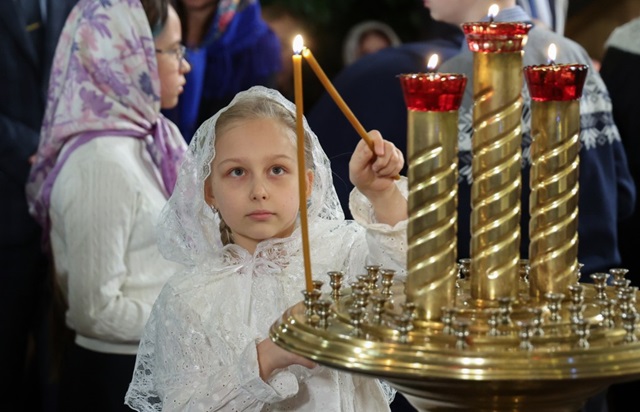
Meanwhile, a Christmas service was held at the Main Cathedral of the Russian Armed Forces, a striking structure adorned with mosaics commemorating various military campaigns. The cathedral’s stained-glass windows are decorated with Soviet symbols, and the steps are made from melted-down Nazi tanks—symbols of Russia’s military might intertwined with its religious identity.
While some Russian Orthodox believers continue to support the war, others are disillusioned by the Church’s support for the conflict. One exiled priest, who spoke on condition of anonymity, expressed deep sorrow over the militarization of the Church, saying, “I feel bitterness and shame. It’s difficult to believe that this is really happening.”
This complex intersection of faith, politics, and war underscores the ongoing tension within Russia’s religious community, as the government continues to use the Russian Orthodox Church to bolster its ideological position in the war in Ukraine.
Report taken from The Times, UK