Jimmy Carter’s lifelong commitment to improving U.S.-Cuba relations has come into sharp focus with the recent publication of a 2004 interview by the National Security Archive. In the interview, released alongside declassified documents from his presidency, Carter reflected on his efforts to normalize ties with Cuba during and after his time in the White House. Describing the U.S. trade embargo and travel restrictions as “unconscionable” and “a deprivation of American civil liberties,” Carter argued that open trade, commerce, and diplomacy were the best ways to influence change in Cuba. His stance, expressed with characteristic candor, underscored his decades-long belief in engagement over isolation as a strategy for fostering reform.
The interview reveals how, within weeks of taking office in 1977, Carter directed his national security team to pursue normalization with Cuba through confidential negotiations. This marked the first time a sitting U.S. president had formally sought rapprochement with Fidel Castro’s revolutionary government. Declassified White House documents detail the complexities of these efforts, including Carter’s reasoning that normalized relations would reduce Cuban dependence on the Soviet Union, curtail its military ventures abroad, and open a “natural market” for U.S. trade. Initial progress included lifting U.S. travel restrictions and establishing Interest Sections in Washington and Havana, but talks stalled over Cuban military involvement in Africa and Castro’s insistence that the embargo be lifted.
Frustrated by the impasse, Carter took bold steps, such as dispatching Coca-Cola CEO Paul Austin as a personal envoy to meet Castro. This initiative initiated a series of secret negotiations, stretching from 1978 to 1980, involving U.S. officials, Cuban representatives, and eventually Castro himself. Although the dialogue yielded some breakthroughs, including prisoner exchanges, major obstacles like the U.S. embargo and Cuba’s foreign policy persisted. The negotiations ultimately reached a dead end as Carter’s presidency gave way to Ronald Reagan’s hardline approach.
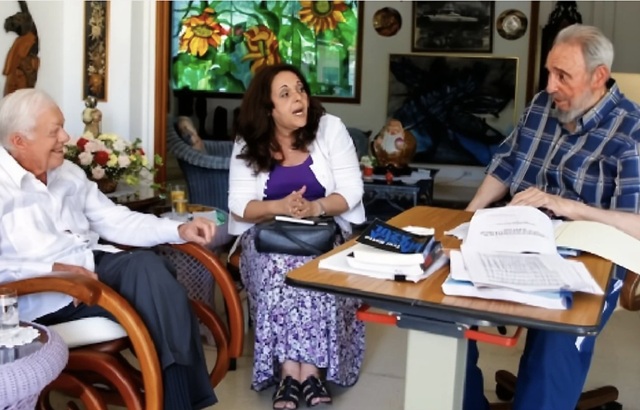
Carter’s post-presidency diplomacy with Cuba reflected his enduring dedication to the issue. He played a pivotal role during the 1994 balsero crisis, acting as a secret intermediary between Washington and Havana, though his efforts were cut short by the Clinton administration. In 2002, Carter became the first U.S. president—sitting or former—to visit Cuba since the revolution, delivering a nationally televised speech on human rights and democracy. He praised Castro for allowing open access to his remarks, which were widely distributed among the Cuban public. Carter’s 2011 visit to Cuba focused on securing the release of imprisoned USAID subcontractor Alan Gross while reiterating his call for the U.S. to lift the embargo, which he labeled a “serious mistake.”
As the Biden administration signals a shift in U.S.-Cuba relations, Carter’s legacy in this realm feels especially resonant. Recent announcements removing Cuba from the list of state sponsors of terrorism and lifting Trump-era sanctions echo Carter’s belief in engagement. The Senate’s upcoming confirmation hearings for Secretary of State nominee Marco Rubio, a staunch proponent of maximum pressure on Cuba, highlight the ongoing debate over the efficacy of Carter’s vision.
For Carter, who once remarked that he wished to see U.S.-Cuba relations normalized before his death, this enduring issue defined his presidency and much of his later life. His dream of rapprochement, as revealed in this newly published interview, remains a powerful reminder of his commitment to diplomacy, dialogue, and human rights.