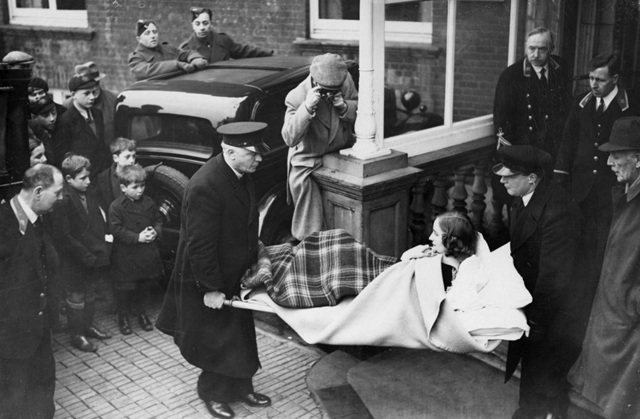
Unity Mitford, the British debutante who became infamous for her infatuation with Adolf Hitler, has left behind a chilling and revealing account of her time within the Nazi regime, now brought to light after 85 years. The diaries, which were discovered and authenticated by biographer David Pryce-Jones and reported by The Times, provide a detailed look at Mitford’s obsession with Hitler and offer disturbing insights into her antisemitism and eventual despair as war loomed.
The diaries reveal how Mitford, who spent over four years in Germany, pursued Hitler from 1935 until the outbreak of World War II in 1939. They paint a picture of an obsessive young woman, determined to gain the Führer’s attention. On February 9, 1935, she described the day she first caught his eye at his favorite Munich restaurant as “THE MOST WONDERFUL DAY OF MY LIFE.” Over time, their encounters became more intimate, with Mitford recording moments where Hitler paid her particular attention, such as the Führer kissing her hand multiple times during a tea. Though their relationship was never explicitly romantic, there is speculation about the closeness of their bond, and some suggest there may have been more to their connection than Mitford’s restrained descriptions.
However, the diaries not only shed light on her personal life but also serve as a window into her disturbing ideology. As The Times reports, Mitford’s diaries reveal her deep antisemitism, which became increasingly evident as the years passed. She mentions visiting the Dachau concentration camp, where she made crude jokes about Jews, and documents her shocking views about Jews, whom she referred to as “untermensch” (subhuman). The diaries also reveal her interactions with Nazi officials and her casual discussions about violence towards Jews, including a chilling entry in which she purchases a “life preserver” for the express purpose of killing Jews.
Despite the chilling nature of her writings, the diaries also reveal a more personal side of Mitford’s character, including her isolation and loneliness as she became more detached from the Nazi inner circle. Her infatuation with Hitler, which had initially earned her a place in his orbit, ultimately led to her downfall. As The Times reports, after Britain declared war on Germany, Mitford attempted suicide, though she survived and was transported back to Britain, where she would live out her final years until her death in 1948.
While Mitford’s diaries reveal the complex and often disturbing nature of her relationship with Hitler, they also serve as a stark reminder of the destructive power of ideology and obsession. Historian Guy Walters, who commented on the discovery, stated, “This is undoubtedly a great find, as any first-hand account written by someone who knew Hitler is historically important.” However, he also emphasized that the diaries show just how far Mitford’s infatuation with the dictator went, surpassing what many might have expected.