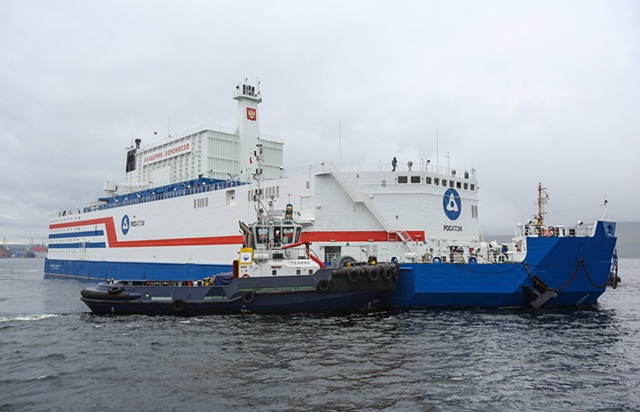
The Akademik Lomonosov, the world’s only operational floating nuclear power plant, has reached a significant milestone by generating over one billion kilowatt-hours (kWh) of electricity, according to Russian state nuclear corporation Rosatom. This achievement marks a major step for the plant, which is based in the Chukotka Autonomous Area of the Russian Far East, and underscores its critical role in powering the remote Arctic and Far East regions.
Rosatom highlighted that the one billion kWh generated by the floating plant is enough energy to “make a double espresso for everyone on earth,” demonstrating its immense power output. The Akademik Lomonosov now provides more than 60% of the region’s energy needs, helping to support local industries and communities.
Launched in 2020, the Akademik Lomonosov is an innovative piece of technology based on Russian nuclear icebreaker designs and powered by low-enriched uranium. The plant is equipped with two reactors, each producing 35 megawatts of electricity, which combine to support energy demands in large, remote industrial sites, including a local copper and gold mine, as well as desalinate water for the region. The plant’s capacity is enough to supply electricity to approximately 100,000 people, although it currently serves a local population of 5,000.
With its ability to operate in extreme conditions, the Akademik Lomonosov represents a technological leap for Russia’s energy sector, enabling the country to supply clean energy to remote areas that would otherwise be dependent on costly and environmentally harmful fossil fuels. The plant has consistently exceeded state power generation targets, with Rosatom attributing its success to meticulous planning and the efforts of a skilled workforce.
Looking ahead, Rosatom is exploring plans to construct four more floating nuclear power plants, each with a 100 megawatt-electric (MWe) capacity and a lifespan of over 60 years. This expansion is part of Russia’s broader strategy to enhance its energy infrastructure in remote areas and reinforce its leadership in nuclear energy innovation.