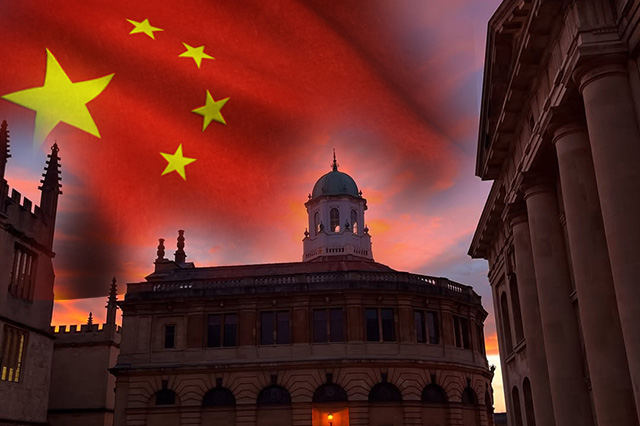
A new investigation has revealed the significant financial influence China holds over some of the UK’s most prestigious universities, raising questions about Beijing’s growing role in shaping academic and research agendas in the UK. New data obtained through Freedom of Information requests has unveiled that top universities, particularly those within the Russell Group – a collection of the UK’s 24 leading research institutions – have received nearly £50 million from Chinese sources over the past four years. As concerns over China’s influence on academic freedom, national security, and human rights mount, experts warn that the UK may be increasingly vulnerable to Beijing’s ambitions.
The Universities of Oxford and Cambridge, two of the most prestigious educational institutions in the UK, were found to be the biggest recipients of these funds. From 2020 to 2024, Oxford received approximately £24 million in gifts, grants, research funding, and donations from Chinese organizations. Cambridge, in turn, received between £12 million and £19 million during the same period. These sums include funding from entities such as Huawei Technologies, despite the company’s ban from Britain’s telecommunications infrastructure in 2020 due to national security concerns.
Sir Iain Duncan Smith, former leader of the Conservative Party and a vocal critic of China’s policies, expressed grave concerns over the dependency British universities have developed on Chinese financial backing. He suggested that this dependency might be compromising academic independence, leading institutions to “kowtow” to China’s interests, especially when it comes to stifling open discussions on human rights issues.
“This is not an accident,” Smith told The Independent. “China seeks sensitive information from the UK because of our intelligence links with the United States, and Beijing sees the university system as a vulnerable strand of British intelligence.”
The situation is further complicated by the nature of some of the Chinese institutions involved in these partnerships. Oxford University, for example, received £1.8 million from Sichuan University in 2020-2021 for a biomedical collaboration. Sichuan University has been flagged by the Australian Strategic Policy Institute as “very high risk” due to its alleged involvement in China’s nuclear weapons program and suspected ties to cyber espionage. Additionally, the university has links to the Chinese Academy of Engineering Physics, which conducts research on nuclear warheads.
Oxford University’s spokesperson defended the institution’s approach, asserting that it had a robust policy to ensure academic independence, stating that “funders have no influence over how Oxford academics carry out their research, or on our teaching and robust policies on academic freedom.” Nonetheless, the significant amount of Chinese funding raises critical questions about the potential influence of these donations on research directions and academic discourse.
Cambridge also disclosed financial connections with Chinese institutions, including hundreds of thousands of pounds from entities tied to China’s military and intelligence networks. For instance, Cambridge received £204,000 from the Institute of Geology and Geophysics at the Chinese Academy of Sciences in early 2024. This research is focused on understanding earthquakes, but given the military-linked background of the Chinese Academy of Sciences, its involvement has raised concerns over the potential military applications of such scientific collaboration.
The scale of the financial ties between China and UK universities is not limited to Oxford and Cambridge. The University of Edinburgh, for example, accepted between £5.3 million and £6.2 million in funding from Chinese sources from 2020 to 2024. This includes a £250,000 donation from Huawei Technologies in 2023, a company banned from the UK’s telecommunications infrastructure on national security grounds. Similarly, the University of Sheffield received £2.4 million in donations from Chinese organizations, including £360,000 from the CRRC Zhuzhou Institute, a subsidiary of the China Railway Rolling Stock Corporation, which is classified by the United States Department of Defence as a “Communist Chinese military company.”
The true scale of Chinese influence is likely even greater than the reported figures, as some institutions refused to disclose their funding details, and others provided only partial information. Experts argue that these partnerships, while economically beneficial, often come with strings attached, especially when it comes to research that may have dual-use applications, i.e., projects that could be used for both civilian and military purposes.
Sam Dunning, director of the UK-China Transparency think tank, warned that China’s growing presence in academic collaborations could have far-reaching implications for the UK. “The Chinese regime is laser-focused on using academic partnerships to further its military modernization,” he said. “Research that seems innocuous can have unforeseen military uses.” Dunning’s concerns highlight the vulnerability of British universities to pressures from the Chinese government, where academic freedom is often compromised to support the state’s strategic interests.
In response, the Russell Group of universities, which represents the UK’s leading research institutions, emphasized the importance of international collaborations for addressing global challenges such as healthcare, climate change, and technological innovation. The group acknowledged the risks involved in working with Chinese entities but insisted that universities undertake thorough due diligence and comply with UK regulations to ensure national security concerns are addressed. The Russell Group also maintained that universities continue to protect academic freedom and act transparently in managing donations and research funding.
Despite these assurances, the extent of Chinese influence remains a contentious issue. With more than £50 million flowing into the UK’s top universities from Chinese sources, the growing presence of Chinese funding represents a substantial shift in the academic landscape, one that could have lasting implications for both UK-China relations and the independence of British higher education.