


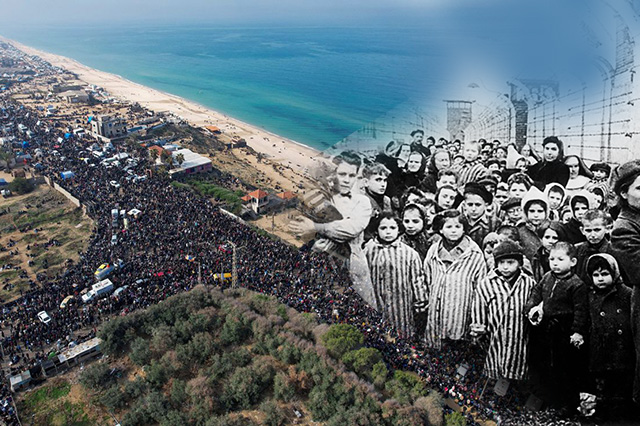
For evil to flourish, it only requires good men to do nothing. ~ Simon Wiesenthal
The International Day of Commemoration in Memory of the Victims of the Holocaust falls each year on 27th January.
On this day, the soul is compelled to confront the haunting shadows of humanity’s darkest hour. There exists no lexicon sufficient to encapsulate the sheer magnitude of this atrocity, yet the silence of the unspeakable demands to be pierced by the whispers of reflection and the outpouring of unyielding remembrance. As Rabindranath Tagore once wrote, “The butterfly counts not months but moments, and has time enough.” In that spirit, the victims of the Holocaust left behind a testament in their fleeting moments of existence—a testament to the resilience of the human spirit, even when encased in the most infernal conditions imaginable.
The Holocaust, or Shoah, represents the apotheosis of hatred institutionalized, a paradigm of state-sanctioned barbarity underpinned by the chilling precision of modern bureaucratic efficiency. Between 1941 and 1945, six million Jews, along with millions of Romani people, disabled individuals, political dissidents, and other marginalized groups, were systematically annihilated under the Nazi regime. The question arises, as posed by the great poets and legal scholars alike: What justice can ever be commensurate with a crime of this magnitude?
International law, conceived in the ashes of this profound tragedy, struggles to grapple with its moral imperative. The Nuremberg Trials, convened in the immediate aftermath of World War II, sought to enshrine accountability within the edifice of international jurisprudence. Justice Robert H. Jackson, Chief Prosecutor for the United States, captured this solemn undertaking with poignant gravitas: “We must never forget that the record on which we judge these defendants today is the record on which history will judge us tomorrow.”
Yet, as we reflect, we are reminded that law alone cannot heal. It is but a tool—a frail vessel—meant to channel the collective will of humanity toward the principles of justice and human dignity. And herein lies the challenge: while the law delineates culpability and prescribes consequences, it falters before the vast emotional abyss of grief and memory. The Holocaust is not merely a chapter in human history; it is a rupture in the moral fabric of existence itself.
What lessons, then, can we draw from this abyss? Tagore’s poetry often emphasizes the transcendence of human connection over the trivialities of division. “The same stream of life that runs through my veins night and day runs through the world and dances in rhythmic measures,” he writes. In the context of the Holocaust, such words call upon us to reassert our common humanity. Where the Nazis constructed an edifice of dehumanization, reducing individuals to mere numbers tattooed on their skin, we must rebuild the sanctity of personhood. Each victim—every mother, father, child, artist, scholar, laborer—was a universe unto themselves, extinguished but not forgotten.
Legal scholars and philosophers often wrestle with the concept of “never again,” a promise born from the ashes of Auschwitz and Treblinka. Yet the perennial recurrence of genocide—in Rwanda, Bosnia, Cambodia, and beyond—poses a stark indictment of our collective failure. The moral arc of the universe, as Dr. Martin Luther King Jr. observed, may bend toward justice, but only if we exert the effort to pull it with resolve. Holocaust remembrance, then, must transcend the perfunctory rituals of commemoration and compel action: education, advocacy, and unwavering resistance to the seeds of hatred that sprout even in our present day.
The Holocaust also demands a deeper inquiry into the nature of evil and the banality thereof, as so incisively articulated by Hannah Arendt in her seminal work Eichmann in Jerusalem. Adolf Eichmann, a principal architect of the Holocaust, epitomized the terrifying ordinariness of bureaucratic complicity. He was not a monstrous aberration but an individual who abdicated moral responsibility under the guise of obedience. This revelation is both alarming and instructive: the potential for complicity lies dormant within us all. The law can criminalize actions but must remain vigilant in addressing the systemic conditions that nurture their genesis.
Indeed, international law has evolved in response to the Holocaust. The Genocide Convention of 1948, the establishment of the International Criminal Court, and numerous other instruments represent a commitment to holding perpetrators accountable. Yet, the law’s effectiveness hinges on the moral vigilance of those who wield it. Institutions are only as strong as the values they embody and the courage with which they enforce them. As Tagore so eloquently observed, “Let me not pray to be sheltered from dangers but to be fearless in facing them.” The post-Holocaust world must confront not only the dangers of explicit violence but also the insidious erosion of truth, tolerance, and justice.
In the realm of art and literature, the Holocaust has left an indelible mark, offering a medium through which survivors and descendants attempt to process the ineffable. The words of Primo Levi, Elie Wiesel, and Anne Frank serve as both testimony and warning. Levi, in If This Is a Man, pleads with us to remember: “It happened, therefore it can happen again. This is the core of what we have to say.” Such works are not merely historical records but ethical imperatives, challenging us to bear witness and act with conscience.
Perhaps the greatest tribute to the victims of the Holocaust lies not only in remembrance but in the active cultivation of a world where such horrors become inconceivable. Education, particularly for younger generations, is paramount. The Holocaust Memorial Day Trust aptly states, “We learn more about the past, we empathize with others today, and we take action for a better future.” In an age where denial and distortion proliferate, the guardianship of truth becomes both a moral and intellectual duty.
We now need a compelling aspiration for a world governed by justice and compassion. The Holocaust stands as an eternal admonition against complacency, reminding us that the veneer of civilization is perilously thin. As Tagore writes in Gitanjali, “Where the mind is without fear and the head is held high; where knowledge is free… into that heaven of freedom, my Father, let my country awake.”
Thus, on this International Day of Holocaust Remembrance, we are called not only to mourn but to awaken—to awaken to the fragility of human dignity, the necessity of moral courage, and the enduring power of remembrance. In honoring the memory of the victims, we reaffirm our commitment to the ideals that their oppressors sought to annihilate. In doing so, we partake in a sacred act of defiance, proclaiming that humanity, though scarred, remains unbroken.










