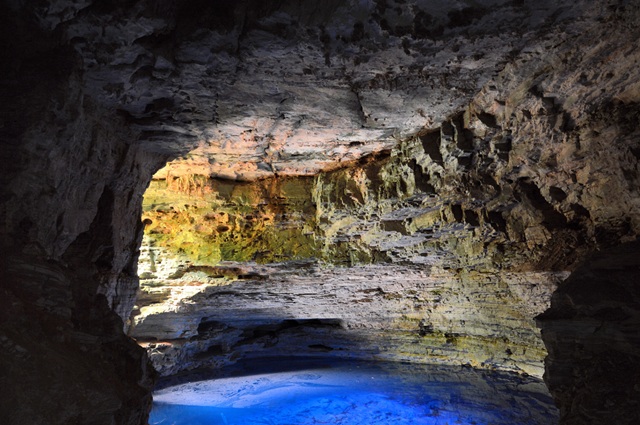
In the lush forests of southern Brazil, a group of researchers is delving into one of the most fascinating and mysterious prehistoric phenomena in South America: massive caves that appear to have been carved into solid sandstone by ancient megafauna. Among the most significant of these caves is the Armadillo’s Den (Toca do Tatu), a colossal cavern large enough to fit a van. The cave’s sheer size and the enigmatic markings found inside have long puzzled both explorers and scientists. Local guide Vadevino Alano, now 75, leads archaeologist Juliano Campos through the cave, where they examine the unusual grooves etched into the walls and ceiling. Campos, an archaeologist at the University of the Extreme South of Santa Catarina in Brazil, is part of a team that is investigating whether these markings were left by the giant ground sloths that once roamed the region before becoming extinct more than 10,000 years ago.
This research, detailed in a report from Nature, is challenging long-held assumptions about the origins of these structures. For generations, explorers and scientists believed that the vast tunnels were the work of ancient Indigenous groups, but recent investigations are shifting the focus to prehistoric megafauna as the likely creators. The giant claw marks on the cave walls are increasingly being attributed to ground sloths, particularly species like Scelidotherium and Glossotherium. These massive animals, which could reach over 3 meters in length and weigh up to 1,500 kilograms, were equipped with powerful claws that may have been used to carve into the soft sandstone of the caves. According to Campos and other researchers, these markings are not only evidence of the creatures’ existence but also provide clues to how they interacted with their environment.
The research into these palaeoburrows is led by Heinrich Frank, a retired geologist and founder of the Palaeoburrows Project, along with palaeo-oceanographer Francisco Buchmann. Together, they have been studying the Botucatu Formation, a layer of sandstone dating back over 100 million years, which serves as the primary site for these vast caves. According to Buchmann, the unique characteristics of the Botucatu sandstone make it an ideal material for the creation of these massive tunnels. The rock is soft enough to carve yet durable enough to remain intact over millennia, allowing for the preservation of the ancient grooves and scratches left behind by the ground sloths and other megafauna.
Some of these caves, such as the ones found in the Amazon region, are among the longest known, stretching up to 1,500 meters in length, and are believed to be the largest ichnofossils, or fossilized tracks and burrows, discovered so far. These palaeoburrows, which can be as wide as 4 meters and more than 2 meters tall, continue to baffle scientists, particularly because they are unique to South America. According to Frank, there are between 1,500 and 2,000 such structures across the continent, but none have been found anywhere else in the world, further raising questions about the behavior of the megafauna responsible for their creation.
While the theory that giant sloths could have carved these tunnels is gaining traction, the reasons behind such behavior remain unclear. Some researchers, like Néstor Toledo from the La Plata Museum, speculate that the sloths might have used the caves as protection from the cold and dry conditions during Ice Age periods. Others, including palaeontologist Richard Fariña, suggest that the sloths’ digging could have been related to their need for shelter or to sharpen their claws. However, not all researchers agree. Cástor Cartelle, a palaeontologist from Brazil, argues that the sloths’ massive size would have made it unnecessary for them to seek refuge in caves. He believes that the scratches were more likely made as the creatures took advantage of pre-existing cave structures to maintain their claws rather than actively digging them out.
Despite these differing opinions, the research into these giant palaeoburrows is still in its early stages, and the full extent of what they can reveal about Ice Age South America remains to be seen. One significant challenge researchers face is the lack of standardized data on these structures, which makes it difficult to analyze their origins with certainty. As highlighted by geographer Arthur Philippe Bechtel from the Federal University of Santa Catarina, there is a pressing need for better data collection and conservation efforts to ensure that these ancient structures are preserved and understood. In fact, many of the caves, including the Armadillo’s Den, are threatened by modern graffiti and human encroachment, further complicating efforts to study them.
For scientists, the study of these palaeoburrows is not just a matter of uncovering the mysteries of extinct species but also a race against time to protect and document these remarkable remnants of prehistoric life. According to ichnologist Luis Buatois from the University of Saskatchewan, these giant palaeoburrows are so unique that they deserve more global attention from the scientific community. Nature notes that while these structures are little known outside of South America, their scale and mystery make them deserving of broader recognition and study.
Alano, who has guided numerous researchers through the Armadillo’s Den, believes that there is still much to learn about the caves and the creatures that may have created them. “The more diverse people come to study the place, the more knowledge we’ll have about it,” he says. “Who knows what they’ll find in the future?” As research continues, there is hope that the true origins of these enigmatic palaeoburrows will be uncovered, offering valuable insights into the behaviors and environments of the incredible megafauna that once roamed South America.