
Orlando Patterson’s Enslavement Past and Present is an exhaustive and deeply analytical examination of slavery, tracing its evolution from antiquity to its modern manifestations in human trafficking and forced labour. The book is grounded in Patterson’s extensive scholarship on slavery’s historical, sociological, and economic dimensions.
Patterson asserts from the outset that “slavery is one of humanity’s most ancient and persistent inequities” (p.1). He explores its origins in early societies, demonstrating how the institution predated written history and became a foundational component of economic and social structures across cultures. He argues that “the institution of slavery was not simply an aberration of human history but a recurring phenomenon that shaped civilizations” (p.14). He meticulously traces slavery’s role in the Roman Empire, medieval Europe, and the transatlantic slave trade, illustrating how economic imperatives and ideological justifications enabled its persistence.
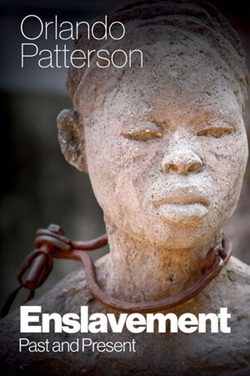
Central to Patterson’s analysis is his influential concept of social death, which describes the condition of the enslaved as one of total exclusion from social, legal, and familial networks. He explains, “the enslaved person is not merely deprived of freedom but stripped of social identity, kinship ties, and cultural agency” (p.56). This dehumanization, he argues, was fundamental to slavery’s function as a system of domination.
Patterson does not confine his analysis to the past. He compellingly draws connections between historical slavery and contemporary forms of exploitation, particularly human trafficking. He writes, “Human trafficking is not merely a crime but a modern incarnation of a deeply entrenched system of coercion and control” (p.231). The book documents cases of forced labour, sex slavery, and debt bondage in various regions, highlighting the structural similarities between these modern abuses and historical slavery. He critiques the global response to human trafficking, arguing that efforts to combat it remain inadequate due to systemic economic and political factors that perpetuate these practices.
A particularly thought-provoking section of the book deals with the economic legacy of slavery and the ongoing debate over reparations. Patterson notes, “The economic benefits of slavery did not vanish with abolition; they were transferred to new forms of racial and class exploitation” (p.274). He examines the role of slavery in shaping wealth disparities and racial inequalities, advocating for policies that address these enduring injustices. His argument is not simply about financial compensation but about structural reforms that acknowledge and rectify the historical impact of slavery.
The book also engages with cultural and psychological dimensions of enslavement. Patterson explores how narratives of slavery have been constructed and contested in literature, film, and historical discourse. He critiques attempts to romanticize or downplay the horrors of slavery, emphasizing the need for historical accuracy and moral reckoning. He writes, “The way a society remembers its past reveals its moral priorities” (p.312), underscoring the importance of truthful representations of slavery in education and public memory.
One of the book’s most powerful sections addresses the resilience and agency of the enslaved. While his social death thesis emphasizes the dehumanization of slavery, Patterson also acknowledges the ways in which enslaved individuals resisted and reclaimed their humanity. He describes slave revolts, maroon communities, and everyday acts of defiance as critical components of the enslaved experience. He argues, “Resistance was not just a response to slavery but an assertion of dignity and personhood” (p.340). This perspective enriches the discussion by highlighting the complexity of enslaved people’s lives beyond victimization.
Some critics have argued that Patterson’s emphasis on social death downplays the ways in which enslaved individuals maintained cultural and familial bonds. However, Patterson anticipates this critique and addresses it directly. He acknowledges that “even within systems designed to erase them, enslaved individuals forged connections and created meaning in their lives” (p.365). This balanced approach ensures that his analysis does not reduce the enslaved to passive victims but rather recognizes their resilience within oppressive systems.
Ultimately, Enslavement Past and Present is a sweeping, meticulously researched work that challenges readers to reconsider the enduring impact of slavery. Patterson’s ability to weave historical depth with contemporary relevance makes this book an essential contribution to the study of slavery and human rights. His exploration of slavery’s economic, social, and psychological dimensions ensures that the book is not merely a historical account but a call to action. His final words resonate powerfully: “To understand slavery is to understand the foundations of inequality; to confront it is to challenge the very structures that sustain oppression” (p.400). This book is essential reading for scholars, activists, and anyone committed to social justice.