by Our Correspondent in New Delhi
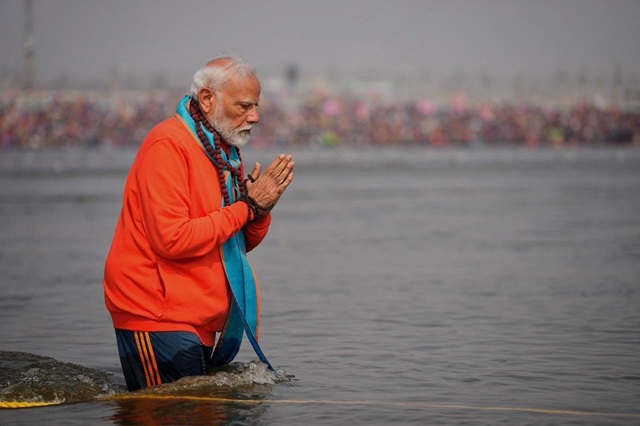
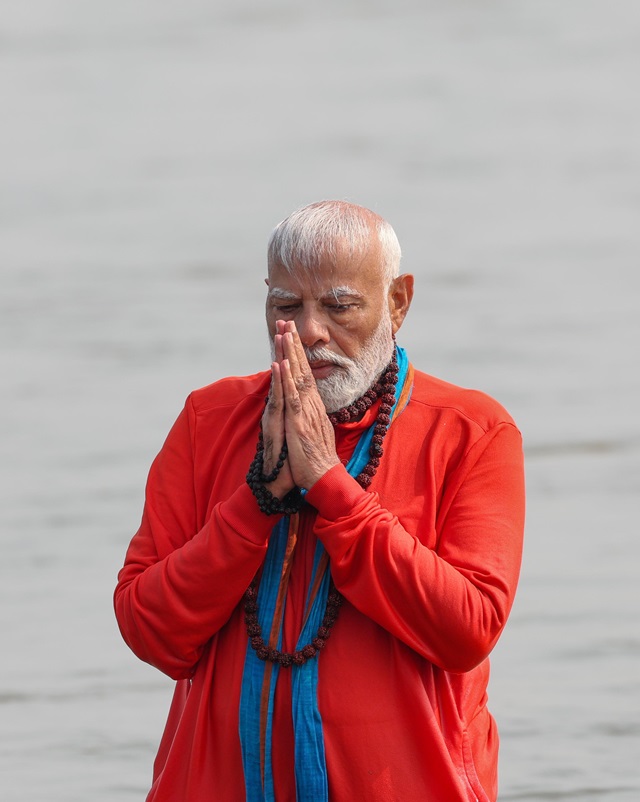
As Delhi voters headed to the polls in a crucial assembly election, Prime Minister Narendra Modi took a spiritual dip in the holy waters of the Ganga at the Maha Kumbh in Prayagraj. Calling the experience a “moment of divine connection,” Modi expressed his reverence for the sacred event and wished for peace, wisdom, and harmony for all. The Maha Kumbh is one of the largest religious gatherings in the world, drawing millions of devotees who believe that taking a dip at the confluence of the Ganga, Yamuna, and the mythical Saraswati washes away sins and brings spiritual awakening.
Meanwhile, in Delhi, polling commenced at 7 AM amid tight security, with voters braving the winter chill to cast their ballots. The initial hours saw a sluggish turnout, but by 11 AM, the Election Commission of India (ECI) reported a voter turnout of 19.95%. The highest participation was recorded in the North East district at 24.87%, while the Central district saw the lowest turnout at 16.46%. Political analysts believe that voter enthusiasm might pick up as the day progresses.
Election Dynamics and Key Contestants
The 70-seat Delhi Assembly election is a high-stakes battle, with the Aam Aadmi Party (AAP) looking to retain power, the Bharatiya Janata Party (BJP) aiming to make a comeback after 27 years, and the Congress hoping for a revival. With 699 candidates in the fray, key constituencies include New Delhi, Jangpura, Kalkaji, Okhla, Mustafabad, and Greater Kailash. The ruling AAP, which has governed Delhi since 2015, is banking on its performance in education, healthcare, and public welfare schemes to secure another term, while the BJP is emphasizing issues like law and order, infrastructure, and governance.
Delhi Chief Minister and AAP leader Arvind Kejriwal faces BJP’s Parvesh Verma and Congress’s Sandeep Dikshit in the prestigious New Delhi constituency. AAP leaders, including Atishi and Raghav Chadha, have framed the election as a “Dharm Yuddha,” emphasizing governance and welfare against what they call “hooliganism.” Meanwhile, BJP leaders like Manoj Tiwari and Manjinder Singh Sirsa have criticized AAP for failing to address Delhi’s challenges, with Tiwari asserting that “people are ready for change.”
Congress, which dominated Delhi politics for 15 years before losing its ground to AAP, remains hopeful for a comeback. Party MP Abhishek Manu Singhvi predicted a “surprising” result. Many Congress candidates have campaigned aggressively, hoping to regain lost voter confidence by promising better governance and a return to the party’s legacy of leadership in the state.
By-Polls and National Significance
Simultaneously, by-elections took place in Tamil Nadu’s Erode (East) and Uttar Pradesh’s Milkipur constituency. Milkipur, a Scheduled Caste-reserved seat, saw competition between SP’s Ajit Prasad and BJP’s Chandrabhanu Paswan, while Erode (East) recorded a 26.03% voter turnout by 11 AM. The by-polls hold significance as they may indicate voter sentiment ahead of the 2024 general elections.
Samajwadi Party chief Akhilesh Yadav alleged that police were selectively checking voter IDs in Milkipur, but the Ayodhya Police refuted the claim, stating they were only verifying a booth agent’s credentials. The controversy surrounding the elections has added to the political tensions in Uttar Pradesh, where the ruling BJP has been at loggerheads with the opposition over governance and election conduct.
Legal and Political Tensions
The Delhi election period has also been marked by legal controversies. BJP MP Ramvir Singh Bidhuri accused Kejriwal of making baseless allegations, citing his history of court apologies. A case has also been registered against Kejriwal under various sections of the Bharatiya Nyay Samhita (BNS), 2024, over remarks about Haryana’s alleged contamination of Yamuna water. The legal battle between political parties continues to add fuel to the already heated electoral atmosphere.
Voices from the Ground
Former Chief Justice of India DY Chandrachud, who cast his vote in Delhi, stressed the importance of electoral participation, urging young voters to exercise their franchise. “When it comes to a particular election, everybody who is associated with it regards it as crucial. Whether it’s Delhi, whether it’s the national elections or the state elections, every single election is crucial. By exercising our franchise, we demonstrate to the world at large and to our own society that we are responsible participants in the process of democracy as citizens,” he said. He also emphasized that India’s democracy is extraordinarily mature and people are cognizant of their responsibilities.
Communist Party of India (Marxist) leader Brinda Karat criticized central interference in Delhi’s governance, calling for greater autonomy for the elected state government. “We need to keep Delhi safe from the double-engine disaster and we have voted keeping that in mind,” she said. Her husband, Prakash Karat, echoed similar sentiments, stating that the only issue in Delhi is that the elected government is not allowed to function due to interference from the central government and the Lieutenant Governor. He asserted that the elected government should have the right to function without hindrance.
What’s Next?
As the day progresses, voter turnout is expected to rise, and the political landscape of Delhi will soon be determined. The results, set to be announced on February 8, will shape the future of the national capital and have broader implications for Indian politics. Experts believe that a higher voter turnout may favor AAP, while a lower turnout could benefit BJP and Congress. The stakes are high, and as parties await the results, Delhi remains the battleground for one of the most intense political contests in recent years.