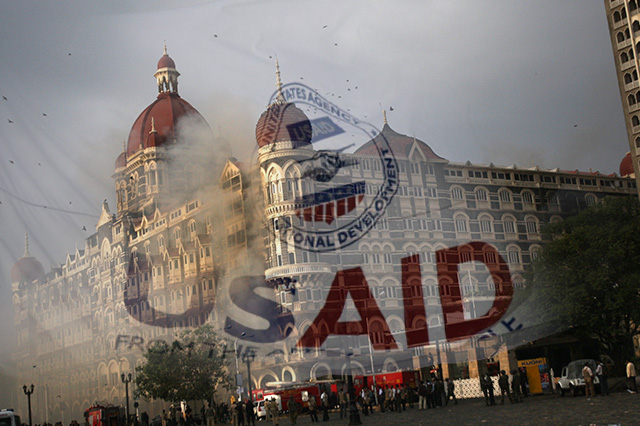
It has come to light that USAID funds were directed to a charity organization with direct ties to the perpetrators of the devastating 26/11 Mumbai terror attacks. According to a report by the Middle East Forum, the Falah-e-Insaniat Foundation (FIF), which benefited from USAID support, is linked to the banned terrorist group Jamaat-ud-Dawa (JuD), which itself acts as a front for Lashkar-e-Taiba (LeT)—the largest terror organization in South Asia.
LeT, responsible for the 2008 Mumbai attacks, killed 166 individuals and left more than 300 injured. Despite the organization’s ties to this horrific event and its designation as a terrorist group by both India and the United States, USAID continued providing funds to FIF for years after these links were well-known. The continued support raises serious questions about oversight and accountability in U.S. foreign aid initiatives, especially given the severity of LeT’s role in multiple terrorist attacks, including in Jammu & Kashmir.
While both LeT and JuD have been banned as terrorist organizations by the U.S. and India due to their destabilizing impact and involvement in numerous attacks, USAID’s funding stream to FIF has persisted, casting doubt on the agency’s ability to vet organizations receiving American taxpayer dollars.
This development calls for a deeper investigation into U.S. foreign aid practices and the measures taken to prevent funding from reaching groups involved in violent extremism. Critics are demanding greater transparency and accountability, particularly regarding organizations with proven links to terrorism, as the consequences of such funding have far-reaching implications on global security.
USAID’s Color Revolutions: Georgia, Ukraine, Kyrgyzstan & Lebanon
In addition to its controversial funding of organizations tied to terrorism, USAID has also been involved in regime change operations across the globe. By 2006, USAID openly acknowledged its role in supporting regime change efforts under the guise of promoting “democracy,” with interventions in countries like Georgia, Ukraine, Kyrgyzstan, and Lebanon. These operations, often referred to as “color revolutions,” were funded through substantial U.S. aid and “democracy programs.”
In Georgia, USAID provided $141.16 million in aid, with $23.5 million directed specifically toward “democracy programs.” These programs supported NGOs, activists, and media outlets, playing a key role in the overthrow of President Eduard Shevardnadze during the Rose Revolution in 2003. The U.S. admitted to assisting in the preparation for Georgia’s elections, and USAID noted that Georgia’s pro-democracy tactics were inspired by Serbia’s 2000 movement, which later influenced Ukraine’s 2004 revolution.
In Ukraine, USAID’s role in the 2004 Orange Revolution was significant, with $143.47 million allocated in U.S. aid. A large portion, $54.7 million, funded “democracy programs” to support pro-Western movements and push a pro-U.S. candidate. The “Strengthening Electoral Administration in Ukraine Project” (SEAUP) was launched by USAID in 2003 to influence Ukraine’s parliament and judiciary and helped pave the way for political upheaval and regime change.
In Kyrgyzstan, USAID funded local NGOs, activists, and media outlets ahead of the 2005 Tulip Revolution. With $56.6 million in aid, $13.5 million was allocated to “democracy programs.” Inspired by the success of earlier color revolutions, U.S. aid sought to facilitate another regime change in Central Asia. The influence of organizations like George Soros’ Open Society Institute, which funneled $5 million to Kyrgyzstan’s American University, played a significant role in mobilizing local activists.
In Lebanon, USAID played an instrumental role in supporting the 2005 Cedar Revolution, which demanded Syria’s military withdrawal and ushered in the pro-U.S. leadership of Saad Hariri. USAID’s 2006 report highlighted the foundation it had laid for years, claiming its work had directly contributed to the uprising. During the early 2000s, U.S. aid to Lebanon tripled from $15 million to $45 million, reinforcing the U.S. government’s influence over Lebanon’s political landscape.
These “color revolutions” have drawn criticism for their destabilizing effects, often causing political and social turmoil in the regions involved. Critics argue that USAID’s interventions were more about advancing U.S. geopolitical objectives than promoting genuine democracy, raising important questions about the true motivations behind U.S. foreign aid.
‘State-run’ Western Media: How Much Did They Get from Team Biden?
In the context of foreign aid and media influence, another troubling trend has emerged. Elon Musk recently criticized the previous U.S. administration for spending hefty sums on mass media outlets, claiming that taxpayers’ money was being used to support media that often serves as a mouthpiece for political agendas. According to reports, various prominent media organizations have received substantial funding from the U.S. government.
The Associated Press, for example, received around $1.2 million in 2024 alone, adding to more than $4 million in 2023 and over $3 million in 2022. Similarly, The New York Times was granted $4.1 million in 2024, after receiving about $2 million in both 2023 and 2022, with nearly $3 million in 2021. Politico, known for its political reporting, also saw notable funds, receiving about $8.1 million in 2024 after getting roughly $600,000 in 2023 and $700,000 in previous years. Even the BBC, which is often considered an unbiased source of news, received more than $3 million in 2023 and 2024, as well as additional sums in the previous years.
According to WikiLeaks, USAID has been funding over 6,200 journalists across 707 media outlets and 279 ‘media’ NGOs, including nine out of ten media outlets in Ukraine. This raises critical questions about the extent to which the U.S. government is influencing global media narratives through financial support, and whether this is leading to a form of state-run media in the Western world.