“Vinasha Kale Vipareetha Buddhi” is an ancient Sanskrit proverb meaning: “When a person’s doom approaches, their intellectual power becomes reversed, disoriented, or turns against them, leading to their destruction.” This pithy saying appears just as applicable to the incumbent President, Anura Kumara Dissanayake, as it once was to former President Mahinda Rajapaksa.
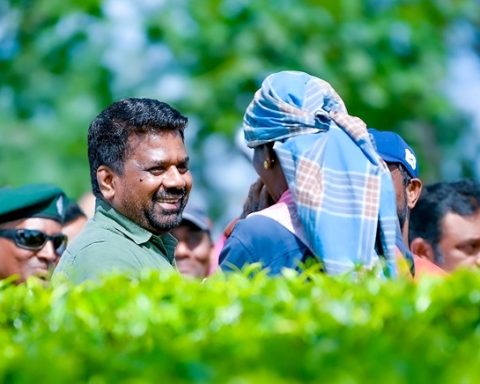
This came to mind when observing President Anura Kumara Dissanayake’s absurd treatment of former President Mahinda Rajapaksa in his keynote address at a public rally dubbed Suhada Hamuwa (Friendly Meeting), held by the ruling JVP/NPP alliance at Katukurunda in Kalutara on 19 January 2025. President Dissanayake stated that he would not hesitate to remove altogether the already reduced security detail of sixty policemen assigned to Mahinda Rajapaksa if the latter did not stop complaining about it. Furthermore, he suggested that the former President could be asked to vacate his high-rent (according to AKD) official residence in Wijerama, which he currently occupies rent-free, and instead be required to accept a monthly allowance equivalent to one-third of his pension to rent alternative accommodation.
AKD’s obvious tyranny in this instance is laughable, given that he was a member of the Yahapalanaya-appointed committee (presumably in 2015) that approved the allocation of that house to Mahinda Rajapaksa as a former President. This piece of information was revealed by Ranil Wickremesinghe, who addressed a meeting of opposition party leaders in Kollupitiya on 1 February, as reported by the Sinhala-language Lanka Leader website the same evening.
According to media reports, Mahinda Rajapaksa’s lawyers, on his behalf, filed a Fundamental Rights (FR) petition with the Supreme Court in Colombo on 25 January 2025 against the current Malimawa (JVP/NPP) government’s alleged decision to curtail the security he is legally entitled to as a former President. Downgrading the security of war-winning Mahinda Rajapaksa, seemingly on a whim, is likely to be seen by the sensible public as an indication that the ruling alliance is already veering off its promised course of ‘clean’ governance.
Just as the SLPP, led by the Rajapaksas, fought the elections of 2019 and 2020 on the single platform of One Country, One Law (aimed at preserving the unitary state and communal harmony), the JVP/NPP alliance organised its presidential and parliamentary election campaigns of 2024 around the exclusive theme of eliminating corruption, punishing the corrupt, and ushering in a clean Sri Lanka while rescuing the country from its current economic crisis.
Owing to his failure to skilfully utilise the tremendous opportunities provided by his democratic electoral victories in 2010 and 2019/20 to pursue the nationalist cause he claimed to champion, Mahinda Rajapaksa has tragically lost his original charisma and heroic stature as a senior politician. He is virtually a spent force. However, he is not just another former President. If Anura Kumara Dissanayake is determined to enhance his own image by harassing Mahinda Rajapaksa, he will soon realise he is gravely mistaken. Some have begun to argue that AKD has inadvertently given MR a new lease of life in politics.
Among the five surviving former Presidents, Mahinda Rajapaksa is the most vulnerable to assassination attempts. Had it not been for his courageous political leadership, the mindless separatist terror campaign that ravaged Sri Lanka for over thirty years (1975–2009) would not have been defeated. The crushing of terrorism earned him many enemies who are still waiting to settle old scores. However, grateful citizens—both young and old—can recall, either as a direct experience or as something learned from older generations or historical accounts, the indescribable suffering inflicted by terrorists on all Sri Lankans, regardless of ethnicity, religion, cultural practices, or political ideology.
They will not forget how deeply relieved they felt when they finally found themselves safe from the mental and physical agony, torment, and torture they had endured during that dark period. Ordinary Sri Lankans hold Mahinda Rajapaksa in special regard despite the many allegations against him, which remain to be properly investigated.
Moreover, Mahinda Rajapaksa has earned both the envy and anger of Western imperialists and their local allies by being one of only two post-independence Sri Lankan political leaders to bring well-deserved recognition and distinction to the country, reinforcing its image as an independent sovereign nation. The other was the late Sirimavo Ratwatte Dias Bandaranaike.
The United Left Front (a coalition of the Sri Lanka Freedom Party and certain leftist parties) led by Sirimavo Bandaranaike swept the parliamentary polls in 1970 with a two-thirds majority. Under her leadership, the ULF government proclaimed the country a republic in 1972, severing residual colonial ties to the British Empire that had persisted since the incomplete independence of 1948. The role of the JVP as an unintended catalyst for the introduction of the republican constitution is another story. The Punarudaya (Renaissance) that today’s JVP leader, Anura Kumara Dissanayake, claims to champion appears to be a reversal of the genuine national revival that Sirimavo Bandaranaike spearheaded in 1972.
Mahinda Rajapaksa made history in 2009 by ending the armed Tamil separatist threat to Sri Lanka’s unity. Both leaders faced significant external and internal resistance, which, unfortunately, persists to this day.
Allegations of wrongdoing against the once-iconic Mahinda Rajapaksa are a separate matter. They should be scrutinised in the relevant context, especially when worse offenders remain in the shadows. However, as suspects or defendants, all individuals should be considered innocent until proven guilty in a court of law.
Anura Kumara Dissanayake, whom many already regard as an arrogant upstart, must not betray the trust placed in him by the people, the majority of whom are baiyas (nationalists). They elected him not out of personal preference but due to the lack of a better alternative in this unprecedented national crisis. AKD must remember that the baiyas—nationalists and patriots from all communities—form the majority in both the government and opposition. They want him to succeed as President for the country’s sake by outperforming his predecessors, including Mahinda Rajapaksa.
The matter of security for a former President is beyond dispute, as legal experts affirm. It is an inviolable right established by an Act of Parliament for individuals who have served in that most exalted position. Security arrangements determined through due assessment cannot be arbitrarily downgraded or withdrawn at the whim of a political rival who has suddenly been catapulted to power by volatile circumstances.
The Presidents’ Entitlements Act No. 4 of 1986 clearly stipulates the provisions for an ‘appropriate’ residence for a former President. It is no surprise that Mahinda Rajapaksa, as the leader who decisively ended three decades of terrorism, remains a prime target for potential assassins. He has also incurred the wrath of racists and religious extremists, both locally and internationally. These groups—though they do not publicly acknowledge it—recognise MR as the leader of inclusive pan-Sri Lankan nationalism, which they deliberately misconstrue as Sinhalese Buddhist chauvinism.
Despite the uninformed approval and impulsive support AKD’s remarks have received from the brainwashed younger ranks of the JVP, numerous critics have already pointed out that he is wrong in his treatment of the former President. Many believe AKD’s actions could constitute a violation of the Sri Lankan Constitution.
To be continued…