
by Satchi
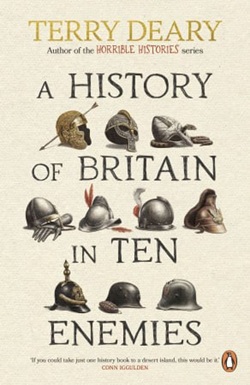
Terry Deary, renowned for his irreverent yet incisive approach to history, delivers A History of Britain in Ten Enemies as a biting, often satirical examination of Britain’s greatest adversaries. It is not a celebration of British triumphs, but rather an unflinching interrogation of the narratives that have shaped national identity.
Deary’s central thesis is clear: “A nation is defined not by its friends, but by the enemies it makes” (p.2). With this in mind, he examines ten historical rivals—from the Romans to the Germans—unpacking Britain’s deep-seated animosities, hypocrisies, and sometimes outright delusions.
His chapter on France is particularly compelling. “For centuries, Britain has defined itself in opposition to France” (p.47). He charts conflicts from the Hundred Years’ War to the Napoleonic Wars, analyzing how rivalry with France cemented British nationalism. “Waterloo was not just a victory; it was a story Britain needed to tell itself” (p.89), he quips, emphasizing how myth-making influences historical memory.
The chapter on Germany is similarly unyielding. “Britain fears German efficiency as much as it admires it” (p.201). He deconstructs the lead-up to both World Wars, critiquing British appeasement policies: “For all their bravado, British leaders spent years pretending Hitler was someone else’s problem” (p.245). He does not spare Britain’s post-war self-perception, noting how “British wartime nostalgia often ignores the years of dithering that led to war in the first place” (p.267).
Deary is at his most scathing when discussing Britain’s colonial enemies. “The British Empire was built on arrogance and sustained by denial” (p.322). The chapter on Ireland is particularly damning: “The Irish Famine was not just a natural disaster; it was a crime of negligence” (p.190). He highlights how Britain’s treatment of Ireland has shaped modern Anglo-Irish relations, remarking: “History doesn’t forget as easily as politicians do” (p.210).
What makes A History of Britain in Ten Enemies exceptional is Deary’s refusal to accept sanitized versions of history. “History is not a series of heroic battles—it’s a series of mistakes we refuse to learn from” (p.355). His cutting wit and meticulous research dismantle national myths, forcing readers to confront uncomfortable truths.
By the end of the book, it is clear that Britain’s history is as much about its enemies as its victories. A History of Britain in Ten Enemies is not just a historical analysis—it is a challenge to the stories nations tell themselves. Deary reminds us that “true patriotism is not blind devotion, but the ability to question one’s own history” (p.389).