


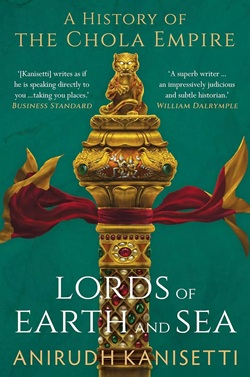
Anirudh Kanisetti’s Lords of Earth and Sea: A History of the Chola Empire is an ambitious and erudite retelling of one of South India’s most influential yet often overlooked dynasties. A sweeping narrative, it dismantles the mythological haze that often surrounds the Cholas, reconstructing their rise and influence with rigorous scholarship and evocative storytelling. Kanisetti challenges conventional historical narratives, exposing the grandiosity, brutality, and political ingenuity of the Chola rulers. However, his approach is not without controversy. While he seeks to demystify the Cholas, the book simultaneously exposes modern historiographical biases, demonstrating how past and present perceptions of the dynasty are coloured by contemporary political agendas.
From the very beginning, Kanisetti forces the reader to confront the constructed nature of historical memory. “There’s a consistent pattern here: the way we imagine the Cholas has never been about who they actually were. It’s who we wish they were, what contemporary anxieties we want to soothe” (p. 14). This assertion sets the tone for the book, challenging the nationalist and Dravidian revivalist glorification of the Cholas, who are often depicted as a golden age of Tamil cultural supremacy. He argues that the Chola empire was not a neatly bounded Tamil kingdom but a dynamic, opportunistic polity that absorbed and wielded power in unexpected ways. The title itself, Lords of Earth and Sea, hints at this paradox—an empire of immense ambition but one often romanticised beyond historical accuracy.
Kanisetti’s prose is strikingly vivid, transforming what could have been a dry recounting of battles and administrative policies into a narrative that brims with life. He describes the transformation of the Kaveri floodplain with poetic grandeur: “The Cholas tamed the Kaveri, studding its delta with settlers, funnelling hundreds of tonnes of granite, thousands of tonnes of golden rice into enormous new imperial temples” (p. 48). His descriptions of the Brihadishvara temples as “blazing with light from dozens of bronze idols, fragrant with offerings of sheep’s ghee and heaps of flowers” (p. 76) capture the sheer scale and religious zeal that underpinned Chola rule. But beyond the grandeur, he does not shy away from the darker realities—forced labour, militarism, and the near-theocratic power wielded by Chola monarchs.
One of the book’s most controversial aspects is its rejection of the widely held belief in an extensive Chola navy. “A sprawling Wikipedia page on the ‘Chola Navy’ served as the basis for a major video game recently, with one minor problem: there are no actual Chola-era sources claiming that they had a navy” (p. 125). This claim is bound to ruffle feathers, particularly among Tamil nationalist historians who have long maintained the idea of a formidable Chola naval presence across Southeast Asia. Kanisetti argues that Tamil merchant corporations—not a state-controlled navy—were responsible for Chola overseas expeditions. This distinction challenges the conventional narrative of a powerful, state-driven maritime empire, suggesting instead that the Cholas relied on commercial networks rather than military might for their influence abroad.
Kanisetti also grapples with the gendered aspects of Chola rule, bringing to light the roles of women in sustaining the empire. The story of Sembiyan Mahadevi, whom he describes as “the dowager-turned-Nataraja evangelist, in a very real sense the founder of the Chola empire” (p. 179), is particularly striking. Far from being passive figures in the royal court, Chola queens and noblewomen wielded significant influence through temple patronage, land grants, and strategic marriages. However, the book does not romanticise their power—it acknowledges that these women operated within a deeply patriarchal and violent system, often reduced to political pawns in dynastic struggles.
The book’s exploration of caste and social structure is another arena where Kanisetti does not pull punches. He notes, “Tamil cultivators were not falling over themselves to hero-worship the Cholas” (p. 210), pushing back against the notion that the Chola reign was universally beloved by its subjects. Instead, he highlights the tensions between landowning elites, merchant guilds, and peasant assemblies, arguing that the Chola state had to constantly negotiate and enforce its authority. By presenting inscriptions and economic data, he paints a picture of a society that was as fragmented as it was expansive, a sharp contrast to the monolithic image often associated with the Cholas.
Perhaps the book’s most provocative argument is its comparison of the Cholas to modern political movements. Kanisetti draws attention to the way the Chola legacy has been co-opted by both Tamil and Hindu nationalist narratives, writing that “In more recent decades, they have been claimed as Hindu nationalist icons, with a sengol, a Tamil royal sceptre, enshrined in India’s new Parliament building in 2023” (p. 256). The implication is clear: historical memory is malleable, and the past is often weaponised to serve present-day ideologies. By highlighting this process, the book forces the reader to consider not just the Cholas themselves but also the broader question of how history is written and remembered.
For all its strengths, Lords of Earth and Sea is not without its critiques. Some may find Kanisetti’s approach too revisionist, particularly in his challenges to well-established narratives. His insistence on economic and social factors over military conquest may downplay the role of traditional power politics in the Chola expansion. Additionally, his scepticism towards certain historical claims, while often justified, may come across as dismissive to readers who have long embraced these narratives as part of their cultural heritage.
Ultimately, Lords of Earth and Sea is a work that provokes as much as it informs. It is a book that refuses to let the reader passively absorb history, instead demanding engagement, questioning, and even debate. It is as much about the Cholas as it is about the way history itself is constructed, challenged, and reshaped over time. For those willing to wrestle with its arguments, it is an electrifying, deeply researched, and ultimately transformative read. However, for those wedded to traditional narratives, it may feel like a direct challenge to deeply held beliefs. In either case, Kanisetti ensures that the Chola empire—and its enduring influence—will not be forgotten or misunderstood without a fight.











