


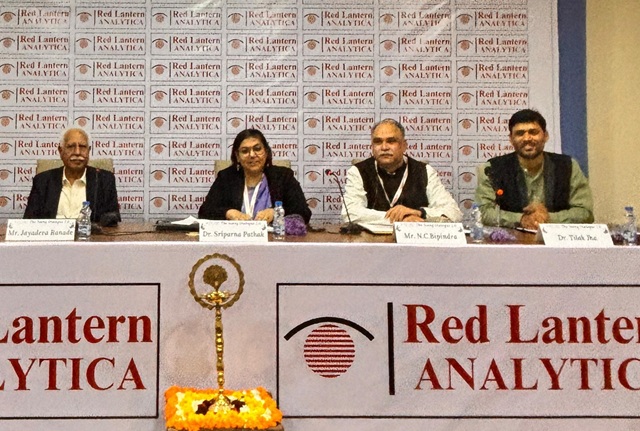
The Deputy Representative of the Taipei Economic and Cultural Centre in India, Robert Hsieh Bor-Huei, issued a strong rebuttal to China’s ‘One China Policy’ during his address at The Siang Dialogue 2.0 in New Delhi. The two-day event, organized by Red Lantern Analytica, convened global experts, policymakers, and academics to discuss pressing geopolitical, economic, and security issues.
Speaking to the Sri Lanka Guardian, Hsieh stated that the One China principle is nothing but a “scam,” emphasizing that Taiwan was never under the control of the People’s Republic of China (PRC). He also asserted that the Republic of China (ROC), which governs Taiwan, and the PRC have always been separate entities since 1949.
He warned that Beijing has an expansionist geopolitical agenda, citing its attempts to claim Japan’s Okinawa as an example. These actions have already led to tensions between China and Japan. He urged democratic nations to unite against such designs by China.
“Remember that Taiwan’s security is critical to maintaining stability in the Indo-Pacific region, and hence any attempt by China to expand its illegal claims should be thwarted,” he added.
The Siang Dialogue 2.0 also addressed pressing geopolitical challenges, information warfare, and cyber defense. Sujeet Kumar, MP (Upper House of the Indian Parliament), spoke about India’s growing soft power and the Indian government’s diplomatic initiatives.
The Executive Director of the Centre for Uyghur Studies, Abdulhakim Idris, highlighted the human rights crisis in Xinjiang, examining China’s treatment of the Uyghur community and the plight of Uyghur refugees. Meanwhile, Aadil Brar, a journalist based in Taiwan, outlined the border challenges India faces from neighboring countries, particularly China’s military presence along the Line of Actual Control (LAC).
Speaking on India’s role in a transforming global order, Sriparna Pathak focused on India’s economic ties with Southeast Asian countries. Jaydev Ranade, a member of India’s National Security Advisory Committee, analyzed President Xi Jinping’s influence on China’s foreign policy, including the ‘China Dream’ and its implications for Taiwan. He also examined China’s expansionist ambitions in the region, while N.C. Bipindra (Editor, Defence Capital) discussed India’s countermeasures against China, including cyber defense and navigating the restrictions of China’s Great Firewall.
An interesting perspective was presented by Tilak Jha, a professor at Bennett University, who discussed narrative-building as a tool to influence public opinion and explored how power politics shapes narratives.
The second plenary session, “Shaping the Future: India’s Role in a Transforming Global Order,” explored India’s economic ties with Southeast Asia, China’s growing influence in South Asia, and territorial disputes with China. Major Amit Bansal, a renowned defense strategist, addressed India’s territorial disputes with China and the increasing proximity between China, Pakistan, and Bangladesh, which has led to a complex geopolitical situation for India. Tenzin Tsundue, a poet and Tibetan activist, spoke about the Tibetan government-in-exile, the Dalai Lama’s reincarnation, and the Tibetan independence movement.
Meanwhile, R. Evan Ellis (Research Professor, U.S. Army War College SSI) discussed India’s trade and economic relations with Latin America and the Caribbean, highlighting strategic opportunities in space technology. Air Commodore S.P. Singh VSM (Senior Fellow, CAPS) emphasized India’s strategic influence in global affairs, analyzing the evolution of QUAD and QUAD Plus, as well as the significance of the Indian Ocean maritime route.
Discussions were also held on cyber threats and building resilient economies. Paul (Editor, Greek City Times) emphasized that the India-Middle East-Europe Economic Corridor (IMEC) is a viable alternative to China’s controversial Belt and Road Initiative (BRI). Regarding cyber threats, experts—including Jayanta Kalita (Senior Editor, Times of India)—examined how Chinese AI models, including DeepSeek, have been programmed to avoid discussing topics sensitive to the Chinese Communist Party’s image. Namrata Hasija (Research Fellow, Centre for China Analysis & Strategy) focused on disinformation campaigns as a key component of China’s broader information warfare strategy, aimed at shaping global narratives, suppressing dissent, and countering criticism.
Ninong Ering, a member of the Arunachal Pradesh State Legislative Assembly and Co-Chair of IPAC (India), as well as a former Union Minister, underscored the importance of countering Chinese authoritarianism and building resilience to global challenges.












