Editorial
Sri Lanka is on the verge of a national disaster, teetering precariously as a government—a group of political opportunists disguised as so-called experts—pulls the country into a tailspin of chaos. What was once trumpeted as a “new dawn,” a political renaissance, as they campaigned it, heralding transparency, justice, and reform, now stands as a grotesque parody of the very ideals it was supposed to embody. It is no longer a story of hope and promise. It has become an all-too-familiar narrative of mismanaged power, arrogance, and a ruling class that has betrayed the trust of the people.
The very government that claimed to dismantle the old political order—rife with corruption and elitism—is proving to be nothing more than a rerun of a failed show. Only now, it is dressed up in the language of “progress,” “transparency,” and “reform,” masking its true intent: to maintain power at all costs. These individuals, who came to power proclaiming ideals of justice, have been exposed for what they are: opportunistic puppets playing a dangerous game with the nation’s future.
Incompetence is no longer the defining trait of this government; it has evolved into something far more sinister. From the top down, political figures masquerade as self-declared intellectuals—beacons of wisdom who claim to have the answers to Sri Lanka’s woes, but who are, in fact, unqualified charlatans. The nation is now at the mercy of these self-styled “reformers,” whose decisions serve not the public good, but their own narrow political ends. With every passing day, the situation grows grimmer, and the promises of reform slip further into the realm of absurdity.
Last week, the entire world was entertained by the curious pronouncement of the Minister responsible for power, who proposed an unconventional theory to explain the nationwide blackout—asserting that a monkey was to blame. A week later, the Ceylon Electricity Board, under the leadership of this same Minister, who had become the subject of global mockery, provided a detailed technical explanation for the cause of the islandwide power outage, absolving the monkey of any involvement and offering an in-depth account of the actual issue.
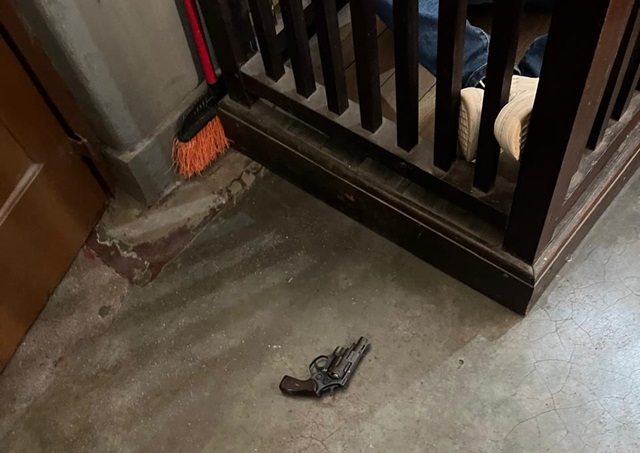
However, the spectacle took a darker turn today, as what had once been a farce evolved into a tragedy. For the first time inside a high-security courtroom, an alleged criminal was shot dead, presumably by a contractor, before making a swift escape. The events surrounding the gruesome killing of Ganemulla Sanjeewa this morning in a courtroom—an incident that should never have occurred—highlight the complete collapse of any semblance of governance in Sri Lanka. A courtroom, a symbol of justice and order, has now become a stage for bloodshed. The killing of a notorious criminal in such a brazen manner exposes the government’s utter indifference to law and order. The silence that followed, the inaction in the face of such violence, speaks volumes. If this is the state of affairs now, one can only imagine what will come next.
This is no isolated incident. This is not merely an example of individual criminality. This is symptomatic of a larger, systemic breakdown in national security. The rule of law, once the bedrock of Sri Lanka’s governance, is being eroded piece by piece. The government’s inability to effectively address such a violent spectacle in the courtroom reveals a deeper rot—one that is spreading throughout the nation. If the very institutions meant to safeguard the public—such as the judiciary—are no longer functioning, then what is left? The government, once a beacon of supposed reform, now finds itself presiding over a broken state, where its only concern is holding onto power. The political opportunists in charge have no vision for the country’s future; they only have an unrelenting desire to remain in control.
What is the government’s response to such violence? Silence. What are we to make of this indifference? This is no longer a question of political failure. This is a question of governance—of the deliberate unraveling of the social contract between the people and the state. The country is slipping into an abyss, and the government’s inaction is its guide. The idea of accountability is dead; any hope for a meaningful dialogue with the people is a distant dream. In a society already fractured by years of conflict, the government’s apathy only deepens the rift.
But perhaps more disturbing than the government’s inaction in the face of violence is the creeping authoritarianism that is slowly taking root. Sri Lanka is not yet fully an authoritarian state, but it is quickly moving in that direction. It is not the bold, decisive moves of an authoritarian government that we are seeing, but the subtle, insidious creeping of power into the hands of a few—those same political opportunists who now occupy the halls of power. They are not interested in the country’s future. They are interested only in consolidating their power, and they will do so at any cost.
The government’s authoritarian tendencies are subtle yet alarming. Public dissent is increasingly met with repression, and opposition voices are silenced through intimidation and force. There is no longer space for disagreement, no tolerance for opposing views. Those who once championed the cause of democracy now revel in their power, blind to the fact that their actions are sowing the seeds of their own destruction. The ruling faction—steeped in its own arrogance and delusion—has begun to view itself as the rightful arbiter of the country’s fate, its control over the levers of power becoming ever more absolute. But this is not a government of reform; it is a government of repression, led by opportunists with no vision for the nation beyond their own self-interest.
The regime is trapped in a cycle of self-preservation, unable to break free of the lies it has fed to the public. The people who put these individuals in power—those who believed in a better future—are now left watching as their hopes are dashed, their faith betrayed. And yet, the government persists, arrogantly assuming it can continue to lead the country into deeper turmoil. The political opportunists at the helm seem utterly oblivious to the consequences of their actions. They continue to grasp for power, blind to the fact that the very fabric of the nation is being torn apart under their watch.
In the end, this government may not fall by the hands of a foreign enemy or a violent uprising. It may simply crumble under the weight of its own incompetence, arrogance, and inability to understand the nature of true leadership. The country is sliding into a crisis from which it may not recover, not because the people lack the will to fight for a better future, but because the political opportunists at the top have shown no intention of putting the country’s needs above their own.
The question is simple: Who will act first? The government or the people?