by Our Correspondent in Colombo
Oh, what an exquisite irony unfolds before us! In the grand theatre of Sri Lankan democracy, where elected representatives are presumably the protagonists, a new figure has taken centre stage—unelected, unaccountable, yet serenely omnipotent. Enter Comrade Tilvin Silva, the General Secretary of the JVP, a man who has mastered the art of wielding power without the pesky burden of electoral legitimacy.
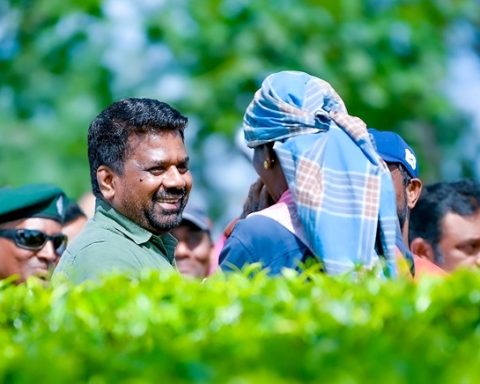
One might ask, “Who anointed him?” Was it the invisible hand of the proletariat, whispering through the winds of Ella as he stood atop his Defender, police officers saluting him with the reverence befitting a monarch? Or was it simply the gravitational pull of his ideological eminence that has drawn foreign dignitaries to his party headquarters in Pelawatta, more frequently than they deign to visit the Presidential Secretariat? Whatever the answer, the result is clear: the nation now finds itself under a peculiar form of dual sovereignty—one elected, the other self-proclaimed.

The spectacle grows ever more intriguing. When the Indian conglomerate Adani withdrew from a renewable energy project, ostensibly citing governmental bureaucracy and regulatory hurdles, it was not the elected officials who found themselves in urgent diplomatic discussions. No, it was Tilvin Silva who graced the hallowed halls of India House, the official residence of the Indian High Commissioner. One might recall a time—not so long ago—when a strict circular was issued, prohibiting any unauthorised tête-à-têtes with foreign diplomats. But who, pray tell, is authorising Tilvin now? Perhaps authority itself has become an antiquated concept, obsolete in the face of a new political reality where power is a matter of possession rather than permission.
Ah, but here is where the spirit of Lenin truly comes alive! Marx once proclaimed that history repeats itself—first as tragedy, then as farce. Lenin, in his wisdom, added that the state must wither away. But here, dear comrades, we see something even more peculiar: not the withering of the state, but its outsourcing! The democratically elected government stands idly by while governance is conducted by a parallel power, one that need not sully its hands with mundane affairs like elections or constitutional legitimacy.
And what of our international comrades, those self-anointed Lenins of the modern age? Ah, how they pontificate on revolutionary struggle, how they wield words like “dictatorship of the proletariat” without the slightest understanding of the texts they so fervently quote! One can almost hear Lenin’s ghost muttering from the beyond: “Have they even read State and Revolution?!” Indeed, many of these self-styled revolutionaries believe themselves to be the reincarnations of Bolshevik firebrands, when in reality, they are little more than bourgeois functionaries draped in red rhetoric.
The people—oh, the poor, unsuspecting people!—are only now beginning to digest the false renaissance they so fervently celebrated. Years of carefully cultivated propaganda have now ripened into a bitter harvest, where democracy appears as a mere façade, and governance is wielded by those who never dared to stand for election.
And let us not forget the broader ecosystem of power accumulation. A certain political “adviser”—a chameleonic figure who has slithered through multiple administrations—has now resurfaced in the current government, ensuring his lineage prospers. As whispers of nepotism ripple through Colombo’s salons, we learn of a nephew conveniently appointed as an ambassador to a Middle Eastern nation. Ah, the perpetuity of power—an art as old as politics itself!
Meanwhile, the masses, burdened by economic hardship, find themselves trapped in an Orwellian nightmare where the slogans of justice and equality are mere echoes of a bygone idealism. Tilvin, much like the apparatchiks of a Soviet politburo, continues his march, overseeing affairs with an authority that defies the logic of democracy itself.
And so, dear reader, we find ourselves at the mercy of a paradox. We cast our votes, we elect our representatives, and yet, we are governed by an entirely different cadre—one that exists in the shadows, unburdened by the mundane expectations of democratic accountability. It is a phenomenon not unlike the fabled philosopher-kings of Plato’s Republic, except that in this version, the philosopher is a seasoned comrade, and the kingship is but a consequence of political inertia.
Oh, but no offence, Comrade Tilvin. Long live the unseen hand of Sri Lanka’s phantom presidency!