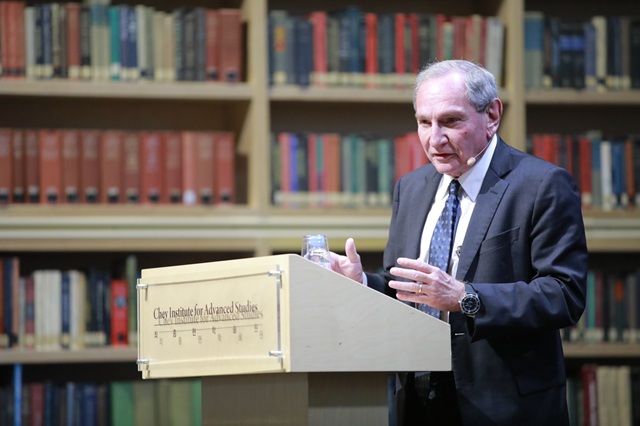
In a recent, candid interview with Ed D’Agostino of Mauldin Economics, George Friedman, renowned geopolitical expert and founder of Geopolitical Futures, provided a strikingly prescient analysis of the current and future trajectory of international relations. With Donald Trump set to resume the presidency in January 2025 following a contentious re-election in 2024, Friedman’s insights now carry even greater significance. The political shift heralded by Trump’s return to office could dramatically alter the global balance of power, particularly with regard to Russia’s diminishing influence. The following article draws from the expert perspectives shared in the interview – Editors.
“You may not like him, but Trump knows exactly what he’s doing,” Friedman declared in his usual blunt manner. For many, the idea that a businessman-turned-politician, with such an unconventional approach to foreign policy, could become a stabilising force seems counterintuitive. However, Friedman’s commentary reveals that, under Trump, the United States is poised to challenge Russia in ways that will leave the Kremlin scrambling. The key question here is: How did the United States, under Trump, come to dominate the strategic chessboard, and what role does Russia play in this evolving game?
The Re-Election of Donald Trump: A New Phase of Global Engagement
“Trump’s second term isn’t just a continuation of the first. It’s a reckoning for Russia,” Friedman asserted. The re-election of Donald Trump was a seismic shock to the global political order. While many predicted a resurgence of old alliances, Friedman saw it differently: “The real challenge to Russia comes not from a divided West, but from the simple fact that Trump’s America is no longer the one that cowers to Europe’s sensibilities. This is a pragmatic, strategic America, and it will make decisions based on a hard-headed understanding of where its interests lie.”
Trump’s unorthodox first term was already marked by a departure from traditional alliances, with the U.S. pulling back from multilateral agreements like the Paris Climate Accords and the Iran nuclear deal. For many, it appeared as though Trump’s administration was an exercise in self-interest, focusing on ‘America First’ while alienating long-standing allies. Yet, as Friedman argues, Trump’s actions were not mere isolationism; they were driven by a strategic, albeit controversial, goal: to secure U.S. interests in a world where Russia and China were rapidly asserting themselves.
“Trump’s foreign policy is deeply transactional,” Friedman continued. “Unlike his predecessors, he doesn’t care about the veneer of multilateralism or the niceties of diplomacy. What matters is American power and leverage. This is why, under Trump, the U.S. is willing to make unconventional moves, and, yes, it will press Russia into submission if necessary.”
The idea that Trump could bring the U.S. back to dominance through sheer will and strategic positioning raises uncomfortable questions about the future of international norms. But in a world where traditional alliances are fraying, and where Russia’s aggressive actions are destabilising Europe, Trump’s approach might be the most rational course of action.
Russia’s Miscalculations: The War in Ukraine and Its Fallout
Friedman’s analysis of the situation in Ukraine provides a chilling view of Russia’s dire strategic position. “Vladimir Putin’s decision to invade Ukraine wasn’t just a blunder—it was a catastrophic miscalculation. Russia is paying a price it cannot afford, and this will weaken their position globally,” Friedman remarked, bluntly. “Putin believed that the West was weak, that NATO was fractured, and that America under Biden would be hesitant to intervene. He could not have been more wrong.”
As Friedman pointed out, the invasion of Ukraine in 2022 has had a profound impact not only on Russia’s military but on its geopolitical standing. “What Putin has failed to understand is the unity that the war has created in the West. NATO is not broken, and Europe is not divided. Rather than fragmenting the alliances, the war in Ukraine has strengthened them, especially under the leadership of the United States. Trump, in particular, understands this dynamic, and he will exploit it for all it’s worth.”
In this context, Trump’s strategy will likely centre on keeping Russia’s military bogged down in Ukraine while making sure the U.S. doesn’t get drawn into a direct conflict. “Trump’s goal will be simple: weaken Russia without triggering World War III,” Friedman said. “The U.S. will continue to supply military aid to Ukraine, increase sanctions on Russia, and isolate it diplomatically. This isn’t about winning a war; it’s about making sure Russia loses—its resources, its standing, and its global influence.”
Friedman’s statement reflects a controversial but clear-eyed view of the war’s long-term implications for Russia. Putin, who believed he could intimidate Ukraine and the West into submission, is now facing the harsh reality of a protracted war with no easy exit strategy. As a result, Friedman predicts that Russia’s ability to project power, particularly in Europe, will be dramatically diminished in the coming years. “Russia is in decline,” he emphasised. “What Putin doesn’t realise is that by overextending his military, he is slowly eroding Russia’s capacity to threaten the West. The war in Ukraine is Russia’s ultimate self-destruction.”
The United States as the World’s Only True Superpower
What does this mean for the United States, and specifically for Trump’s vision of American dominance? “Trump’s approach to foreign policy isn’t about diplomacy for diplomacy’s sake,” Friedman argued. “It’s about using power as a lever. He won’t shy away from a confrontation if it serves American interests, and that includes confronting Russia head-on. But the key to Trump’s strategy is that it’s not based on ideology—it’s based on pragmatism.”
Trump’s re-election marks a clear shift in U.S. policy towards Russia. Instead of seeking to contain or coexist with Russia, Trump will likely focus on ensuring that Russia’s influence is sharply diminished. “The U.S. will continue to escalate its support for Ukraine, but more importantly, it will work to ensure that Russia has no viable path to recovery,” Friedman explained. “The U.S. has the power to hurt Russia economically, militarily, and diplomatically. Trump understands this, and he won’t hesitate to use it.”
As Russia’s military falters in Ukraine, its economic sanctions continue to bite, and its diplomatic isolation deepens, Trump’s pragmatic use of American power will aim to keep Russia in a perpetual state of decline. “This is the American way of doing things now,” Friedman concluded. “You don’t just defeat your rivals; you ensure that they never have the capacity to challenge you again. And for Russia, that means a future where it’s not a great power, but a declining state, increasingly irrelevant on the world stage.”
The Decline of Russia: A Geopolitical Miscalculation of Historic Proportions
The larger question remains: Can Russia recover from this strategic disaster? Friedman is sceptical. “What Putin has failed to see is that the U.S. is no longer content to play by the old rules of geopolitics. The world has changed, and Russia is being left behind. The U.S. will continue to push back against Russia’s ambitions in Europe, using a combination of military, economic, and diplomatic pressure to ensure that Russia remains weak.”
For Russia, this is not just a question of losing a war in Ukraine; it is a matter of losing everything. “Russia’s future will be shaped by a cold reality,” Friedman predicted. “They may hold onto their nuclear arsenal, but without the economic or political power to project influence, they will be sidelined. Putin has boxed Russia into a corner, and the U.S. is going to make sure it stays there.”
Trump’s World Order
As Donald Trump assumes the presidency once more, the world faces an uncertain future. But one thing is clear: the United States, under Trump, will not allow Russia to remain a major player in the global order. The coming years will see a systematic effort to weaken Russia, using all the tools at the U.S.’s disposal. This may involve direct pressure on Russia’s allies, continued sanctions, and strategic engagement with countries that have been on the periphery of the West.
In a world of shifting alliances and rising powers, Trump’s return to the White House marks a new phase in global geopolitics. Friedman’s analysis reveals the harsh truths behind Russia’s decline and the role the United States will play in ensuring that decline continues. For Putin, the future is bleak; for Trump, the opportunity to reshape the global order is now.
“Russia lost everything the moment they miscalculated Ukraine,” Friedman summarised. “Now, the question is how far the U.S. is willing to push to ensure that they never regain it.”