



by Paul
Michael Mandelbaum’s The Titans of the Twentieth Century purports to be an incisive exploration of eight men who “made history and the history they made.” The author, with an almost reverential tone, presents Woodrow Wilson, Vladimir Lenin, Adolf Hitler, Winston Churchill, Franklin Roosevelt, Mohandas Gandhi, David Ben-Gurion, and Mao Zedong as the definitive architects of the modern world. Yet, despite its erudition and sweeping narrative, this book succumbs to the most dangerous of historical fallacies: the myth of the “Great Man.” It is an insidious distortion that not only overestimates the role of individuals but also whitewashes the darker aspects of their legacies.
Mandelbaum states that “[m]ost people do not affect events beyond the scope of their personal lives,” but these men “did”. This assertion, so uncritically accepted, is the book’s foundational flaw. It is a seductive but simplistic reading of history that ignores the systemic forces that enabled these figures to rise and shape their times. Did Hitler “make” the Holocaust, or was it the confluence of bureaucrats, industrialists, and centuries of European antisemitism that allowed it to unfold? Did Roosevelt “create” the New Deal, or was it the desperate struggle of millions of workers, unions, and progressive intellectuals that forced his hand? Mandelbaum skirts such questions, preferring the comfort of individual agency over the inconvenient complexities of socio-political movements.
Moreover, the book’s selection of figures betrays a troubling bias. The absence of Joseph Stalin—arguably the most consequential leader of the 20th century—raises immediate concerns. Mandelbaum rationalises his exclusion by claiming that Lenin was the “chief architect” of the Soviet Union. Yet, Stalin, not Lenin, defined the USSR’s trajectory, orchestrating industrialisation, mass terror, and the Cold War order. The omission of figures such as Atatürk, Charles de Gaulle, or even Franklin Roosevelt’s successor, Harry Truman, suggests an arbitrary and Western-centric approach. The most glaring lacuna, however, is the complete absence of women. Mandelbaum acknowledges Golda Meir, Indira Gandhi, and Margaret Thatcher but excuses their exclusion on the grounds that they belonged to the “second half of the century”. This reasoning is disingenuous—Mao and Ben-Gurion both exercised their influence well into the 1970s. The book thus implicitly reinforces the notion that history is a male domain, an unchallenged assumption that reeks of antiquated historiography.
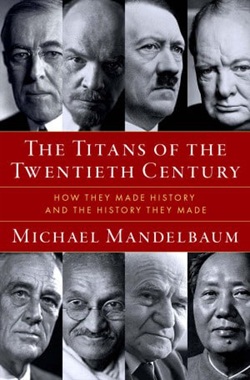
Mandelbaum’s treatment of his chosen figures varies from hagiography to measured critique, but even his condemnations are curiously selective. The three dictators—Lenin, Hitler, and Mao—are treated as malevolent, yet there is a tendency to frame them as tragic figures, their cruelty explained as a byproduct of ideological commitment rather than conscious choice. Lenin is depicted as a man whose “novel, radical, indeed revolutionary ideas” shaped history, but this sanitises the brutality of the Red Terror and his utter contempt for democracy. Hitler, described as the “most extreme nationalist of all”, is rightly condemned, yet his ideological convictions are dissected with an academic detachment that fails to capture the sheer horror of his rule.
By contrast, the democratic figures receive a more indulgent treatment. Churchill, despite being an unapologetic imperialist responsible for the Bengal famine, is lionised as a defender of “British independence and the sovereignty of the countries of Europe”—a grotesque irony given his role in maintaining colonial subjugation. Roosevelt is lauded for preserving American democracy, yet his internment of Japanese Americans is relegated to a footnote. Gandhi, whose casteist attitudes and reluctance to challenge Hindu orthodoxy should at least complicate his saintly image, is presented as an unassailable moral leader. The author’s selective moral calculus reveals an implicit hierarchy of sins: those of the democratic leaders are mere “failures,” while those of the dictators are existential evils.
One of the book’s most problematic assumptions is its underlying celebration of power as an inherently valuable trait. Mandelbaum declares that these men possessed “self-confidence, energy, resilience, and perseverance”—as though these qualities alone justify their status as history-makers. But what of morality? What of the consequences of their actions? Resilience is not inherently virtuous; it is only as good as the cause it serves. Hitler, too, was resilient. So was Stalin. So were countless despots who wielded power with unrelenting force. The book’s failure to distinguish between power as an instrument of justice and power as an instrument of domination is one of its most insidious intellectual failures.
Perhaps the most galling oversight of The Titans of the Twentieth Century is its lack of engagement with the limits of individual agency. Mandelbaum briefly acknowledges Karl Marx’s dictum that “men make their own history, but they do not make it as they please”, yet he does not fully grapple with its implications. The 20th century was not shaped by these men alone; it was shaped by the masses who followed them, resisted them, or were crushed by them. The book glosses over the role of social movements, economic structures, and ideological currents. Did Churchill “save” Britain, or was it the collective resilience of the British people? Did Mao “establish” modern China, or was it the millions of peasants and workers who laboured, suffered, and died in his campaigns? Mandelbaum’s failure to answer these questions renders his history not only incomplete but dangerously misleading.
The book’s conclusion is particularly revealing in its wistful lament that the age of “heroic leadership” has passed. This sentiment is as naive as it is ominous. Should we truly mourn the decline of singular figures with unchecked power? The 21st century has seen the rise of leaders who aspire to be “Titans”—from Trump to Putin to Xi Jinping. Their brand of populist, authoritarian leadership is precisely what the modern world must resist. If the 20th century teaches us anything, it is that placing history in the hands of singular figures, no matter how charismatic or ideologically driven, leads to catastrophe.
The Titans of the Twentieth Century is a well-researched but profoundly flawed work. It is a relic of an outdated historiographical tradition that elevates individuals at the expense of broader social forces. Its omissions, biases, and moral inconsistencies render it more a tribute to myth than a serious work of historical analysis. Mandelbaum, in seeking to understand the past, has instead produced a glorification of power—one that, if uncritically accepted, risks distorting our understanding of history itself.









