


by Satchi
Deepa Mandlik’s Dynasties of Devotion is a work that does not merely present temples as places of worship, but as testaments to an India that thrived on artistic ambition, imperial patronage, and the politics of faith. The book is not just about stone structures; it is about history’s breath echoing through the chiselled deities and intricate carvings that survived the brutal passage of time.
From the grandeur of the Brihadeeswara Temple to the haunting remnants of Hinduism in Cambodia’s Angkor Wat, Mandlik does not shy away from drawing the reader into the paradox of cultural endurance and religious erasure. In her contemplation of Cambodia’s past, she does not mince words: “Witnessing the gradual erosion of a culture that had thrived and been widely embraced for centuries was indeed disheartening” (p. 112). This statement, more than any other, forces the reader to confront an uncomfortable reality—the erasure of history is not always a matter of decay but often of deliberate replacement.
Mandlik’s exploration of the Kailasa Temple at Ellora challenges modern scepticism with a well-articulated takedown of conspiracy theories. She scoffs at the notion that this architectural marvel was built by extraterrestrials rather than by the Rashtrakuta dynasty, asking provocatively: “The question arises: why is this alien logic selectively applied to Kailasa, and what underpins the scepticism towards the accomplishments of ancient Hindus?” (p. 85). It is a sharp critique of the intellectual laziness that denies indigenous genius its due credit, reducing a civilisation’s achievements to the realm of myth and fantasy.
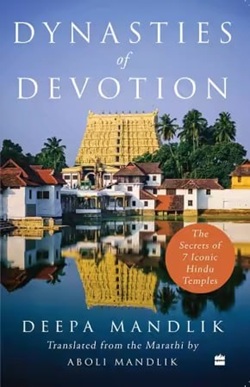
The book also raises the question of how political power and temple patronage were deeply intertwined. In her discussion of the Chola empire, she highlights how “King Rajaraja’s temple was not merely a spiritual sanctuary; it was a stage where power performed” (p. 58). These temples, built with precision and mathematical brilliance, were more than mere religious centres—they were declarations of dominance, places where kings immortalised their rule in stone.
Yet, Mandlik’s work does not succumb to nostalgia; she acknowledges the contradictions of temple culture. In her reflection on the sculptors and artists behind these grand edifices, she raises a poignant point: “When an artist creates an idol that evolves into a deity worshipped by society, they relinquish control over it” (p. 132). The tension between art and devotion, between individual creation and communal ownership, runs as an undercurrent throughout the book.
One cannot read Dynasties of Devotion without questioning the modern-day neglect of these grand testaments to the past. As Mandlik notes during her visit to the Chennakeshava Temple, “While foreign visitors marvelled at the intricacies of its stone sculptures, the indifference displayed by some of our own countrymen towards their heritage was disheartening” (p. 147). This is a sentiment that should provoke unease—why do we fail to respect and preserve the legacy left to us?
Further, Mandlik delves into the enigmatic Padmanabhaswamy Temple, where divinity and wealth intersect in a perplexing manner. She recalls the myths surrounding Vault B, writing, “There were myths associated with Vault ‘B’, such as there being an engraved image of two cobras on the door and a belief that opening it would cause a catastrophic flood destroying the world” (p. 175). This legend, whether one views it with reverence or scepticism, speaks to the temple’s deep entanglement with power, mystery, and faith.
The author’s descriptions of the sculptural grandeur of temples such as Airavatesvara and Chennakeshava are particularly striking. She notes how the sculptures in the Airavatesvara Temple “capture the most intricate expressions, where even the subtlest gestures of a deity’s hand tell an entire story” (p. 98). Similarly, at the Chennakeshava Temple, the ornate pillars are described as “an artist’s rebellion against time, a defiance against the transience of human endeavour” (p. 145). Such reflections elevate the book from a mere architectural chronicle to a philosophical meditation on history and artistic legacy.
Mandlik also unpacks the political motives behind temple patronage. She examines how the Chola kings ensured their deification through architectural feats, remarking: “These kings did not just build temples; they built their immortality” (p. 62). In contrast, she discusses the Rashtrakutas’ motivation behind the Kailasa Temple, calling it “a monument to a dynasty’s audacity, to their unshaken belief in their divine right to rule” (p. 90). Such insights remind us that temples were not only spiritual centres but also instruments of power and control.
Throughout the book, Mandlik maintains a fine balance between admiration and critique. She acknowledges the brilliance of ancient temple architecture but also questions the exploitative systems behind their construction. She writes, “For all their grandeur, these temples were built through the toil of unnamed artisans whose names history has erased” (p. 110). This tension—between artistic brilliance and the historical amnesia regarding its creators—adds depth to the narrative.
The book’s most pressing question remains: what happens when we neglect our heritage? Mandlik does not hesitate to lament the apathy toward temple conservation. She warns, “A forgotten monument is history’s funeral” (p. 188). Her call to action is urgent and necessary, as she urges readers to see these temples not as relics of the past but as living testaments to an enduring civilisation.
This book is not merely about temples; it is about the aspirations, ambitions, and contradictions of Indian civilisation. It demands that the reader ask difficult questions: Who owns history? Who gets to narrate it? And, most importantly, who is responsible for ensuring it is not forgotten?










