



by Nil
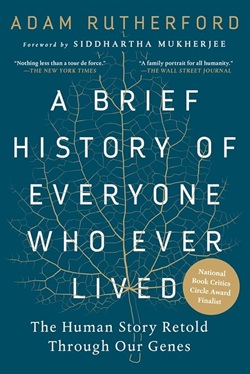
Adam Rutherford’s A Brief History of Everyone Who Ever Lived is an incendiary, provocative, and profoundly necessary book. It does not merely narrate human history through the lens of genetics; it dissects, dismantles, and challenges long-held myths about race, identity, and the flawed science that has often sought to categorise humanity into simplistic boxes. At a time when political and cultural discourse is still polluted by outdated notions of racial purity and genetic determinism, Rutherford’s work arrives like a genetic wrecking ball, shattering these illusions with empirical evidence and razor-sharp wit.
At the core of Rutherford’s book is a direct confrontation with the toxic legacy of eugenics, a pseudo-science that has shaped policies and prejudices for over a century. He exposes the disturbing fact that many of the most celebrated figures in history were not only influenced by eugenic thought but actively promoted it. “Francis Galton, the father of eugenics, sought to categorise humanity into hierarchical structures, arguing that intelligence and success were hereditary” (p. 75). This wasn’t an isolated belief. Winston Churchill, Theodore Roosevelt, and even Marie Stopes – the famed advocate for women’s reproductive rights – harboured deeply disturbing views on racial purity and genetic ‘fitness’ (p. 112). The consequences of these ideologies, Rutherford reminds us, were not confined to academic debate but fuelled policies of forced sterilisation in the United States and beyond, with the Nazis taking these ideas to their most horrifying conclusion (p. 143).
Yet, the book is not merely an exposé of historical atrocities. It is also an exploration of how modern genetics has debunked many of the racist assumptions that underpinned these ideologies. Rutherford meticulously dismantles the idea that race has any meaningful genetic basis. “There are no essential genetic elements that define any particular racial group” (p. 198), he asserts, demonstrating that genetic diversity within so-called racial groups is often greater than between them. This argument is not mere rhetoric; it is backed by a wealth of genetic data. The human genome, far from being a rigid map of identity, is a tangled web of migrations, interbreeding, and shared ancestry that refuses to conform to the neat racial categories imposed by society.
Perhaps the most unsettling revelation of the book is how contemporary genetic testing companies exploit public ignorance to sell an illusion of ancestry. “23andMe and similar services offer a narrative of identity that is more poetic than scientific” (p. 224), Rutherford argues, warning against the reduction of complex genetic histories to simplistic percentages. He is especially scathing of those who use DNA tests to assert dubious claims of racial superiority or ancestral purity. “Every single one of us is the result of countless entanglements, betrayals, conquests, and migrations. The idea that any lineage is ‘pure’ is both scientifically absurd and historically illiterate” (p. 237).
The book also delves into the thorny relationship between genetics and behaviour. While the media and public often grasp for simplistic explanations—linking genes to intelligence, criminality, or even political leanings—Rutherford cautions against such reductionism. “Genetics is not destiny. It is probability, interacting with environment, chance, and culture” (p. 259). He critiques books like Nicholas Wade’s A Troublesome Inheritance, which attempt to draw direct lines between genetics and racial characteristics, dismissing them as “clumsy, racist, and scientifically bankrupt” (p. 276). His point is clear: the allure of genetic determinism is strong, but it is ultimately a misleading and dangerous narrative.
One of the book’s most fascinating sections explores the Neanderthal legacy within modern humans. Many Europeans and Asians carry small percentages of Neanderthal DNA, a fact that has been twisted by some into a point of racial pride. Rutherford eviscerates this idea, pointing out that “the presence of Neanderthal DNA does not confer superiority or inferiority; it is simply the genetic residue of ancient human interbreeding” (p. 308). Furthermore, he notes that African populations, often dismissed in racist discourse as ‘genetically inferior,’ actually carry the greatest genetic diversity of all human groups, reinforcing the book’s central thesis that race, as commonly understood, is a social construct, not a biological reality.
Rutherford does not shy away from controversy, nor does he offer comfortable conclusions. He challenges us to rethink what it means to belong, what it means to be human, and how we define ourselves in an era of increasing genetic knowledge. “If anything, the greatest lesson from genetics is that we are all related, all messy composites of countless ancestors, and all equally complex” (p. 356). This is a powerful rebuke to the growing movements that seek to divide people based on perceived genetic differences.
But for all its polemical edge, A Brief History of Everyone Who Ever Lived is ultimately a deeply humanist work. It is a call to embrace complexity, to reject simplistic narratives, and to celebrate the extraordinary interconnectedness of our species. Rutherford’s voice is at once authoritative and engaging, blending rigorous science with wry humour. He does not merely lecture; he provokes, questions, and forces the reader to confront the implications of the genetic revolution.
As the book closes, Rutherford leaves us with a stark warning: “Science is a tool, and like all tools, it can be used to build or to destroy. We have a choice in how we wield it” (p. 389). In an age where genetics is increasingly weaponised in political and ideological battles, this reminder is both urgent and necessary. A Brief History of Everyone Who Ever Lived is not just a book about genetics; it is a manifesto for a more informed, more sceptical, and ultimately more humane approach to understanding ourselves.









