


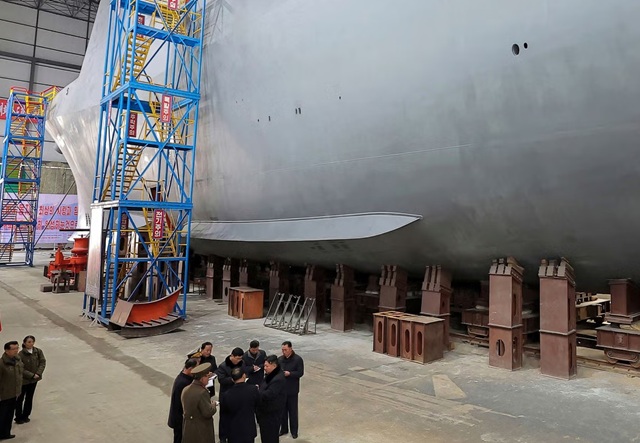
North Korea has revealed for the first time a nuclear-powered submarine under construction, a development that experts warn could pose a significant security threat to both South Korea and the United States. State media released images on Saturday of what it described as “a nuclear-powered strategic guided missile submarine”, with leader Kim Jong Un inspecting major shipyards where such warships are being built.
According to reports, including those from The Independent UK, North Korea has not disclosed specific details of the submarine’s capabilities. However, analysts suggest that the vessel could weigh between 6,000 and 7,000 tons and be capable of carrying around ten missiles, potentially nuclear-armed. Moon Keun-sik, a submarine expert at Hanyang University in Seoul, emphasised the gravity of the situation, stating that “it would be absolutely threatening to us and the US.”
The construction of a nuclear-powered submarine is part of Kim’s broader military ambitions, outlined during a 2021 political conference, where he pledged to enhance North Korea’s weapons capabilities in response to perceived US-led threats. Other planned advancements included solid-fuel intercontinental ballistic missiles, hypersonic weapons, spy satellites, and multi-warhead missiles. Since then, North Korea has accelerated its missile testing activities, seeking to materialise these ambitions.
A nuclear-powered submarine would significantly improve North Korea’s ability to launch missiles from underwater, making such strikes more difficult for adversaries to detect in advance. However, doubts remain over whether North Korea, a heavily sanctioned and economically struggling nation, has the resources and technology to develop such an advanced weapon system.
Speculation has arisen that North Korea may have received technological assistance from Russia in exchange for supplying conventional weapons and troops to aid Moscow’s war in Ukraine. Moon suggested that if this is the case, “North Korea could launch the submarine within one or two years to test its capabilities before deployment.”
Despite boasting an estimated 70-90 diesel-powered submarines, North Korea’s fleet is largely outdated, with most only capable of launching torpedoes and mines rather than missiles. The regime has been testing underwater-launched ballistic missiles since 2016, but most have been fired from a single 2,000-ton-class submarine with just one launch tube, which experts consider more of a test platform than an operational weapon.
North Korea previously claimed in 2023 to have launched its first “tactical nuclear attack submarine”, but foreign analysts largely dismissed the claim, suggesting the vessel was likely a modified diesel-powered submarine previously disclosed in 2019. So far, no independent verification has confirmed its deployment.
The unveiling of the new submarine comes amid rising tensions, with North Korea ramping up its aggressive rhetoric ahead of joint military exercises between the US and South Korea, set to begin on Monday. During his visits to shipyards, Kim Jong Un reiterated his commitment to modernising both surface and underwater naval forces, declaring that “the incomparably overwhelming warships must fulfil their mission” to counter what he termed “the inveterate gunboat diplomacy of the hostile forces.”










