


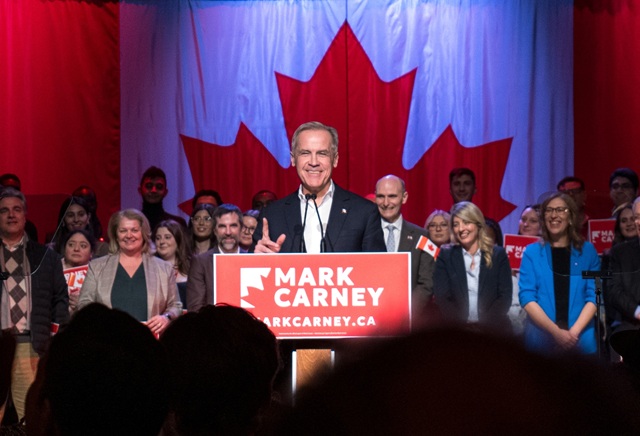
Canada’s ruling Liberal Party is set to elect a new leader on Sunday, with former central banker Mark Carney emerging as the frontrunner over former finance minister Chrystia Freeland. The leadership contest comes at a critical time as the country faces the immediate challenge of responding to a trade war with U.S. President Donald Trump.
Liberal party members, who began voting on February 26, have until Sunday afternoon to cast their ballots. The official results are expected to be announced between 5:00 PM and 7:00 PM in Ottawa, where the party’s new leader will be introduced to the nation.
After nearly a decade in power, Prime Minister Justin Trudeau announced his resignation in early January, citing declining poll numbers and internal party tensions. As the party seeks a new direction, Carney, the former governor of the Bank of Canada, has taken the lead in the leadership race, buoyed by strong fundraising and widespread support within party ranks.
An Angus Reid Institute poll released on Wednesday showed that 43% of Canadians believe Carney is best suited to take on Trump in a future election against opposition leader Pierre Poilievre, while Freeland polled at 36%. Poilievre, the Conservative Party leader, has long been expected to win a majority in the next federal election, but Trump’s trade threats have reshaped the political landscape in Canada.
The race for the Liberal leadership has taken on added urgency following Trump’s threats to impose a 25% tariff on Canadian imports and his controversial remarks about annexing Canada. These developments have sparked a wave of patriotism across the country, reinvigorating the Liberal base.
Freeland, who resigned as deputy prime minister in December, has emphasized the importance of Canadian sovereignty in the face of Trump’s aggressive trade policies. “Our sovereignty is not negotiable, and Canadians are incredibly united about that,” she said in an interview with the Financial Times.
Carney has focused his campaign on economic growth, pledging major infrastructure investments to strengthen Canada’s global competitiveness. “By accelerating decision-making on major projects, Canada will be able to lower costs, attract more investment, create more jobs, and build the strongest economy in the G7,” he stated.
Whoever wins the Liberal leadership may not hold the position for long, as a general election could be called as early as April or May. If elected, Freeland has proposed meeting with provincial premiers, business leaders, and unions to assess whether an early election is the best path forward. Carney, on the other hand, has indicated a preference for quickly calling an election to solidify the party’s mandate.
The transition to a new prime minister will require the approval of Canada’s governor-general, though the timeline for the official swearing-in remains uncertain. Meanwhile, the Liberal Party’s ability to maintain its minority government status faces challenges, with smaller opposition parties threatening to support a Conservative-led no-confidence motion when Parliament reconvenes on March 24.
The leadership race has not been without controversy. Candidates were required to pay a hefty C$350,000 (US$240,000) fee to enter, and the party has faced criticism over its strict voter registration process. Additionally, two leadership candidates were disqualified under unclear circumstances, further fueling internal party tensions.
With nearly 400,000 registered members participating in the vote, the contest marks one of the most closely watched political events in recent Canadian history. As the Liberal Party prepares to announce its new leader, all eyes will be on how Canada’s next prime minister tackles both domestic economic challenges and a volatile relationship with its southern neighbor.









