


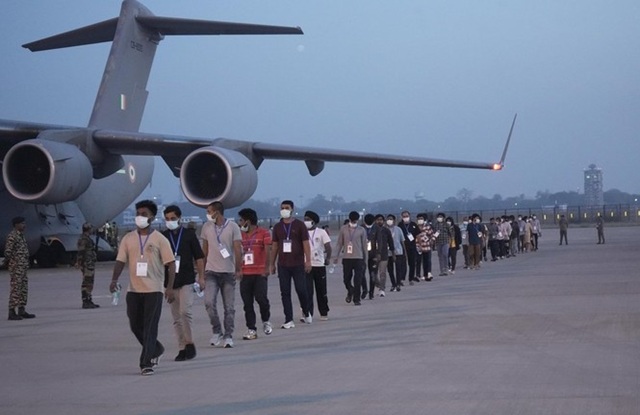
India has repatriated 549 citizens who were lured into scam centers along the Myanmar-Thailand border under the false promise of high-paying IT jobs, the Ministry of External Affairs announced on Wednesday. The rescued individuals were flown back to India in two groups via military aircraft earlier this week.
The victims were among thousands of Asian and African citizens who traveled to the region seeking employment opportunities, only to be trafficked into cybercrime syndicates. These scam operations, allegedly run by Chinese criminal networks, operate in Myanmar’s ungoverned border regions beyond the control of the central government.
External affairs ministry spokesperson Randhir Jaiswal stated that the Indian government had been making “sustained efforts” to secure their release. “These persons were subsequently made to engage in cybercrime and fraudulent activities in scam centers operating in regions along the Myanmar-Thailand border,” the ministry said in a statement, also warning citizens to remain cautious of such job offers.
Most captives were freed in a joint crackdown by Thai, Chinese, and Myanmar authorities. The operation led to the release of more than 7,000 individuals from locked compounds where they were forced to carry out financial scams, primarily targeting victims in the United States, according to the Associated Press.
The issue of cyber slavery has become a growing concern, with hundreds of Indian citizens falling prey to similar criminal networks in Cambodia, Laos, Myanmar, and Thailand. In January, India’s embassy in Laos successfully rescued 67 Indian men who had been trafficked into cyber fraud rings within a special economic zone.
One of the most notorious fraud schemes operated by these syndicates is the “pig butchering” scam, in which victims are manipulated into investing in fake financial platforms. The term is derived from an analogy where a farmer fattens a pig before slaughtering it, symbolizing how scammers build trust with their victims before financially exploiting them.
The extent of this crisis first surfaced in September 2024, when media reports revealed that thousands of Indians were being held as “cyber slaves” in Southeast Asia. According to New Delhi’s immigration authorities, of the 73,138 Indians who traveled to specific countries on visitor visas between January 2022 and May 2024, nearly 30,000 have yet to return, raising concerns about the scale of human trafficking linked to these cybercrime syndicates.










