


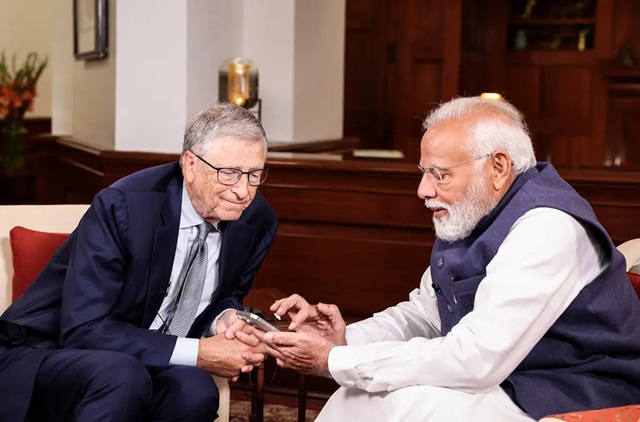
Billionaire philanthropist Bill Gates and Indian Prime Minister Narendra Modi share a close, high-profile relationship that has garnered significant attention over the years. The bond between the two figures has yielded benefits for both, with Gates’s Gates Foundation supporting key initiatives in India, a country crucial to his global philanthropic work. However, as noted by The New York Times, this alliance raises important questions about the erosion of democratic and human rights in India under Modi’s leadership.
The relationship between Gates and Modi was brought into the spotlight in September 2019, when Gates awarded Modi for his work in improving sanitation in India. The recognition, handed out during the United Nations General Assembly, sparked an outcry from Nobel Peace Prize laureates who argued that Modi’s record on democratic freedoms and human rights disqualified him from receiving such an accolade. Despite the criticism, Gates and Modi have continued to strengthen their ties, underscoring the complexity of their partnership.
India has long been a key focus for Gates’s philanthropic efforts, with the Gates Foundation heavily invested in the country’s development, particularly in the areas of public health, sanitation, and financial inclusion. Gates’s visits to India, which have become more frequent in recent years, reflect the importance of the country in achieving global development goals. In his latest blog post, Gates expressed his intention to further understand India’s innovations and progress during his upcoming visit, marking his third trip in just three years. His foundation’s ongoing presence in India is crucial, especially as the country grapples with extreme poverty and challenges related to global health.
For Prime Minister Modi, the endorsement from Gates offers a global seal of approval for his policies and serves as a bridge between the technological legacy of Gates and India’s vision for a digital economy. Modi’s push for technological advancement aligns with Gates’s belief in innovation as a powerful tool for social and economic progress. However, Gates’s increasingly close association with Modi has drawn criticism from those who argue that the partnership downplays the troubling aspects of the Modi government’s policies, particularly its stance on civil rights, religious freedoms, and its crackdown on dissent.
In The New York Times, it was highlighted that Gates’s relationship with Modi has become a strategic maneuver not just for philanthropic purposes, but also as a way to maintain access to a rapidly developing and influential nation. This close relationship comes at a time when global attention on India’s political climate has grown more critical, with the Modi government facing allegations of undermining secularism, suppressing opposition voices, and targeting religious minorities, particularly Muslims.
Gates’s association with Modi is not isolated. Many Western political and business leaders have sought to align themselves with India as the country rises in geopolitical importance, often overlooking or minimizing concerns about the state of democracy under Modi. However, critics like activist P. Sainath point out that Modi’s ties with Gates could be politically advantageous in the tech-driven segments of India’s middle class, who see Gates as an iconic figure tied to innovation and progress.
While the Gates Foundation has focused on its mission of public health and development, it has not been immune to the shifting political landscape in India. The Modi government has increasingly imposed restrictions on foreign-funded NGOs, targeting organizations like Greenpeace and the Public Health Foundation of India, which the Gates Foundation has supported. These regulatory measures have led to questions about the independence of international organizations in India and their ability to operate freely under the current regime.
Despite these challenges, Gates’s continued embrace of Modi’s leadership underscores a delicate balance between philanthropic objectives and the political environment in which these efforts are carried out. As Gates prepares for his upcoming visit to India, the ongoing collaboration between the Gates Foundation and the Indian government will be closely watched, especially as it intersects with broader concerns about the erosion of rights in the country under Modi’s rule.











