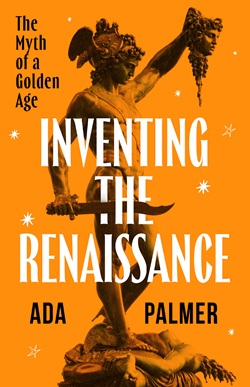
If history is the scaffold upon which civilizations build their myths, then Inventing the Renaissance: The Myth of a Golden Age ruthlessly dismantles one of the grandest illusions of all: the Renaissance as a beacon of unparalleled intellectual and artistic enlightenment. The book, erudite and unflinching, shatters the romanticized veneer of this period, exposing its fractures, hypocrisies, and revisionist triumphs.
One of the most striking assertions made in the book is that the Renaissance, far from being an era of rebirth and humanist purity, was in many respects an era of rebranded medievalism, where the supposed revival of antiquity was often nothing more than “a selective resurrection of Roman ideals, weaponized for the purposes of political legitimization and social stratification” (p. 144). The text unpacks the artificiality of the era’s self-congratulatory humanism, pointing out that figures like Machiavelli—often lauded as paragons of Renaissance thought—were simultaneously the products and manipulators of an era rife with deceit, paranoia, and power mongering. As the book notes, “Machiavelli’s world was not one of unbridled intellectual freedom but of calculated rhetoric, designed to navigate the labyrinthine intrigues of Medicean Florence” (p. 203).
The book does not shy away from targeting the contradictions within Renaissance art, frequently hailed as the pinnacle of aesthetic sophistication. It argues that the very masterpieces of Michelangelo and Raphael, often cited as “divine manifestations of human genius,” were, in reality, elaborate exercises in patronage politics, where artistic innovation was dictated less by the pure pursuit of beauty than by the economic and ideological imperatives of their commissioners (p. 275). “The gilded ceilings of papal halls were not merely canvases of divine inspiration, but elaborate propaganda pieces, carefully curated to align artistic legacy with ecclesiastical supremacy” (p. 285).
Perhaps the most radical deconstruction presented in this work is its treatment of the era’s so-called intellectual revival. The book dismantles the notion that the Renaissance represented an unprecedented reclamation of lost knowledge, arguing instead that it was largely an aestheticized regurgitation of antiquity. As the text incisively states, “Petrarch did not so much ‘rediscover’ antiquity as he did fashion it into a sentimentalized relic, embalmed for posterity rather than engaged with as a living intellectual force” (p. 147). The so-called recovery of Greek knowledge was often superficial, selective, and tailored to reinforce contemporary power structures rather than to genuinely expand human understanding (p. 68).
The treatment of the Medici, long enshrined as the architects of the Renaissance’s golden age, is particularly devastating. The book unearths the economic mechanisms behind their patronage, arguing that their financial empire was built on the backs of exploitative banking practices that made them “the godfathers of modern economic disparity” (p. 263). Lorenzo de’ Medici, often idealized as a benevolent patron of the arts, is instead depicted as an astute manipulator who understood that “cultural capital could be wielded as effectively as mercenary armies” (p. 285).
This text also draws uncomfortable attention to the era’s intellectual xenophobia, pointing out that many Renaissance scholars were ardent gatekeepers of knowledge, seeking to solidify rather than democratize intellectual privilege. “The Renaissance humanists claimed to champion knowledge, but their actual goal was the monopolization of cultural literacy, fencing off antiquity as the domain of an elite few” (p. 536). The book argues that rather than being a democratizing force, Renaissance humanism often reinforced the stratification of knowledge, ensuring that literacy and learning remained the currency of the privileged.
A particularly incendiary chapter is dedicated to the role of women and marginalized groups in the Renaissance. Contrary to the idealized vision of an era that celebrated individual potential, the book exposes a world that remained entrenched in misogyny and exclusion. “The Renaissance did not emancipate women—it refined the mechanisms of their subjugation, disguising patriarchal control beneath the illusion of courtly sophistication” (p. 409). Even the celebrated figures of the time, such as Isabella d’Este, were forced to navigate a labyrinth of societal constraints that allowed them to wield influence only in ways that did not overtly challenge the gendered power hierarchy (p. 356).
Even the Renaissance’s most ardent defenders cannot escape the book’s withering critique. The notion that this era birthed modern science is dissected and dismissed, with compelling evidence that many of its so-called “scientific pioneers” were less interested in empirical inquiry than in theological justifications cloaked in the guise of natural philosophy. “Renaissance science did not so much break free from medieval dogma as it repackaged it with better illustrations” (p. 592). Figures such as Galileo, while undeniably influential, are situated within a broader context of intellectual continuity rather than radical rupture.
In its concluding chapters, the book delivers a damning verdict on the Renaissance’s enduring mythos. “The Golden Age was not gold, but gilt—shining on the surface, but hollow underneath” (p. 640). It argues that our persistent veneration of this era says less about the period itself and more about our modern nostalgia for an imagined past, one that conveniently glosses over its own contradictions and violences. In short, the Renaissance was not a rebirth, but a brilliant act of historical stagecraft, its legacy preserved not by its truths, but by the seductive power of its illusions.
Inventing the Renaissance: The Myth of a Golden Age is not merely a book; it is an exorcism of comfortable fallacies. It forces the reader to confront a deeply unsettling reality: that history is often less a record of facts than a tapestry of fictions, woven by those with the power to define them. This book is an unrelenting confrontation with one of history’s most cherished myths, and it is an essential read for anyone who dares to question the official story.