
by Eric
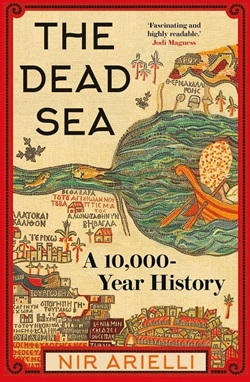
In The Dead Sea: A 10,000-Year History, the author excavates not merely the layers of sediment that compose the physical basin of this enigmatic inland sea but the strata of human ambition, folly, and unintended consequences that have shaped its existence. It is a tome of haunting profundity, for the Dead Sea does not merely serve as a geographical feature but as a stark memento mori of civilization’s recurrent overreach. Through rigorous scholarship and an almost poetic narrative, the author exposes the Dead Sea as a case study in environmental myopia, colonial greed, and human resilience.
The Dead Sea, an entity of geological antiquity, bears witness to millennia of human settlement, from the proto-agriculturalists of Jericho to the industrialists of the modern era. “Jericho degenerated into a small village” (p. 26), the author notes, pointing to the precarious balance that has always defined habitation around this body of water. It is a reminder that civilizations rise and fall at the mercy of environmental vagaries, a truth often neglected by those who believe in humanity’s invulnerability. “The histories of various bodies of water have sparked a lively debate about the relationship between people and nature and which of the two has been more significant in shaping the course of events” (p. 3), a poignant statement that echoes throughout the book.
Even in prehistoric times, the vicissitudes of climate dictated the fate of human settlements. The author observes that “towards the end of the millennium, the spring of Ain es-Sultan reduced its flow or even ceased altogether” (p. 27), an omen that should have forewarned future generations about the perils of overextraction. The tale of Ain es-Sultan is eerily prophetic, echoing the current anthropogenic destruction of freshwater sources that once nourished the Dead Sea. Indeed, the irony is almost literary in its cruelty—the very civilizations that thrived by exploiting the region’s resources ultimately sowed the seeds of their own decline.
The Chalcolithic period heralded an era of artistic and technological innovation, as evidenced by “the enigmatic wall paintings” (p. 27) of Tuleilat Ghassul. These frescoes, unique in their aesthetic complexity, suggest a culture that, while flourishing momentarily, was nevertheless subject to the whims of environmental forces. The author’s meticulous chronicling of such artifacts underscores an essential contradiction in human progress: the simultaneous impulse to create and destroy. These “unique masterpieces” (p. 27) are not only relics of a long-lost civilization but also metaphors for humanity’s ephemeral grasp on permanence.
Throughout the book, the Dead Sea’s fluctuating levels emerge as an unrelenting motif, a barometer of both natural and human-induced changes. “The flow of water into the Dead Sea fell, and its level dropped significantly just before 6000 BCE” (p. 26), the author states, foreshadowing the far more catastrophic declines of the 20th and 21st centuries. What was once a consequence of climatic cycles has now become an indictment of human hubris. The construction of dams and diversion of the Jordan River have precipitated an ecological catastrophe of unprecedented magnitude. The Dead Sea, in its modern incarnation, is an emaciated specter of its former self, its shoreline receding as if in silent protest against human rapacity. “By the Pre-Pottery Neolithic B, human settlements in the Levant grew in size and sophistication” (p. 24), yet today, this very growth threatens the region’s delicate ecological balance.
The book is not merely a study of environmental transformation but an indictment of colonial and economic exploitation. The author does not shy away from exposing the culpability of the colonial enterprises that commodified the Dead Sea’s mineral wealth, setting a precedent for its relentless degradation. The industrial extraction of potash and other minerals, driven by “an insatiable appetite for profit” (p. 45), has exacerbated its desiccation. The juxtaposition of ancient resource management with modern extractionist greed is both damning and disquieting. “In recent decades, human intervention has increasingly been reshaping the environment of the lake and its surroundings” (p. 4), a chilling reminder of the consequences of unchecked economic exploitation.
Perhaps the most unsettling aspect of the book is its implicit suggestion that history is cyclical—that despite the abundance of cautionary tales embedded within the Dead Sea’s sedimentary layers, humanity remains inexorably tethered to patterns of ecological recklessness. “Settlements flourished, then vanished” (p. 48), the author remarks, as if to emphasize the futility of expecting long-term sustainability from civilizations that refuse to learn from their predecessors. “The lake earned yet more names, among them Bahr Lut, or Lot’s Sea” (p. 6), a reference that highlights the deep historical and mythological resonance of this body of water.
And yet, despite its overtly elegiac tone, the book is not wholly devoid of hope. The author highlights contemporary efforts to mitigate the crisis, from desalination projects to regional water-sharing agreements. However, the question lingers: Are these measures too little, too late? The prospect of the Dead Sea’s complete evaporation is not a dystopian fiction but a plausible reality, an eventuality that will stand as an indictment of humanity’s failure to act when warnings were ample and unmistakable. “Because of its present environmental crisis, the Dead Sea may benefit from renewed international attention” (p. 7), the author suggests, though with an unmistakable undercurrent of skepticism.
Ultimately, The Dead Sea: A 10,000-Year History is a masterful synthesis of environmental history, archaeology, and political critique. It is not merely an academic inquiry but a requiem for a dying sea and a cautionary tale for a species that has yet to grasp the gravity of its own destructiveness. With its wealth of archaeological insights, historical depth, and environmental warnings, this book demands to be read not only as a scholarly text but as a moral imperative. If the Dead Sea is, indeed, a mirror, then what it reflects back at us is both terrifying and illuminating.