


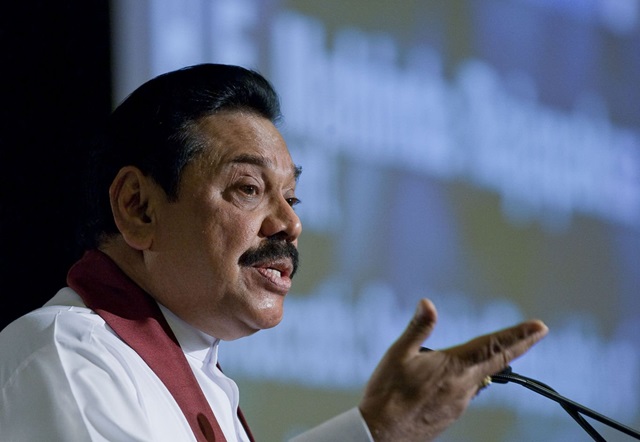
Sri Lanka Podujana Peramuna leader and former President Mahinda Rajapaksa has strongly criticized the United Kingdom for imposing sanctions on key Sri Lankan military officials, alleging that the move is based on unproven allegations of human rights violations during the war against the Liberation Tigers of Tamil Eelam (LTTE). The sanctions target former Chief of Defence Staff Shavendra Silva, former Navy Commander Wasantha Karannagoda, and former Army Commander Jagath Jayasuriya.
In his statement, Rajapaksa emphasized that as the President at the time, he had made the decision to engage in military action against the LTTE, with military leaders implementing the operations on the ground. He detailed the circumstances leading up to the conflict, recalling that despite the 2002 ceasefire agreement, the LTTE had carried out 363 killings between February 2002 and September 2005. He noted that LTTE attacks escalated following his assumption of office in November 2005, citing key incidents such as the claymore bombings in Jaffna in December 2005 that killed thirteen soldiers, a suicide attack on a naval vessel in January 2006 killing fifteen marines, and an assassination attempt on the Army Commander in April 2006.
Rajapaksa further pointed out that despite these hostilities, his government engaged in two rounds of peace talks in Geneva and Oslo in 2006, which the LTTE unilaterally abandoned. He highlighted the LTTE’s brutal attack on civilians in Kabithogollawa in June 2006, where a landmine explosion killed 64 people, including children, and seriously injured 86 others. Military operations were initiated in July 2006 in response to the closure of the Mavil Aru anicut, which had cut off irrigation water to farmers in Trincomalee. The conflict ultimately concluded with the LTTE’s defeat on May 19, 2009.
Rejecting allegations of widespread human rights abuses during the war, Rajapaksa cited a statement made by Lord Naseby in the UK Parliament on October 12, 2017. Lord Naseby referenced conversations with the then UK Defence Advisor in Colombo, Lieutenant Colonel Anton Gash, who had reportedly praised the discipline of the Sri Lankan military and noted that there was no policy to kill civilians. Rajapaksa argued that these statements contradict the narrative promoted by UK political authorities, further claiming that the UK has selectively edited and released only a portion of these wartime assessments.
Rajapaksa also pointed to the political dynamics surrounding the issue, particularly the UK’s approach to Sri Lanka’s war history. He noted that in the 2010 presidential election, just months after the war ended, the Tamil National Alliance (TNA) had supported his wartime Army Commander as the opposition candidate. This, he argued, contradicts the UK government’s stance on the conflict. He further criticized the UK for sanctioning Vinayagamoorthy Muralitharan, also known as Karuna Amman, who defected from the LTTE in 2004 and later joined democratic politics. Rajapaksa claimed this action was a case of punishing anti-LTTE Tamil figures to appease sections of the UK Tamil diaspora.
The former President recalled that during the final phase of the war in April 2009, then UK Foreign Secretary David Miliband had visited Sri Lanka, urging a halt to military operations. Rajapaksa stated that he had refused this request, later learning from documents published by WikiLeaks that Miliband’s intervention was partly motivated by an attempt to gain Tamil votes for the Labour Party. He lamented that “vote bank politics” continues to shape the UK’s stance on Sri Lanka’s war efforts.
Highlighting the toll of the three-decade-long LTTE insurgency, Rajapaksa noted that 27,965 armed forces and police personnel had lost their lives, along with thousands of civilians, including political leaders. He pointed out that the LTTE was officially recognized by the US Federal Bureau of Investigation as the world’s deadliest terrorist organization at the time. He also referenced the UK’s enactment of special legislation in 2021 and 2023 to protect its own military personnel from legal action, suggesting a double standard in the UK’s approach to Sri Lanka.
Meanwhile, the Government of Sri Lanka has formally responded to the UK’s imposition of sanctions. In a statement issued by the Ministry of Foreign Affairs, Overseas Employment, and Tourism, the government took note of the UK Foreign, Commonwealth, and Development Office’s announcement on March 24, 2025, regarding sanctions on four individuals, including three former heads of the Sri Lankan Armed Forces. The press release highlighted that the UK government had linked these sanctions to a previous election campaign pledge to ensure accountability for human rights violations.
The Ministry emphasized that these unilateral sanctions, which involve asset freezes and entry bans, are counterproductive to Sri Lanka’s internal reconciliation efforts. It argued that such external interventions complicate the situation rather than supporting progress. The statement reaffirmed the government’s commitment to strengthening domestic mechanisms for accountability and reconciliation, asserting that any past human rights violations should be addressed through Sri Lanka’s own legal frameworks rather than external punitive measures.
In this context, Sri Lanka’s Minister of Foreign Affairs, Vijitha Herath, conveyed the government’s position directly to the British High Commissioner to Sri Lanka, Andrew Patrick, during a meeting at the Ministry of Foreign Affairs, Overseas Employment, and Tourism. The Sri Lankan government continues to maintain that reconciliation and accountability are best pursued through its own domestic mechanisms rather than through external actions that may be influenced by political considerations.









